Books to Gift the Temperamentally Political
A short winter list for readers who see the world in layers rather than headlines. These are books that travel well across arguments, histories, and uneasy times.
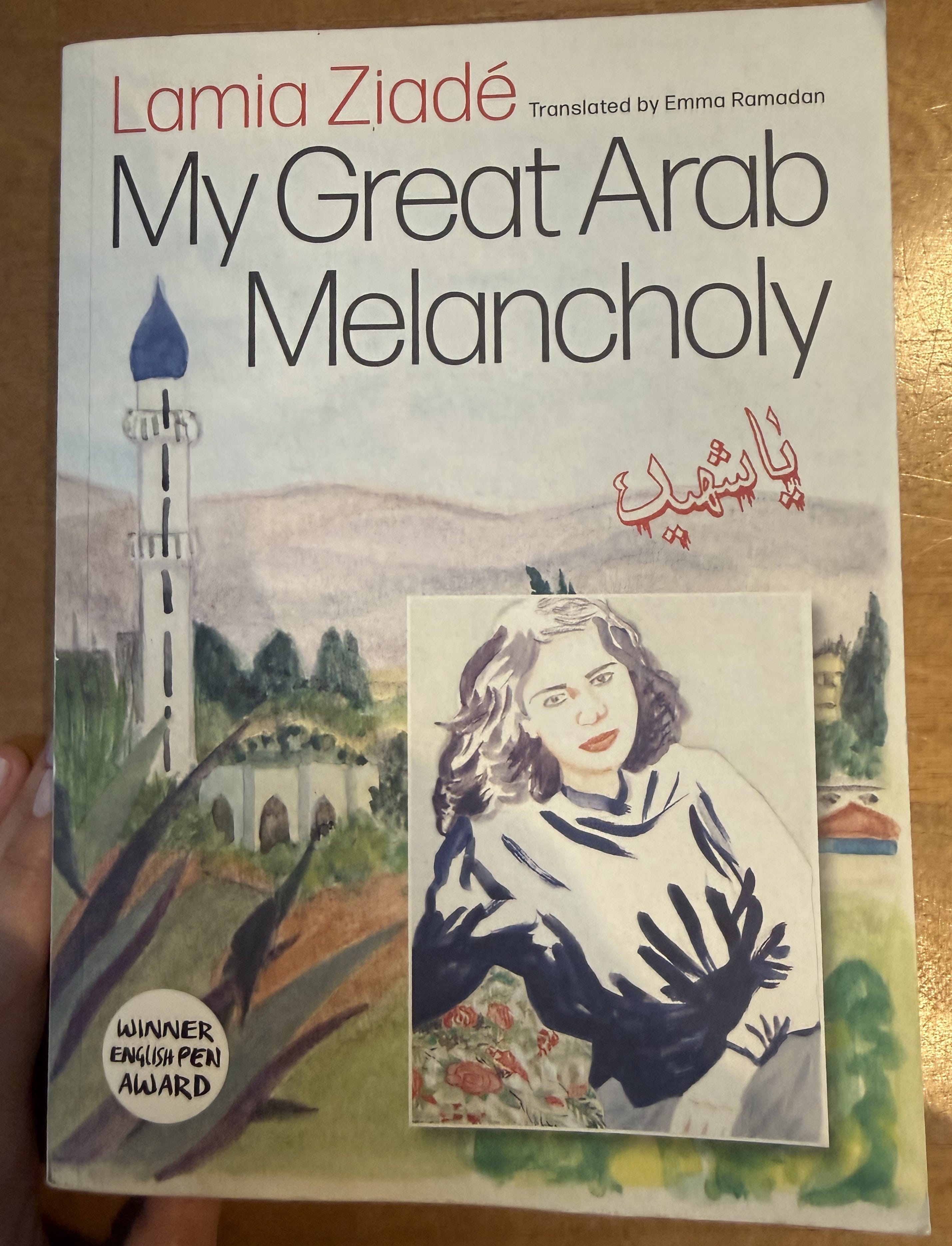
My Great Arab Melancholy, Lamia Ziadé
Ziadé brings an unusual combination to the modern Arab story: the eye of a visual artist, the memory of someone raised amid the Lebanese Civil War, and the discipline of a researcher who has spent years tracing the region’s political and emotional ruptures. The result is a memoir-archive hybrid where illustrations carry as much weight as the prose, and where the history of Beirut, Jerusalem, Cairo and Baghdad is told through the derailed ambitions that shaped them. She writes with quiet fury about imperial interventions and the long afterlife of Palestine’s dispossession while remaining attentive to the revolutionary imagination that once animated the Arab world. I recommend it because it gives readers a way to feel the history without drowning in sentiment. It is also an exquisitely made book, the kind you end up keeping out on the table.
The Story of an Idea: Fascism, Ian Dunt & Dorian Lynskey
Dunt and Lynskey approach fascism as an argument that keeps resurfacing whenever democratic life thins out. Dunt and Lynskey first developed a podcast called Origin Story in 2022, where each episode took a word, idea or historical figure and traced its roots before showing how it continues to shape political discourse today. This book is one of its strongest by-products. They write with the clarity of journalists who enjoy dismantling muddled thinking, tracing how the idea took shape, why it seduced people, and how its language persists in our present. Brisk and grounded, which is exactly what a topic this charged needs. I recommend it because it gives readers a clean conceptual toolkit.
History of Ideas, David Runciman
Runciman, an honorary professor of politics at the University of Cambridge, has a gift for making intimidating thinkers feel like slightly eccentric acquaintances you’d actually want to argue with. He moves through the big themes of power, freedom, democracy and technology with a light touch that conceals the depth of his scholarship. I am a long-time fan of his books and of his weekly podcast Past, Present and Future, which offers the same mix of clarity and dry humour. I recommend this book because it shows how ideas evolve without ever pretending they settle
Israel on the Brink, Ilan Pappé
Pappé’s latest book is a clear-eyed account of how Israel arrived at its current political and moral crisis. He traces the structural forces behind the country’s shift toward maximalist violence, showing how apartheid, settler ideology and institutional impunity converged long before October 2023. His argument is uncompromising and based on decades of archival research and a lifetime of studying the mechanisms of domination in Palestine. I recommend it because it helps readers see the present as the logical outcome of a system built to deny equality.
Hannah Arendt’s Lessons in Love and Disobedience, Lyndsey Stonebridge
Stonebridge reads Arendt with unusual intimacy, showing how Arendt’s reflections on love, exile and responsibility illuminate the political world we now inhabit. This is not a biography of Arendt but a study of how thinking itself becomes an act of resistance when the public sphere collapses into fear and conformity. Stonebridge captures Arendt’s her conviction that love for the world must coexist with a willingness to stand apart from it. I recommend it because it reminds readers that political judgement is not only about institutions or ideology but about how we choose to live with one another. It is also simply a beautifully written book.
Multitude: War and Democracy in the Age of Empire, Michael Hardt & Antonio Negri
Hardt and Negri map the early twenty-first century with a confidence that now feels almost prophetic. They argue that war, global capitalism and new forms of sovereignty are reshaping political life, yet within this turbulence they locate a collective democratic potential they call the multitude. The book is demanding, sometimes audacious, but it opens up a vocabulary for thinking about power beyond the nation-state and resistance beyond traditional movements. I recommend it because it still helps readers make sense of our networked, post-imperial world, even when one disagrees with parts of its optimism. It is one of those texts that reorganises how you think about the political landscape
Question 7, Richard Flanagan
Flanagan moves between his parents’ experiences in the Second World War — his father’s imprisonment on the Thai–Burma railway and his mother’s childhood under Japanese bombing in Tasmania — and his own formation as a writer. The book shows how these private histories sit inside the wider violence of the twentieth century, from imperial war-making to the quiet aftershocks that shape family life for decades. Its structure is extraordinary, shifting between memoir, history and reflection with a precision that feels effortless, and the prose is some of his most moving. I recommend it because it offers a refreshing and resonant reading experience, the kind that broadens your sense of how personal stories illuminate political worlds.
Nationalism: A World History, Eric Storm
Storm’s core claim is that nationalism is a modern political technology that spread because it worked. He shows how European elites first assembled nations through language, history and territory, then how anticolonial movements across Asia, Africa and the Middle East adapted the same toolkit for their own purposes. The book is concise and empirical, showing how different societies used nationalism to imagine political community, justify state power and reshape the twentieth century. I recommend it because it gives readers a global frame that cuts through the clichés and shows nationalism as a deliberate political invention.
I Saw Ramallah, Mourid Barghouti
Barghouti, one of Palestine’s most acclaimed poets, returns to the West Bank after thirty years in exile and turns that homecoming into a meditation on memory, loss and political estrangement. The book moves between the intimate and the historical with a precision only a poet can manage, and its emotional clarity is sharpened by the foreword Edward Said wrote for this edition. Barghouti captures the disorientation of return and the quiet devastations of occupation without ever slipping into sentimentality. I recommend it because it remains one of the most incisive accounts of what exile does to a life and to a country.
A Map of Absence: An Anthology of Palestinian Writing on the Nakba, ed. Atef Alshaer
This anthology brings together a century of Palestinian poetry and prose, charting how writers have documented loss, survival and the ongoing experience of dispossession. Alshaer’s editorial curation is thoughtful as he pairs well-known voices like Mahmoud Darwish and Samih al-Qasim with writers less familiar to English-language readers. This is a literary record of the Nakba that refuses both erasure and nostalgia, insisting on the complexity of Palestinian life across generations.
How the World Made the West, Josephine Quinn
Quinn dismantles the familiar idea of a self-contained “Western civilisation” and replaces it with a history built on exchange, migration and entanglement. Drawing on archaeology, ancient history and a sharp comparative approach, she shows how cultures we think of as foundational to the West were themselves shaped by the movement of people, goods and ideas across Africa, the Mediterranean, the Near East and beyond. I recommend it because Quinn gives readers an account of how the world’s interconnected past produced the political map we inhabit today. It is ambitious but readable and genuinely paradigm-shifting.


