
Erdoğan and Israel's Muslim Brotherhood Trick
The Muslim Brotherhood label has a long history of doing political work. Israel is now reaching for it against Turkey, while the Brothers it nominally describes die in Egyptian prisons.

On 11 April, after a Turkish prosecutor sought sentences of more than 4,596 years for Benjamin Netanyahu and thirty-five other Israeli officials over the interception of the Sumud flotilla to Gaza, Netanyahu posted on X that Israel would continue to fight Iran's terror regime and its proxies, unlike Erdoğan, who accommodated them and had massacred his own Kurdish citizens. Hours later, Israel's defence minister Israel Katz went further. Erdoğan, he said, was a Muslim Brotherhood man, who massacred the Kurds. The phrase travelled the way these phrases now travel, repeated across Israeli media, picked up by Iranian outlets pleased with the symmetry, recycled in Turkish nationalist circles for the opposite reasons.
Two weeks before Katz spoke, the Foundation for Defence of Democracies (FDD) in Washington published a paper titled “Islamist Turkey: A Base for Muslim Brotherhood Jihadism.” FDD has been part of the Israel lobbying machine in the United States for two decades, with funding patterns and policy outputs that have drawn it consistently into the orbit of Israeli strategic priorities. The paper is worth reading not for what it tells you about Turkey but for what it tells you about how the Brotherhood label is being manufactured for current use. A similar paper was published at the beginning of this year by the Jerusalem Institute for Strategy and Security(JISS) recommending that Israel treat Turkey as the leading force of the Muslim Brotherhood worldwide and lobby Washington and NATO accordingly.
Now, this should give any observer of the region pause. The Muslim Brotherhood, in 2026, is in full disarray. The Egyptian organisation has been hollowed out by twelve years of Sisi’s prisons. Its London leadership and its Istanbul leadership have been at each other’s throats since the death of Ibrahim Munir in 2022. There is no operational coherence, no unified command, no urgent project being run out of Istanbul or Doha. The figures who remain in exile are mostly producing policy commentary and writing memoirs. So why, all of a sudden, is Erdoğan a Muslim Brotherhood man?
The label is doing extraordinary work in this transition, and it is worth asking what the label actually contains. The answer, on close inspection, is very little.
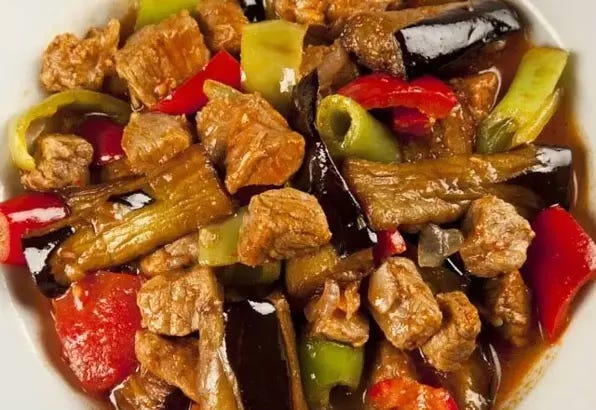
Türlü is a Turkish stew and…
The methodology is guilt by association. Bin Laden, the report tells us, made a trip to Turkey in 1976 and considered the Turkish Islamist and former prime minister Necmettin Erbakan a source of inspiration. How do we know this? From one journal seized at Abbottabad, the Pakistani town where US soldiers killed Bin Laden in 2011, and reported in Turkish newspapers four decades after the alleged event. Erbakan mentored Erdoğan. Erdoğan, therefore, sits in a lineage that runs through al-Qaeda. This is offered as evidence rather than as the McCarthyite syllogism it actually is.
The conceptual slide is more damaging. It is almost like türlü, the famous Turkish stew where we throw all the leftover vegetables into one pot and serve it for dinner. By the end of the report, the Brotherhood includes Hamas, Ennahda, Yemeni Islah, Libyan Justice and Construction, the Syrian National Army, Hayat Tahrir al-Sham, al-Qaeda in Syria, ISIS recruitment networks, Naqshbandi Sufi orders, and Turkish Hezbollah, which is in fact a Sunni group with no relationship to the Lebanese Hezbollah and no clear ideological proximity to the Brotherhood. When the term stretches that far it stops describing anything. It becomes a name for whatever the report wants designated. I think Türlü.
The citation chain is closed. FDD analysts cite earlier FDD analysts. Almost like a sweet little circle of friends playing tag. A-cites-B-cites-A-cites-the Meir Amit Centre-cites-the Jerusalem Center! The New York Times investigation into Hamas financing in Turkey appears as a single piece of mainstream journalism doing the work of an entire field.
There is no engagement with the academic literature on Turkish foreign policy, on the AKP’s actual relationship with Islamist movements, on Brotherhood internal politics, its evolution since 1970s, on the considerable scholarship now available in English on the variety of Islamist trajectories since 2011, including my own book on the interactions between the AKP, Ennahda and the Muslim Brotherhood, The New Spirit of Islamism, which is based on more than seventy elite interviews. Nada!
In other words, the report is not in conversation with the academic field, or with what is happening on the ground. Or shall I say reality? But it is in conversation with previous policy advocacy, with its circular arguments that, vallahi, say nothing useful about the present. Pure regurgitation of neocon mindset.
The main problem is selective ignorance when it comes to unpacking anything related to Islamist ideology, its evolution and trajectory. Of the Muslim Brotherhood. There is a plethora of Arabic and English sources that no one wants to cite in Israel or Washington. That is a much bigger problem than trying to tie Erdoğan to the Muslim Brotherhood with funny little attempts.
Um Kulthum’s songs as torture
The Brotherhood, as the world has learned to imagine it, has very little to do with the movement that actually exists. To see how thoroughly the gap has opened up between the label and the thing it claims to describe, it helps to look at the people the label is meant to refer to.
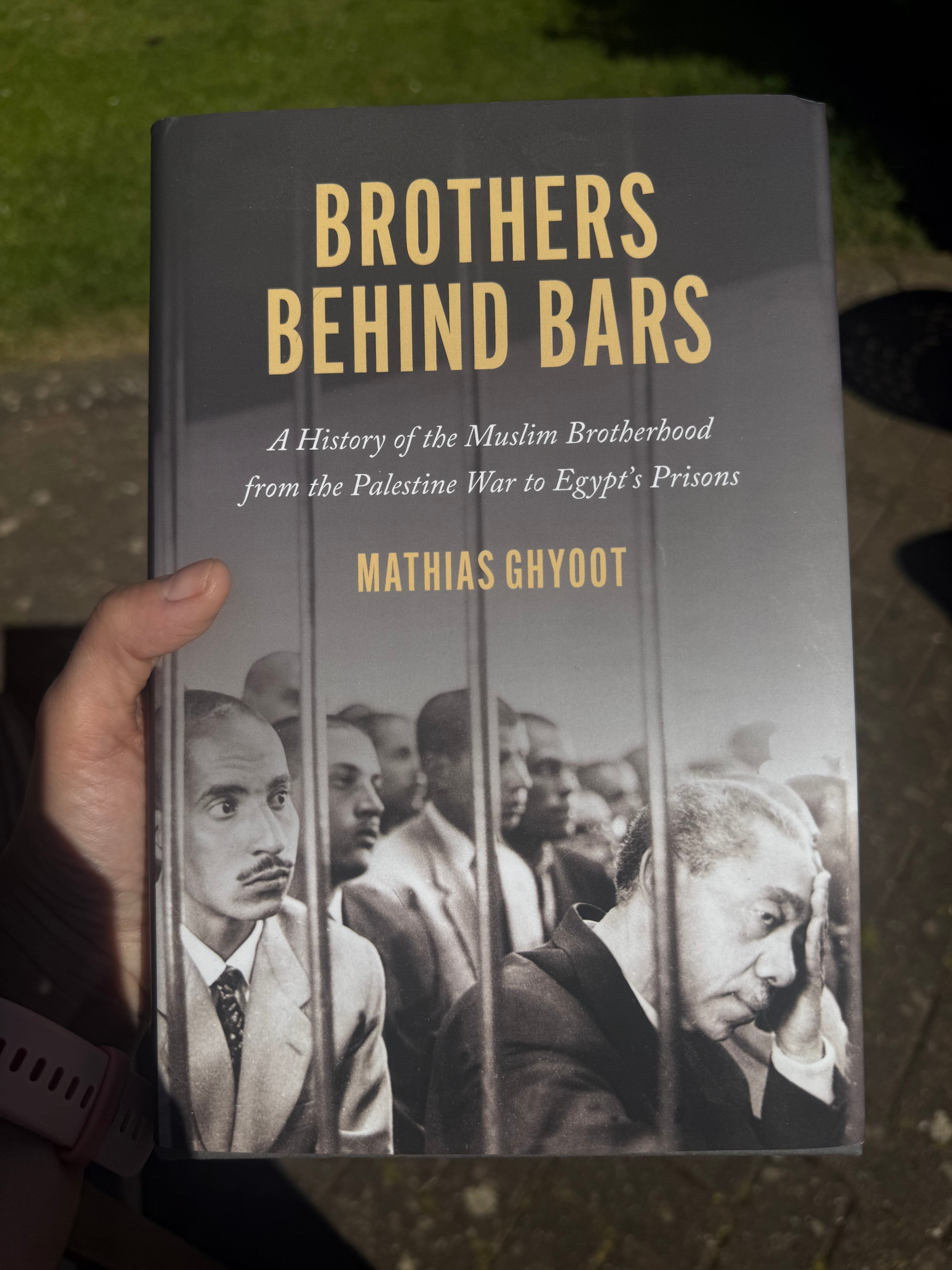
I went yesterday afternoon to a talk at Oxford University’s Middle East Centre by Mathias Ghyoot, a young historian at Princeton. His new book, Brothers Behind Bars, has just been published by Oxford University Press. It reconstructs the Brotherhood’s experience inside Egyptian prisons from 1948 to 1975, drawing on more than three hundred memoirs by Brothers and Sisters that have remained almost entirely outside the English-language literature. Um Kulthum’s voice was piped through loudspeakers into prison cells, a feature of the Free Officers’ rehabilitation reforms after 1952, meant to integrate prisoners into the new republic. Many were haunted by those songs for the rest of his life. What a shame that the most beautiful voice of the Arab world was conscripted into a torture campaign. So, the reforms Gamal Abdel Nasser introduced became their inversion, and the Egyptian prison service expanded into one of the most violent carceral regimes in the region.
Despite this violent prison machine, according to Ghyoot's sources, the Brothers built underground prison societies of remarkable organisational coherence. They held elections, ran councils, smuggled letters and books with help from the Sisterhood, organised football fields and theatres and Quran recital competitions. Some reported greater religious and political freedom inside than in what they called the big prison of Egypt. The book shifts attention from what state repression prevented to what it enabled, and the result is an account of agency rather than victimhood, of intellectual production rather than radicalisation.
This is the move that matters. The dominant narrative of the Brotherhood’s prison years, as it travelled from Gilles Kepel and Emmanuel Sivan in the 1980s into Western counterterrorism literature after 2001, was that prison produced mass radicalisation and that Sayyid Qutb was the principal radicaliser. America’s strategy on 11 September, one of these accounts claimed, was born inside Egyptian prisons. Ghyoot’s primary sources do not support this. He shows that radicalisation was often shaped outside the Brotherhood by the rise of Salafism in 1960s Egypt, and that the more consequential phenomenon inside the prisons was a sustained majority effort by senior Brothers to contain radicalism, denounce takfir, and articulate a disciplined moderation. Preachers Not Judges, the text written by Hassan al-Hudaybi and circulated in the mid-1960s, was not an aberration but actually the dominant register of the leadership.
Who really ‘radicalised’ the Brothers
Therefore radicalisation thesis was not produced by the Brothers’ own writings. It was produced by the Egyptian state, then exported. Beginning in the mid-1950s, Nasser collaborated with tabloid journalists and Al-Azhar clerics to cast the Brotherhood as a threat to Islam and society, depicting arrested members as deranged bomb-makers or recruits seduced by weird ceremonies. Pamphlets with titles like The Brotherhood and Terrorism and The Brothers of Satan portrayed the Brothers as Kharijites and apostates. By the mid-1960s the smear campaign had internationalised, presenting the Brotherhood as Saudi agents in the Arab Cold War, and even alleging mass conversions to Baha’ism. These tropes entered popular fiction, then nationalist historiography, then Western scholarship.
Yani…The shorthand the world now reaches for when it says Muslim Brotherhood was forged inside the Egyptian state’s propaganda apparatus, refined under Mubarak, formalised after 2013 by Sisi, and exported through Gulf lobbying networks to US and Israel. Or vice versa.
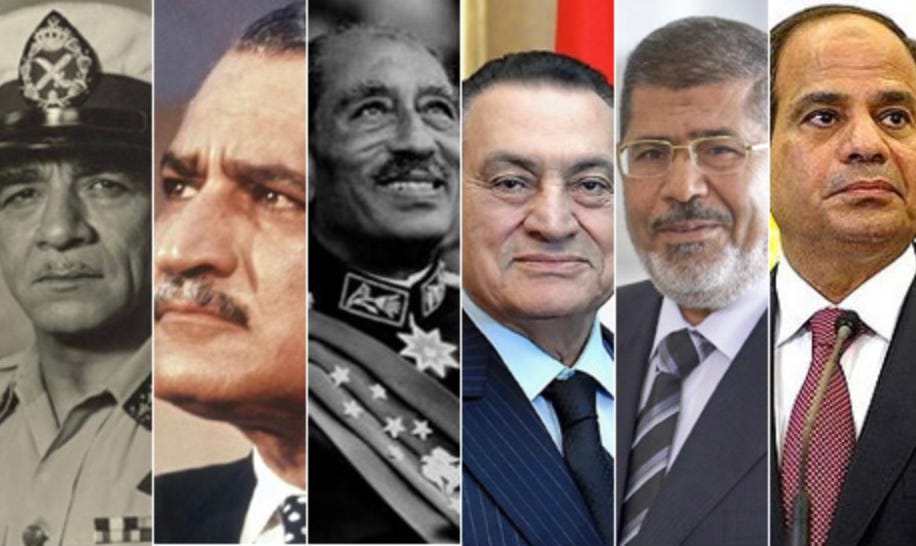
Since the overthrow of Mohamed Morsi in 2013, more than 45,000 MB members have been imprisoned across Egypt. Morsi himself died in 2019, collapsing in a Cairo courtroom after six years in solitary confinement and denied medical care. Some have been executed. Some have died under torture. The vast majority are held in indefinite pre-trial detention, in conditions that human rights organisations have struggled even to document, because the Sisi government does not permit the documentation. The number is larger than the entire active membership of most political parties anywhere in the world. They are imprisoned in part because the Egyptian state has spent seventy years exporting a description of the Brotherhood that allows the West to hear their imprisonment as counterterrorism rather than as repression.
This is the empty category the Israeli campaign against Turkey has reached for recently, in the FDD report, in Katz's outburst and the Netanyahu tweet. The label is doing two kinds of work at once. In Egypt, it provides the cover that allows tens of thousands of people to be erased from political life. For Israel, it provides the cover that allows a NATO state - Turkey- to be repositioned as a strategic adversary. The same Muslim Brotherhood label, hollowed of empirical content, available for whichever project a state is currently advancing.
Do not get me wrong here. There is a relationship between the Erdoğan government and various Brotherhood-aligned movements. I have spent years documenting its texture. The Erdoğan government had a close relationship with the Egyptian Brotherhood until 2013 and with Tunisian Ennahda until 2019. It supported them while they were in power. Not after they were ousted. So for Erdoğan it was Realpolitik, power politics, strategic calculation, pure pragmatism, economic opportunism, raison d'état, or whatever you would call a situation that is not determined by ideology. He instrumentalised Islamism to gain influence and economic opportunities, just as he uses nationalist tropes at home to consolidate his base. The instrument is real. The conspiracy is not.
Israeli apparatus turn on Turkey
Katz’s phrase about Erdoğan is not, of course, a description of anything. But so very classic because there is a long tradition in foreign policy of using categories that nobody has had to define for decades because everybody is assumed to know what they mean, and the Muslim Brotherhood, in the Israeli usage Katz is reaching for, is one of these. The category arrives pre-loaded, its content assembled out of seventy years of Egyptian state propaganda, Western counterterrorism literature and Gulf lobbying papers, and it is now applied to a NATO ally with a complicated foreign policy in order to convert that ally into a member of an international conspiracy requiring sanctions, designations and possibly military preparation.
There is something almost vertiginous about watching the apparatus turn on Turkey. Israel is at war on multiple fronts. Its government faces an indictment in The Hague and a separate one from a Turkish prosecutor seeking sentences of between 1,100 and 4,500 years for Netanyahu and thirty-four other officials. Its strategic doctrine, post-Iran, requires a new principal adversary, and Turkey is structurally available.
The Muslim Brotherhood label gives Israel something it can say in public. The real reasons for the rupture between Turkey and Israel are geographic, strategic and emotional. They are about competition in the Eastern Mediterranean, Turkey's drift toward Greece and Cyprus, and Erdoğan's response to what Israel is doing in Gaza. None of these reasons sound respectable when stated plainly. The Brotherhood label makes them sound respectable. It turns a fight over geography and Gaza into a fight against Islamist ideology. It does the work that any honest accounting of the rupture, which would have to begin with Gaza, would refuse to do.
In Cairo, the Brothers Ghyoot writes about, or their grandchildren, are dying in prisons whose conditions resemble those of the second ordeal under Nasser. In Istanbul and Doha and Ankara, a small number of Brotherhood figures live in exile and most of them produce the kind of policy commentary and think-tank work that closely resembles what comes out of Washington outfits like FDD itself. The FDD report describes as if they are the centre of the Islamic world. This is laughable. And they know well it is laughable. What is serious is that they are using this empty Muslim Brotherhood package to attack Turkey. While there are countless claims that can be put forth about the regime that runs Turkey for more than two decades; its clientelist networks, the corruption, the lack of rule of law but Israel chooses to go on with the Muslim Brotherhood. Why? Because it is just the first step and the easiest and the laziest.
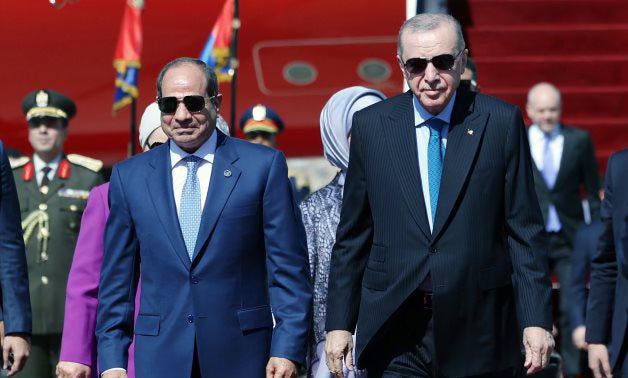
There is more to say about Israel’s aims at Turkey, and I will return to them. But for now, I can say that the campaign does not have a moral backbone or empirical weight. In the meantime, the Muslim Brotherhood members will keep dying in Egyptian cells for nothing more than becoming a social movement that built a political party, won an election, had a crappy eight months of rule, were then massacred by the military and their leaders thrown out by a coup. And Erdoğan, the so-called Islamist, a Muslim Brotherhood man as the Israel lobby likes to put it, has mended his ties with the man responsible for the persecution of the Muslim Brotherhood. Haven’t you seen him shaking hands with Sisi recently?
Neo-Orientalism and Islamophobia make people stupid. So much so that they believe the rest of the world is stupid. Well, well.