
Extraordinary weeks for the Kurds
From al-Sharaa's reception of the Kurds to Turkey's amnesty law, a fortnight that moved the Kurdish issue forward on several fronts at once.

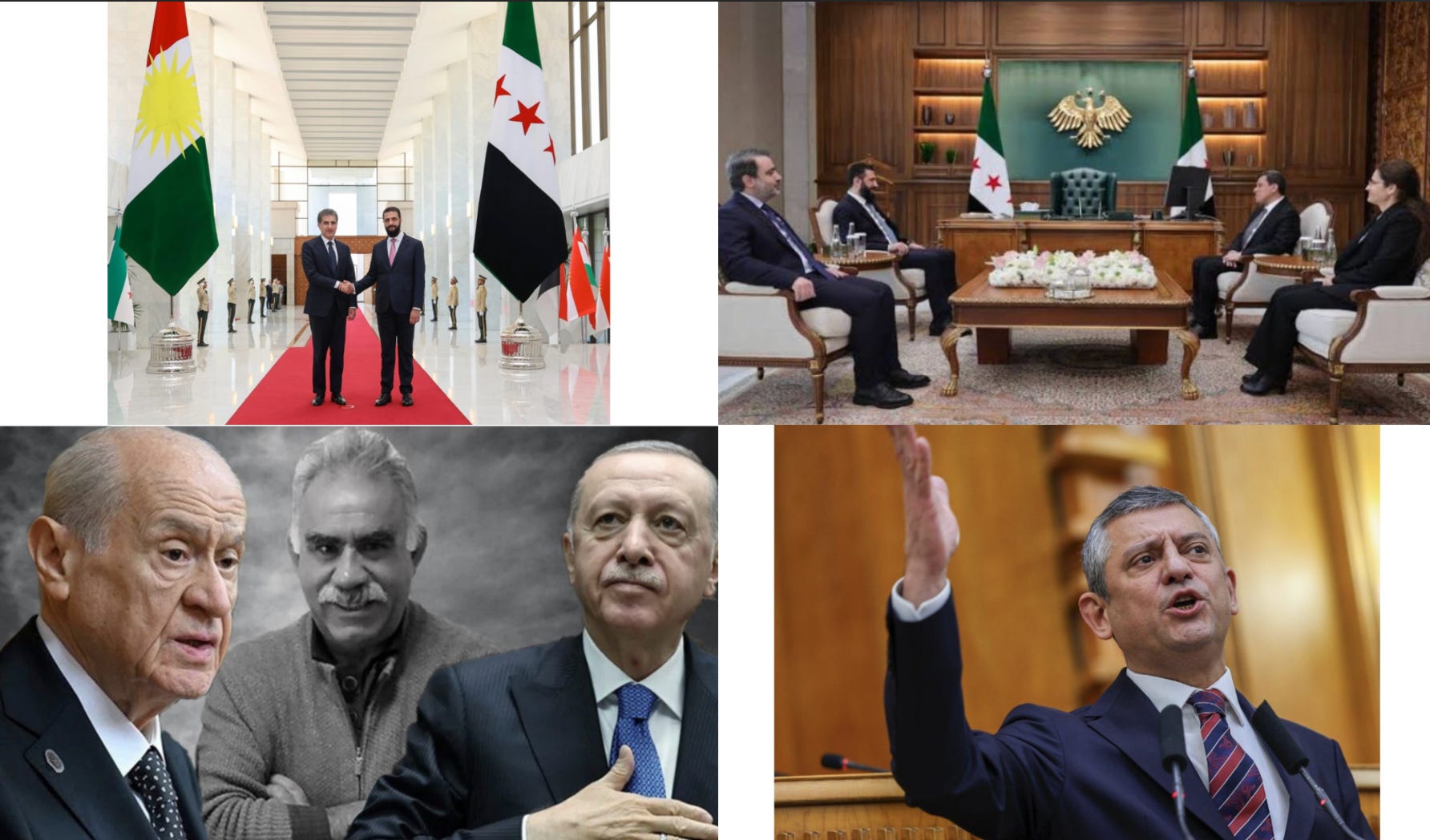
I followed the political developments regarding the Kurds in multiple countries over the last couple of weeks with a mixture of relief and anxiety.
Syrian president al-Sharaa hosted Iraqi Kurdistan leader Nechirvan Barzani. What a hosting, though. A giant Kurdistan flag was put next to the Syrian flag. Sources close to Barzani claimed that he was very impressed. Al-Sharaa then tweeted about the meeting in Kurdish, but this time his audience was Kurds in Syria, because the dialect was Kurmancî, the dialect of Syrian Kurds.
A couple of days later, the Syrian Kurds’ leader in north-east Syria, Mazloum Abdi, and İlham Ahmad came to Damascus and met with al-Sharaa. The integration of their armed forces and administration, formerly known as AANES or the Rojava administration, into the Syrian state and army apparently came to its final stage. Ahmad was offered, once more, the position of deputy foreign minister, as the second man to Asaad al-Shaibani. We do not know her response. It is also said that Abdi refused any government position but is preparing to establish a political party.
Syrian Kurds and Sharaa’s gestures
What these two meetings prove is that the Sharaa government is making real headway in its rapprochement with the Kurds. Only six months ago, government forces and the SDF (Syrian Democratic Forces, led by Mazloum’s armed force, the YPG) clashed in Sheikh Maqsoud, Arab groups within the SDF defected to the government side, and the Kurds were forced to concede, relinquishing their semi-autonomous status and folding their armed force into the national army. Many analysts and interested parties argued ex post facto that Mazloum and the leaders in Rojava had miscalculated and forfeited Rojava’s autonomous status. I disagreed.
First, it is much easier to advise in hindsight. It was the only right move to concede, to prevent carnage and bloodshed. The slight blindness came, in my opinion, in their misinterpretation of the status quo and the geopolitics in the aftermath of Assad’s fall and Sharaa’s assuming power. Unnecessarily, they delayed finalizing better deals with al-Sharaa in the hope that he would fail and be removed. That was a misread. However, these last two weeks proved that those marginal losses would be amended too. The Sharaa government is eager for stability, legitimacy, and, as a reward, foreign investment. A resolved Kurdish issue, even backing from the Kurds, would reinforce Sharaa’s hand.
As for the Kurds in Syria, their position is far better than it was before, above all under Assad, whose state refused to recognize them as a people. A Syrian president posting, or issuing a statement, in Kurdish would once have been inconceivable. But I am not one to overstate such gestures, since they often cost the state next to nothing and do little to improve the lives and standing of ordinary Kurds. The Erdoğan government is a virtuoso of the empty gesture. So I know them by heart and recognize them from quite a distance, evvelallah. Yet Kurds in both Iraq and Syria seemed gratified by the warmth and the theatre of Barzani’s and Abdi’s meetings with Sharaa, which suggests that these gestures matter to them, and that should be enough.
In this context, another reason I judge the Syrian Kurds’ position to be better than before is that Turkey’s assaults on them have ceased, contingent on two conditions. First and foremost, the Rojava administration and the SDF/YPG must be dissolved and their armed forces absorbed into the Syrian army. This is precisely what Turkey has pressed for relentlessly since Sharaa took power.
Amnesty bill for the PKK militants
The second condition runs on a parallel track, the negotiation between the Turkish state and the PKK’s imprisoned leader, Abdullah Öcalan. The YPG was Öcalan’s creation, and when he opened the current negotiations with Turkish state, he wrote several letters mapping the way ahead to the PKK’s armed branches and its leaders. One went to Mazloum Abdi, counselling integration into the Syrian state and a role as one of the leading forces in rebuilding post-Assad Syria. Two parallel armies, he wrote, meaning the Syrian state military and Abdi’s YPG, could not coexist, and the YPG had fulfilled its founding purpose. Sipan Hemo, a former SDF commander appointed deputy defence minister for the eastern region under the integration deal, made the same case on the civil side, declaring that ‘there cannot be two administrations in one state’. The SDF’s integration is now almost complete.
Alongside these developments, Turkey’s negotiations with the PKK reached another milestone. On 12 May 2025, the group had announced that it was disbanding, that its armed struggle was over, and that the Kurdish movement would carry on its fight for greater recognition and democracy by peaceful means.
A bill passed the Turkish parliament this week as part of that process. It is an amnesty law governing PKK militants and the terms on which they can come down from the mountain without fear of reprisal or imprisonment. Its scope is narrow. It does not cover every militant, it withholds amnesty from the senior leadership, and it comes hedged with conditions.
For it to take effect, the PKK’s disarmament must first be certified by Turkey’s intelligence service, the MİT, and then by the National Security Council, the MGK. A stretch of road still lies ahead before ‘some’ militants can petition their local prosecutor for the law’s benefit. Öcalan and the leadership in Qandil are granted no release and no new legal standing at this stage. I doubt a further stage will come that lets them practise politics in Ankara.
I take this to be the furthest the Turkish state will go in what remains a transactional bargain, and the Kurdish party DEM and Öcalan appear, for now, to accept it. Qandil takes a contrasting view, calling the bill as it stands too narrow and warning that full disarmament cannot be delivered unless Öcalan is free to lead the process. That may become a sticking point over the short to medium term. From the outset there has been a mismatch over how the process is cast, and this law does nothing to close it. Qandil prefers to treat it as an opening move, ‘just the start’. The government frames it as a closing settlement.
So what happens next?
I would not expect a descent from the mountain, certainly not en masse, when and if the disarmament is confirmed and the bill becomes law. The first stage explicitly excludes the roughly two hundred senior cadres in Qandil, who are barred from entering Turkey altogether. They may decamp to Brussels, Köln, or Paris, though they will most likely remain in Iraq's Sulaymaniyah. For everyone else, coming down means a probation file and curtailed political rights. And the incentive to approach a prosecutor, claim the law's benefit, and somehow face down a Turkish courtroom is slender for fighters schooled, rightly or wrongly, to distrust the state. What I foresee is a trickle of low-level or token cases, at most.
As for the disarmament, laying down the armed struggle is one thing and surrendering the arsenal quite another. The PKK has reserved the right to self-defence precisely so as to keep its weapons in the mountains until it deems 'it is safe to do so'. Yet the bill ties implementation to the state's certifying a handover. Either side can seize on that gap. Even so, I would resist the notion that the armed struggle will resume. If the process fails, I do not think a return to the mountains and renewed war on Turkey would be the PKK's default fallback. The likelier failure scenario would be a frozen process with the amnesty bill left in the books.
Extra pressure on the opposition
In the meantime, this bill caused, I think, an expected sense of division within the opposition this week. The main opposition leader, Özgür Özel, whom I called the Odysseus of Turkey’s opposition in my previous column, was left between a rock and a hard place.
The base of his new party, Yeni Parti, has a nationalist, Kemalist core that is against this process for two reasons. The first is the good old nationalist one, considering negotiation with the PKK, and amnesty for its militants, as something akin to treason. The other reason is that Erdoğan would use this process to pull the Kurdish party into a bargain to change the constitution, so that he can run for the presidency for a third time, which is not possible in its current state. Which can happen.
The broader case against lending the process support also has merit. Authoritarianism in Turkey has tightened to the point where few believe the Erdoğan regime would ever let a genuine rival walk free. The regime has clawed back nearly all the municipalities it lost in the 2024 local elections through lawfare, bending the judiciary to jail the mayors on flimsy charges, hold them through the long wait for trial, and strip them of office. Set against that, a democratic reform meant to settle decades of Kurdish grievance looks like a charade. So Yeni Parti should have voted No on the bill, its supporters argued. Even if the bill have passed regardless, the party would at least made its position clear.
Yet… A No would have cost it Kurdish support, and to Kurdish voters the amnesty means a great deal. Özel saw the trap and freed his MPs to vote as their constituencies dictated, while he, as leader, voted yes, on the ground that he stood for peace and an end to violence. To my mind that was a deft move, and the best available to him.
I understand some of the anger directed at Özel for backing the deal, and it is well founded, since it is hard, close to impossible, to imagine the Erdoğan regime in its present form doing anything other than turning every opening to its own advantage and pressing on with the crackdown. Yet a cooler view helps too. This regime will grind on with its merciless authoritarianism whether or not the process with the Kurdish movement goes ahead, whether or not this amnesty bill passed. A new party ought to think in the long term and take part in an attempt at resolution, even one launched by an undemocratic actor. The global record shows that undemocratic regimes, too, embark on conflict resolution and see it through.
Grievances pile onto each other
The resentment, though, runs well beyond Yeni Parti and into the broader public, much of which read the bill as a lavish concession to a ‘terrorist who took a great many lives’ over the past forty years. Other grievances pile onto that perception, a wretched economy, a crushing living costs, inflation that will not come down, a relentless crackdown on freedoms, all of it folding into the sense that the state has caved to a terror group. The fault lies with the Erdoğa regime, which, in its vanity, imagined it could run this transactional process without much bothering to prepare the public for it. For the government, as I have argued in post after post in this publication, the opening to the Kurdish movement was forced by developments across the Middle East, above all Israel’s hostile moves. And as the nationalist leader Devlet Bahçeli put it, this was not an AKP undertaking but a Turkish state one, which is why he, at the head of the nationalist MHP, drove it.
Whether Erdoğan can manage the public’s resentment over the amnesty law remains to be seen. He has the skill for it. That is for sure. But I am less sure of his will, or his bandwidth. As for the Kurdish movements in Turkey, Syria, and Iraq, these strike me as small but consequential steps forward.