
I Was in Damascus. Left with Respect.
The air in Damascus has shifted, even if its material conditions have not. I moved through a city marked by energy, anxiety and moments of hope, while its society negotiated its future in real time.

I was in Damascus last week and found myself unexpectedly struck by the energy of the streets. Not the sort of energy that translates as full recovery, nor the kind that pretends the last 15 years did not happen. But a practical energy.
Not because the damage is invisible. It is not. The buildings are tired, the infrastructure worn down, the economy clearly strained after civil war, sanctions and foreign intervention. But the streets were alive in a way I had not expected.


Yani there was movement. Noise. Shops open late. Traffic impatient – horrible is another word- as ever. A kind of ordinary insistence on daily life. It did not erase what the Assad dynasty had done to this country. Nothing erases that. But it interrupted the narrative of paralysis that so often frames Syria from the outside.
I believe the resilience of Syrians is a lesson worth listening to.
From afar, the story is still written in extremes. A former jihadist now leads the transitional government. Depending on who is speaking, Ahmad al-Sharra is either an inevitable tyrant waiting to strike against his own people, especially women, or as a saviour. On the ground, what one encounters is something less theatrical, more subtle and complicated — and perhaps more politically interesting: a society testing the limits of speech after decades of fear.
Equally striking, especially for those who approach Arab societies through a fixed – and Orientalist- lens, is how familiar much of Damascus feels. The rhythms of daily life are not so distant from any other urban neighbourhood, for example, of Istanbul. Cafés full. Women moving through public space without visible hesitation. The small frictions and accommodations of urban coexistence. Surely, none of these fit easily with the idea of a society captured by fanaticism or permanently on the brink.
Yes, Damascus was never reduced to rubble in the way Aleppo was. Assad preserved it as a showcase but also controlled it as a prison.
What seems to be shifting now is not the material condition of the city — that will take years — but the atmosphere. People talk. They criticise. They measure their words less carefully than before. There is noise. This does not mean a democratic transformation is underway. It does mean, however, that the architecture of silence has cracked.
And I like political cracks. They can be messy and uncertain, but they show where the real pressure has been building. Again, they may not promise immediate outcomes but definitely allow space. Breathing and ‘being’ space.
You notice this not only in conversations, but as you move through the city.
Mesela…


Enter the spectacular Umayyad Mosque, where women use the space to gather in groups of four, let their children run freely so they can have ten minutes of peace without being constantly interrupted, eat a small bite from their bags, and where no one asks anything from them, at least for the time being. If this is not sacredness for women with children, I do not know what is.
You might also walk around the National Museum, whose beautiful garden is filled with bitter orange trees, and whose interior houses pieces displaying the thousands of years of civilisation that have lived on this land. What remains after ISIS attacks and looting in Palmyra. The Umayyads, the Romans, the Byzantines, the Ottomans. One is reminded that Damascus is one of the most ancient cities in the world, its origins dating back to the third millennium BCE among those still inhabited.
The old city reflects Greek-Hellenistic urban design, later integrated by the Romans, with a grid of orthogonal axes surrounded by boundary walls. Two of the main east-west axes are still recognisable in Straight Street and Suq al-Hamidiye, which once opened onto the sanctuary of Zeus, Jupiter Damascenus, the local god Hadad. This sanctuary was the largest shrine in Roman Damascus. Nothing remains of it today. After the Roman period, it became a Christian Basilica dedicated to St John the Baptist and later, in the eighth century, the core structure of the Umayyad Mosque.


Mahmoud, a man in his late forties whom I spoke to in the museum garden, was originally from Deir ez-Zor and moved to Damascus when the war broke out.
“I don’t know if this new regime is good or bad. It is too soon. Life on the street has not changed much. We still struggle to make ends meet. But what I can say is that we definitely feel much freer to talk and say what we think. We used to say the walls had ears. We took down the walls and the ears with them.”
This was a sentence I heard repeatedly for the rest of my trip, from almost everyone I spoke to.
Suq al-Hamidiye (Hamidiye Bazaar) is crowded with people grabbing bites of traditional maarouk, the date-stuffed star-shaped bread, but many shops are largely empty. One trader who owns a family business selling traditional handmade Damascene ornaments with sadaf told me: “Our wellbeing depends on tourists coming and buying from us. I don’t know what this current government is doing. They are not meddling with our lives. That is already much better.”
Turkey in the Background


I passed through the Sulaymaniyah Takiyah in Baramkeh, a sixteenth-century Ottoman religious complex built by Mimar Sinan for Sultan Suleiman. The complex had been renovated under the patronage of Bashar al-Assad’s wife, Asma, and now its door carries the flag of TIKA, the Turkish Cooperation and Coordination Agency.
TIKA, established in 1992, operates aid and development projects around the world and is often viewed as a tool of Turkish state influence. Israel, for example, long opposed its presence in the Middle East and Africa. TIKA was only able to open an office in Cairo after Mubarak fell and Morsi assumed office. As a side note, before leading Turkey’s National Intelligence Organisation and later becoming foreign minister, Hakan Fidan headed TIKA.
But TIKA is not the main display of Turkey’s presence in Syria or Damascus. Turkey’s presence is far more pervasive, malleable but all-encompassing.
Even though I have always supported Turkey’s decision to open its doors to Syrian migrants and refugees when the civil war broke out, I have long criticised the state of the borders that enabled ISIS and other jihadist militias to cross into Turkey with little inconvenience beyond paying a taxi fare. I also criticised Ankara’s reliance on jihadist proxy forces to fight both Assad’s troops and the Kurds, and its multiple military incursions into Syria to create buffer zones against the SDF/YPG-led Kurdish entity. I found this approach reckless and lacking a clear long-term strategy.
And yet, just when almost everyone assumed Assad was not going anywhere, even as Erdoğan made overtures towards rapprochement, the regime collapsed.
“We were terrified when even Turkey was considering rapprochement with Assad a couple of years ago,” my friend Hamza, originally from Idlib and who lived in Hatay for 11 years, told me. “We were so depressed. And then a miracle happened.”
The circumstances surrounding Assad’s ousting were less the product of coherent, linear strategy than of contingency, and they ultimately worked to the advantage of Turkey more than any other actor.
With the stamina of a strong state, the AKP government maintained support for the opposition and emerged with the upper hand. This deserves acknowledgment regardless of how this opportunity will be used, or whether the outcome was the product of meticulous planning rather than political contingency. Many political results emerge from thousands of variables, including luck.
As a Turkish speaker, I have never felt more at home outside Turkey than in Damascus. It felt as though everyone spoke some Turkish, many of them, especially children, impeccably so. At the bazaar, in traffic, in cafés and grocery stores, anyone who realised I was Turkish greeted me with that familiar regional gesture: hand on the heart, a slight tilt of the head.
This does not mean Syrians did not face hardship or racism in Turkey. “At first it was fine,” a middle-aged woman told me. “Then around 2017, we became the problem blamed for everything going wrong.” Another woman said she had been chased out of a grocery store in Istanbul for speaking Arabic. The prejudice and ignorance towards Arabs in the Turkish polity is something to be discussed at length, as an issue on its own.
And yet, a Syrian resident of Hatay who has now returned to Damascus seemed to have moved beyond those bitter memories: “For fourteen years, the sirens of ambulances crossing the border to bring sick or wounded Syrians to Turkey for treatment never stopped once. We will never forget this.”
A couple I met on the narrow streets of Bab Touma exclaimed: “Have we really reached the days when we see tourists from Turkey in Damascus, mashallah.”
Surely, it is not a bed of roses, I am not a proper tourist and much can go wrong during a transitional period. But what I felt, and what I was repeatedly told, is that ‘this’ is better than Assad. The disgust and hatred towards his rule is palpable across Damascus. I have rarely seen anything like it. Not even for Egypt’s Mubarak or Tunisia’s Ben Ali.
Idlib versus Damascus versus Hasekeh
Waleed, a businessman and activist from Ghouta who lived in Hatay for ten years, is hopeful about the al-Sharra government. When I asked him how he could trust that this regime would not become power-drunk and authoritarian like Assad, he was adamant:
“We have done it before, we will do it again. If Sharra becomes a dictator, we will take him down as well. If a police officer harasses any citizen on the street like during Assad’s time, we would all run to prevent it. The time of the brutes has expired in Syria.”
“What would be the main impediments to Syria’s stability and prosperity?” I asked.
“We would” he replied, meaning Syria’s different sectarian communities. “I believe the real threat will come from inside, not outside. If Israel attempts to invade Syria, we would come together. The real problem is our internal divisions, ideological and sectarian.”
Waleed also seriously considers the possibility of a counter-revolution from remnants of the Assad regime, supported by Iran and Hezbollah, now operating in sleeper cells. This concern was echoed by others I spoke to.
Surely this does not bode well for Alawites in Syria, who may now be viewed, fairly or not, as inseparable from the former regime. A man in his late 50s told me that his and his family’s life had not changed much since Assad’s fall. When I asked him directly whether he was Alawite, he chose not to answer the question as framed.
“I am from the sahil,” he said instead, referring to the coastal region where many Alawites live, in Latakia and Tartous.
Khaled, the general manager of a renowned aid organisation and a businessman focusing on agriculture, who spent the war years between Kuwait and Turkey, acknowledged that this is an important period for the Alawite community:
“They [Alawites] need to regain our trust, show that they do not long for Assad and that they do not see themselves as superior to the rest of the people. Think about it. The bureaucracy, the military, state positions were largely composed of Alawites. Scholarships went disproportionately to Alawite children. There is an oil refinery in Homs with 300 personnel. Two 298 of them are Alawites.”
Another trader I met in the Mezzeh district was unhappy with the recent tensions between the Syrian government and the SDF in the northeast.
“Look at the Kurds who want autonomy. Why would they have autonomy but not communities in other parts of Syria? Arab tribes? Ghouta? If we all want autonomy, what is left of Syria?”
In Damascus, I sensed - and heard- resentment towards the SDF and even frustration with the Sharra government for sitting at the negotiating table with them, thereby, as one person put it, “giving legitimacy to the arrogance of SDF leaders who are actually PKK leaders.” The SDF’s autonomy demands are often seen by young people as orchestrated by outside actors, particularly the PKK. Turkey’s narrative appears to have resonance here.
Mustafa, a cameraman who has worked as a freelancer and at times as a fighter over the last fifteen years, told me that when he was fifteen he had different dreams. Holding a gun was not one of them. During the war, he travelled across the country, fighting in Idlib at times and documenting clashes, skirmishes, and aid distribution. He now receives tips from across Syria. The most recent was a voice message from Hasekeh claiming that the SDF had forced a woman’s son and daughter to fight government forces, and asking him to come and see that there is no democracy under them.
Damascus, as a real urban centre, tends to blur ethnic boundaries under the weight of daily survival. A Kurdish man in his late thirties, living in the Rukn al-Din district, in the Sheikh Khaled neighbourhood, a lower-income area, told me that he does not know what the SDF wants to do and does not particularly care.
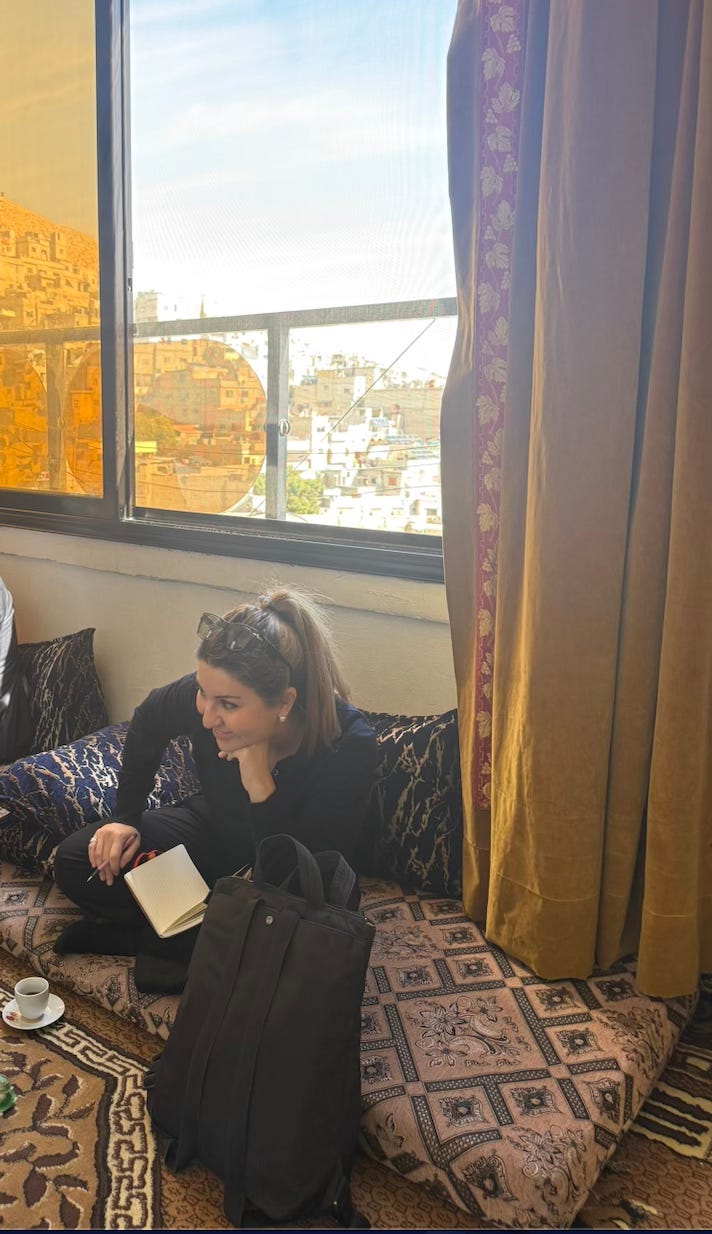
“We live here in a kind of equality of poverty. I am surrounded by Arabs, Kurds, Alawites, and Palestinians. We looked after each other during the war and we will continue to do so. The owner of our market used to work for the mukhabarat. We knew it. But we also knew he would protect this neighbourhood.”
As I travelled in a small van designed to navigate the narrow uphill roads, I met a group of Alawite youth working at a small construction site. They were grateful for the new job, explaining that they had previously needed at least three different jobs to make ends meet. The construction site was for a new masjid donated to the Ministry of Endowments by a Sunni resident whose one of his three houses had collapsed and would now be rebuilt as a mosque.
Everyone in Damascus needs more than one job to sustain a life.
“What do we expect from the new government?” Majid repeated my question before answering it himself. “A dignified life. Simple as that.”
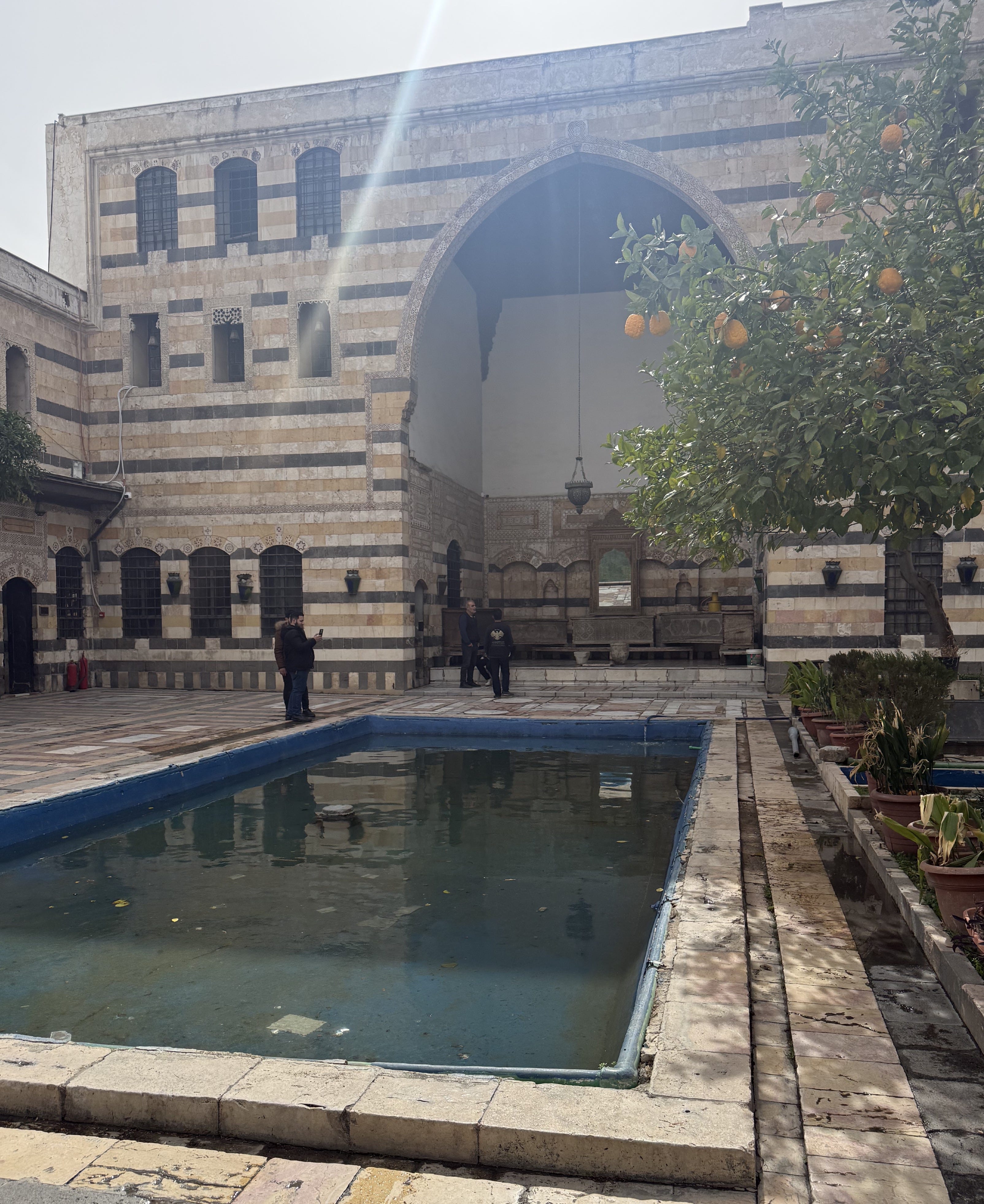
A young Druze man working at the Azm Palace was critical of the influential Druze leader Hikmat al-Hijri’s entourage.
“We all know that people around him are involved in drug smuggling,” he said. “He recently said that individuals are responsible for their own actions. I see life that way. I don’t know much about the new government. I know that my wage used to be sixty dollars. Now it is ninety. Still not enough. I have to find other jobs, painting walls, playing the organ at events if I am lucky.”
He added something else.
“When Assad was in power, I would not be allowed to talk to you because you are a foreigner asking about politics. I would have either walked away or lied that Assad is a great leader. There is only one Assad I miss these days. The one that used to perch on that small pool and that the kids dismantled and we put into storage.”
He was referring to the lion statue, Assad meaning lion in Arabic, that once ornamented the courtyard fountain of the Azm Palace, the house of an Arab-Ottoman notable.
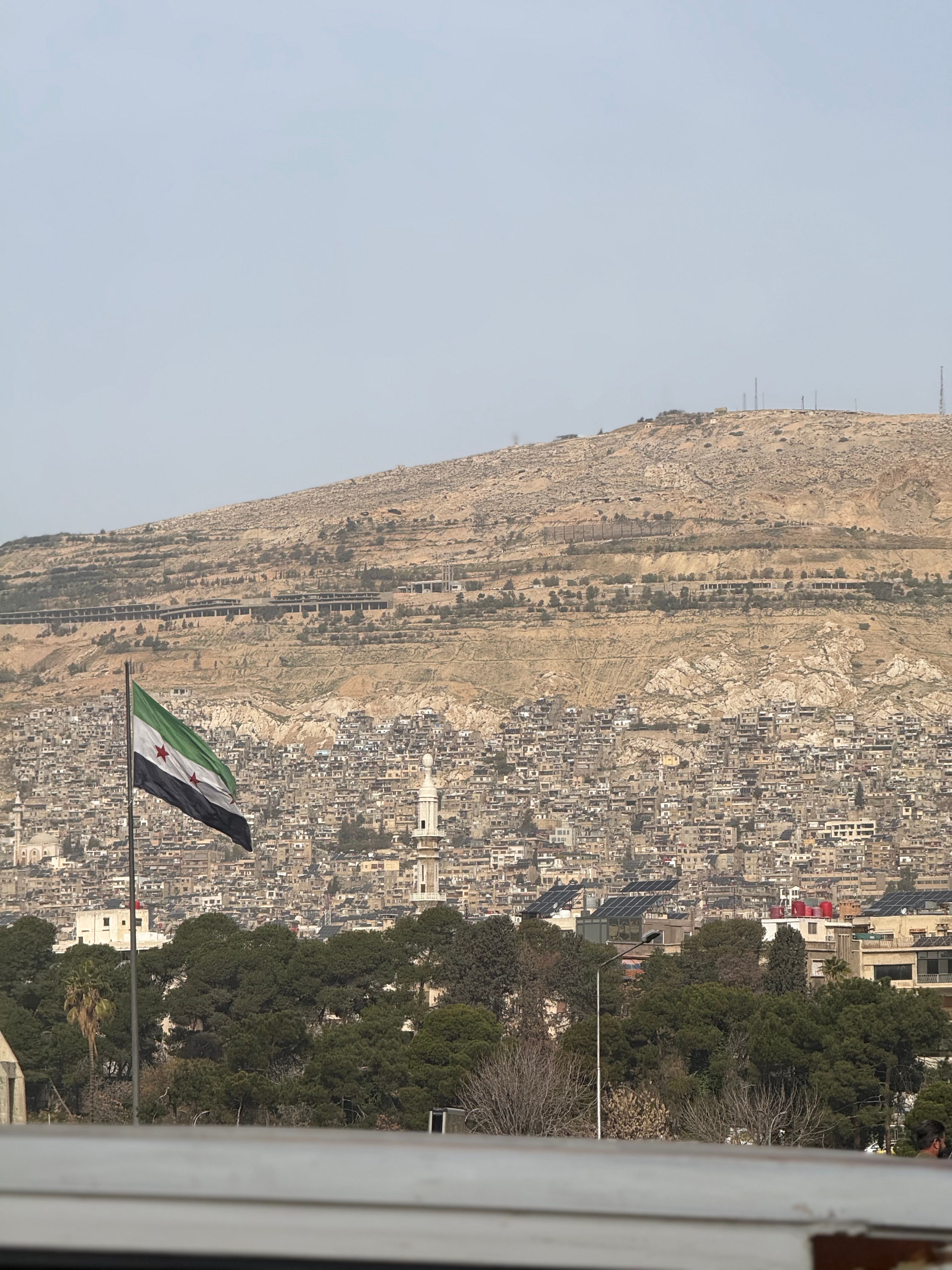
With all these divisions, there is yet another, described to me by Yusuf, now working in a government position.
“It is us versus them,” he said. “Us who left Damascus to fight, went to Idlib, and those who chose to stay and did not fight. Now we have come back from Idlib. They look at us as if we are foreigners. Why the long beards? Why the long abayas? And we look at them with suspicion. Why did you stay? How did you live under this brutal regime while your friends were dying?”
He paused.
“We need a space for dialogue where each side tells its story of the war and finds common ground.”
There will be a second post tomorrow, titled “Do Syrian Women Need Saving?”. Apologies for the double dispatch; the two pieces are best read together.