
Interview with Faisal Devji: 'Islam as an actor, an agent, a protagonist in history is dying.'
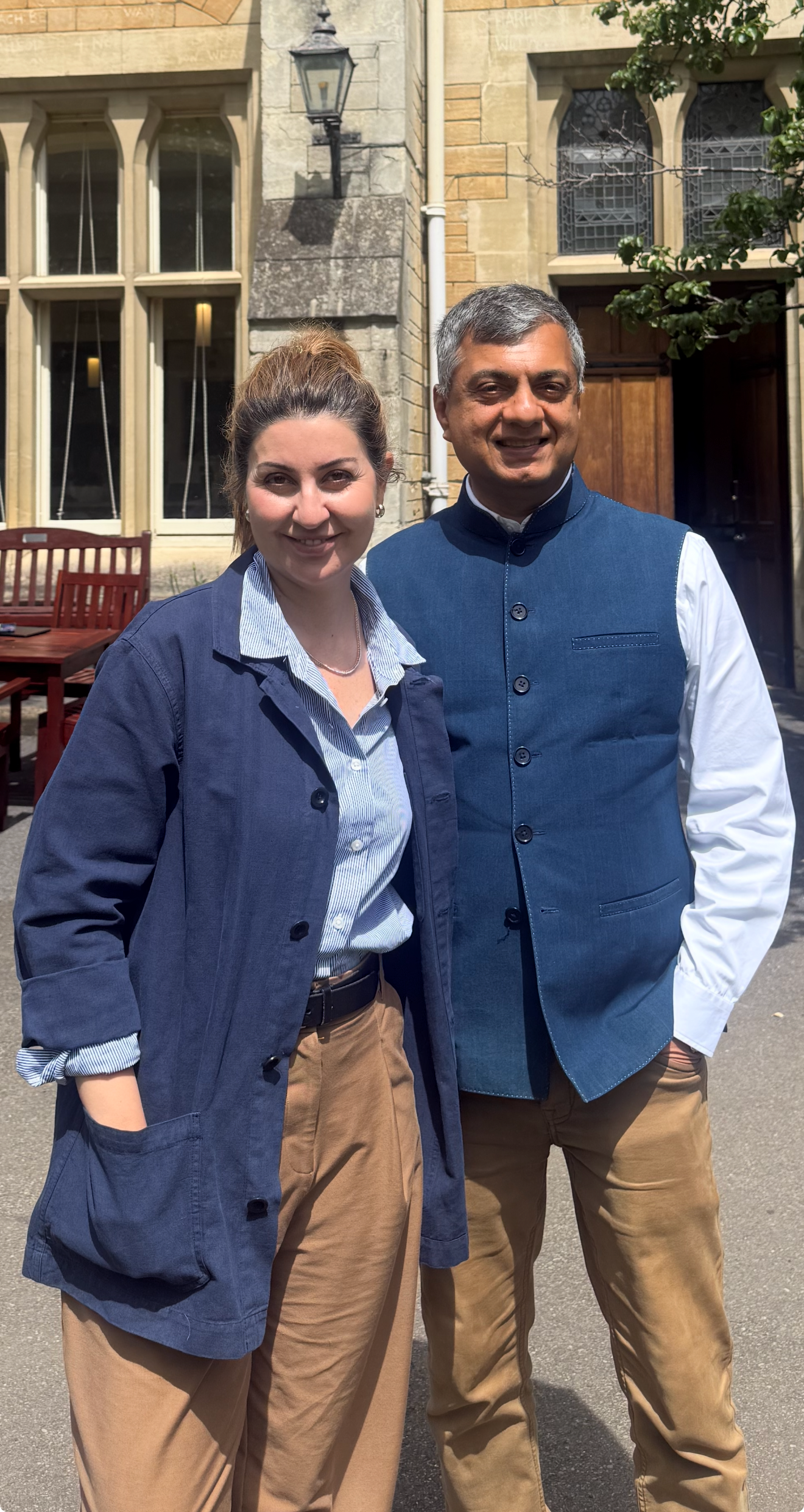
I talked to Faisal Devji at Oxford about his arguments in his new book The Waning Crescent: The Rise and Fall of Global Islam.I talked to F

Hey hey…
This week I come to you in podcast form as I promised earlier.
I interviewed Faisal Devji, a top historian and a public intellectual. He is the Beit Professor of Global and Imperial History at Oxford and a Fellow of Balliol College. He is the author of some of the most original books written on Muslim political thought in the past two decades, among them The Impossible Indian, on Gandhi, and Muslim Zion, his study of Pakistan as a political idea.
He is also, I should say, a friend, and one of those rare people I get to call a friend while also looking up to him. As an intellectual, as an academic, as a teacher, Faisal has a depth and an integrity that I have come to treat as a kind of benchmark. And he is also genuinely a kind person, which in our line of work does not always travel together with brilliance.
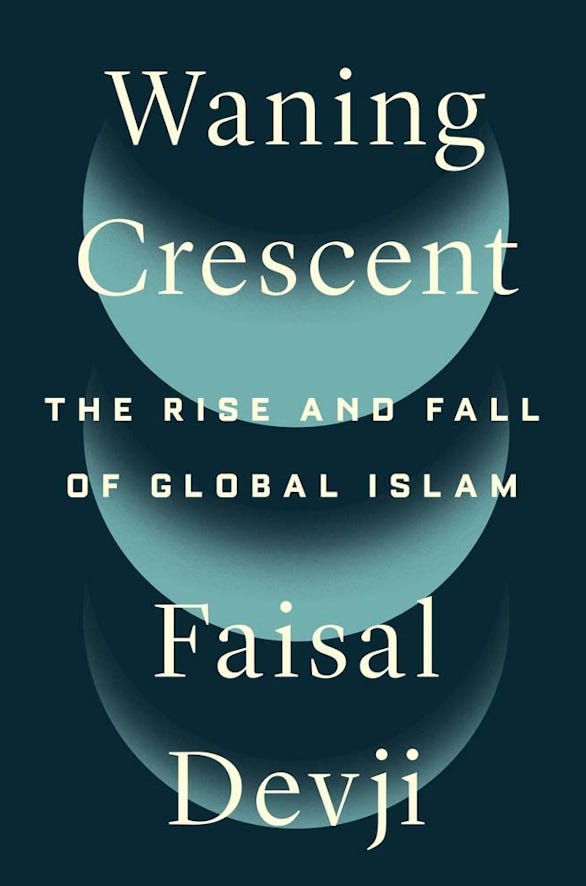
His new book is The Waning Crescent: The Rise and Fall of Global Islam, published by Yale University Press. It is a history of an idea, the idea of Islam as a global political force, and its central claim is that this idea is dying.
Devji traces the birth of Islam as a protagonist in history to the nineteenth century, when Muslim societies fell under European empire. Reformers responding to that crisis began to imagine their faith anew, as a power in the world, something that could decline, be defended, and be revived.
Over the following century that imagination passed through three hands. First the modernists, who presented Islam as a great civilisation. Then the Islamists of the Cold War, who hardened it into a political ideology to rival communism and liberalism. Then the militants of our own era, who reduced it to a bare identity worth killing and dying for. At each stage, he argues, God and the Prophet were pushed further into the background. The louder the politics became, the thinner the theology grew. And now, he says, the whole project is exhausted.
From the Arab Uprisings to the protests in Iran, India, and Bangladesh, Muslims are mobilising in their millions without invoking Islam as their cause. So, the crescent of his title is waning, not because the faith is weakening, but because the political career built in Islam’s name is coming to a close.
It is a bold thesis. Some of its parts I do not agree with, but this is exactly why I wanted to sit with him in his office in one of Oxford’s most famous colleges, Balliol.
Islam as a Historical Protagonist
In the interview, Devji clarifies that “global Islam” is a broader concept than “political Islam,” which he considers a subset. He defines this global Islam as the idea that the religion itself acts as a protagonist in history, an abstract system that directs human behaviour, much like ideologies such as Communism or concepts like “civilisation” are often framed. This conception, he argues, is not theological but a modern construct that emerged around the mid-19th century. Devji outlines a historical trajectory for this idea, beginning with Muslim modernists and liberals of the late 19th and early 20th centuries, continuing through the Islamists of the mid to late 20th century, and culminating with 21st-century militant groups like Al Qaeda and ISIS. However, he asserts that at this final stage, the idea self-destructs, and we are now entering a period where Islam no longer functions as this type of historical agent.
Encounter with the Empires
I wanted Devji to pinpoint, if he must, the historical moment when Islam stopped being only a faith people practised but became an actor with a destiny and a plan. He argues that the idea took root in the context of expanding European empires and the concurrent decline of traditional Muslim sovereignties, such as the formal end of the Mughal Empire after the Indian Mutiny of 1857 and the establishment of the British Raj. This power vacuum created an environment where a new, educated middle class of Muslim intellectuals began to conceptualise Islam as an abstract, agentive force acting in its own right. This “democratisation of Muslim authority” allowed individuals to make claims in the name of Islam without relying on traditional figures like kings or clerics. Initially, Muslim liberals framed this abstract Islam as a “civilisation,” a way to understand its collective historical action. Devji emphasises that Islam as it emerged in modern times is inseparable from, and in fact is, a colonial category, even if used for oppositional purposes.
Ottoman Empire and Turkish Islamism
What about Islam during and within the Ottoman Empire? According to Devji, the Ottoman Empire had a significant imprint on the idea of Islam as a historical agent, particularly through the enduring figure of the Sultan-Caliph. Unlike other parts of the Muslim world where Islamic movements often emerged in opposition to monarchies, Turkish Islamic movements consistently referenced this imperial past. He notes that even with Abdülhamid II, Islam was invoked and imagined as an entity in its own right, allowing for calls for support from Muslims globally. This support was directed towards the institution of the Caliphate rather than the person of the Sultan. For many, the Ottomans’ role as a great power in the Middle East was crucial, as they opposed the region’s fragmentation, which was seen as opening it up to European colonisation. Devji also highlights that Turkish Islamism is distinct from other Islamist movements because it has never repudiated its Ottoman, monarchical past. Not only that, Islamic movements in Turkey consistently referenced this past. In contrast, Muslim movements elsewhere, both liberal and Islamist, often emerged in opposition to their royal or monarchical pasts. He states that the figure of the Sultan-Caliph endured in Turkey, and Islamic movements there consistently referenced this past.
Islamism in the Cold War era
Pakistani thinker Abul A’la Maududi, a key figure who was considered the father of Islamism, was influenced by the era’s dominant ideologies. He reconceptualised Islam on the model of Communism, complete with a vanguard party (the Jamaat-e-Islami) modelled after the Bolsheviks. A core feature of this Islamism was a profound, almost anarchist, suspicion of the modern state, which was seen as a Western, secularising imposition, contends Devji. The goal was to limit the state’s power and allow an “authentically Islamic” society to manage itself, with Islamist thinkers acting as guardians outside the state structure.
Contrary to popular belief, Devji positions the 1979 Iranian Revolution not as the vanguard of this movement but as a late, unique, and divergent event. By 1979, he argues, mainstream Islamism was losing momentum. The Iranian Revolution gave it a new character by being appropriated by the traditional ulama (clergy), a class that lay-intellectual-driven Islamism had traditionally repudiated. While Khomeini was influenced by thinkers like Maududi, he engineered a state where the ulama became its guardians, merging religious and state authority in a way that differed from the original anti-statist impulse. This model, however, remained a “one-off” and failed to export itself, marking the end of the global Islamist story rather than its peak.
Jihadism and the Neoliberal Turn
And then comes the third and final phase of global Islam, characterised by the rise of jihadist groups like Al Qaeda and ISIS. Devji explains that these movements inherited the Islamist suspicion of sovereignty but individualised it, turning the focus from challenging the state to dismantling the “Muslim self” to ensure personal conformity to a rigid interpretation of Sharia. While Al Qaeda remained a stateless global network, ISIS attempted to create a state, though one with fluid borders and international personnel, thereby continuing the rejection of the traditional nation-state.
But then I asked him about the recent shift in the goals and praxis of jihadist groups like Jabhat al-Nusra and its successor Hayat Tahrir al-Sham (HTS) in Idlib, Syria, whose leader now sits as the president of Syria and is considered a legitimate political actor on the international scene. Here, the global jihadist project has been abandoned in favour of a localised, nation-state-focused entity. This shift involves governing, marginalising foreign fighters, and seeking international respectability. According to Devji, this localisation is driven by a “neoliberal turn,” where the movement’s survival depends on creating a consumer-driven economy with shopping malls and a supportive merchant class, heavily influenced by Turkey’s AKP model. This practical transformation into a market-oriented, localised power signifies the effective end of the global jihadist ideology, as it is supplanted by a pragmatic need to operate within the existing world order. Devji, whom I know through and who helped with my research project on The New Spirit of Islamism, agrees that the “neoliberalisation of Islam” is particularly evident in Turkey, where a marketised model of Islam operates through the private sector with state guidance, and this model is diffused to other Islamist movements both in South Asia and in the Arab World.
Unlike me, though, he really is not fully convinced that this model should be called Islamism. Because for one, this represents a shift from the older, revolutionary form of Islamism to one that can coexist with various political systems. In this vein, I see the apex of adaptation of Islamism to the dominant capitalist system and the core concepts within its morphology rearranged rather than a death. It is true that Devji is talking about a broader idea than Islamism, but he is also, in a way, closer to thinking that the full adaptation of Islamism to the market means that it is not Islamist in the old-fashioned sense of a revolution with a revolutionary state and an ideology like Iran’s. Instead, it can coexist with various political systems and lacks the systematic nature of the older ideology. Therefore, for Devji, the current transformation represents a fundamental shift away from the core tenets of traditional Islamism, rather than a mere phase in a recurring cycle.
What Fills the Vacuum
After finishing Devji’s book, the most sensible question to ask is what comes next. As Pratap Bhanu Mehta says in his review of Devji’s book, there must now follow a profound vacuum if Islam as an idea is waning. Emptiness in politics does not stay too long as emptiness. So, what fills it? A different version of nationalism? Devji argues that the vacuum left by the waning of Islamism is part of a global phenomenon of fragmentation, mirrored in the West, where the collapse of the bipolar world has led to a resurgence of racism, xenophobia, and far-right movements.
So maybe the idea of the “West” itself is also waning, I suggest. Maybe, he says. The post-Cold War unipolar structure has degraded former alliances. The Muslim world’s current trajectory is not an isolated event but is intertwined with this global history, reflecting a worldwide search for new political forms. But he suggests that the “return of nationalism” is not a simple revival of old forms. New nationalisms, such as those in Scotland or Catalonia, are predicated on pooled sovereignty within larger bodies like the EU. In contrast, places like the Gulf states challenge the very definition of a nation-state, with populations composed largely of non-citizens. This novelty and variety indicate that the world is not returning to a familiar order but is in a state of flux.