
Revolutions Without Revolutionaries: Actor Khalid Abdalla, Palestine, and Iran
A reflection on Khalid Abdalla’s Nowhere, and what protest leaves behind when it does not topple power. From Egypt and Palestine to Iran, on endurance, repression, and the long life of dissent.

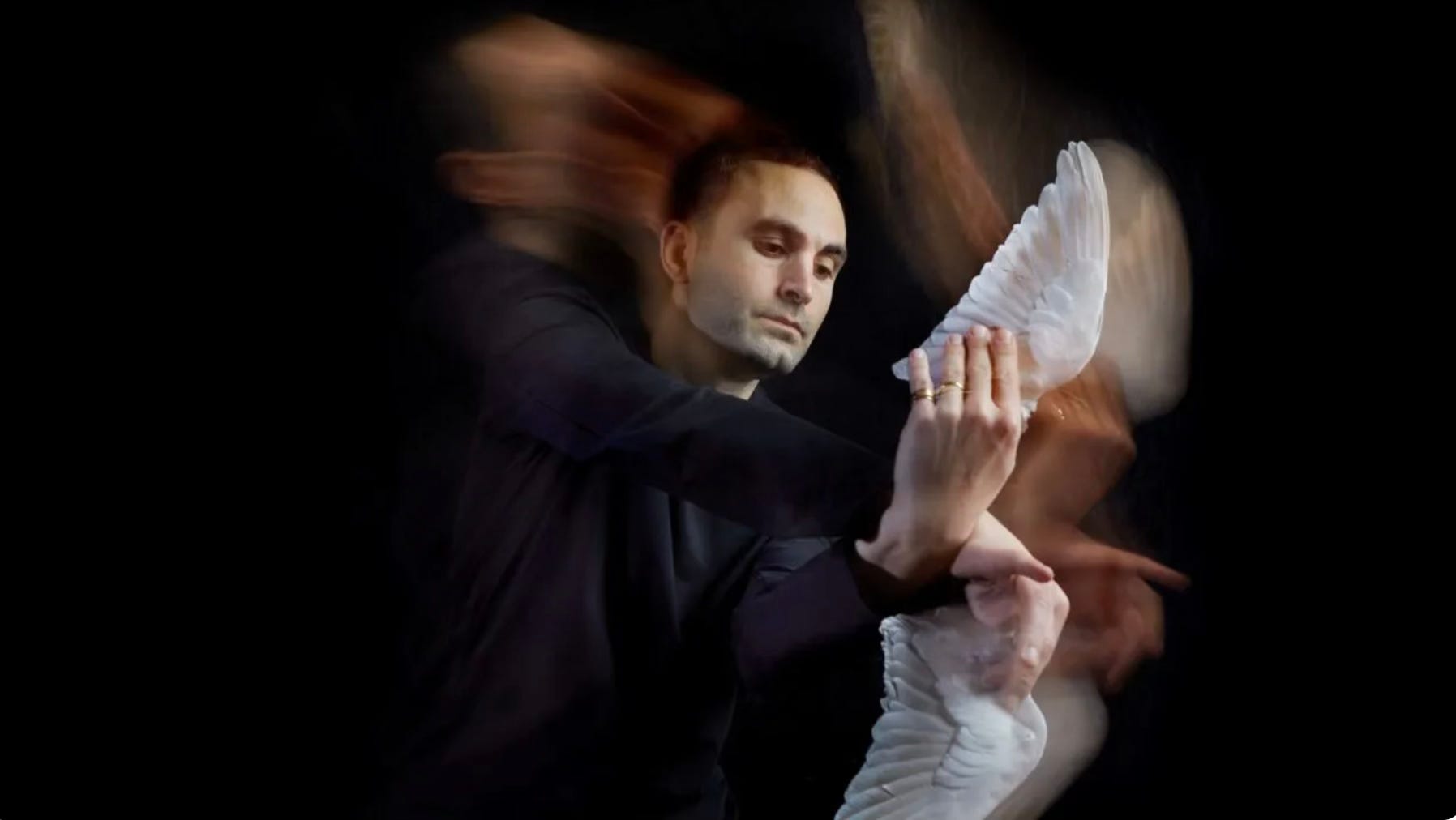
I had the privilege of watching writer and actor Khalid Abdalla’s autobiographical one-man play Nowhere at the Oxford Playhouse. Contrary to its name, the play, using unexpected but marvellous tools of modern theatre, took us everywhere that is politically relevant to our understanding of who we are.
We as friends. We as revolutionaries. We as failed political agents. We as political prisoners. We as immigrants. We as forced immigrants, our countries rendered unliveable under authoritarian regimes and neoliberal miasma. We as asylum seekers fleeing civil war and genocide. We as hopefuls and optimists. We as citizens of everywhere and therefore, as right-wing populists want us to believe, “nowhere.”
Abdalla, an Egyptian born and raised in Glasgow, showed us during the play that he can be Scottish, Cambridge-educated English, proudly Arab, if necessary Irish, and if pushed, American. He also showed us how political contexts shape our private lives. Even those who consider themselves privileged enough to remain aloof, immune to world events, are affected. Especially if you come from a people who have been colonised, exploited, and displaced.
His great-great-grandfather was born in Egypt in the year Britain invaded Ottoman Egypt. His grandfather was arrested for protesting Sadat-era liberalisation policies. When his father followed the same path of political conscience about Egypt and, by extension, Palestine, he too was unsurprisingly arrested. It was then that Khalid’s grandfather persuaded his son to leave Egypt and pursue an education. He first moved to Iraq and then to the United States, eventually ending up in Glasgow, where Khalid was born. Khalid himself, as an Arab, received his share of terrorist labels in the aftermath of 9/11 and was ironically cast in 2006 as the lead terrorist in a film based on the United 93 hijacking.
Tahrir, Taksim and, Friendship
But politically, the pivotal moment was the 2011 Egyptian Revolution, which toppled the Mubarak regime. Khalid was in Tahrir Square alongside thousands of Egyptians. He was also there two years later, in 2013, when a military-led counterrevolution ousted the Muslim Brotherhood government and carried out an outright massacre of its supporters at Rabaa Square.
So Abdalla witnessed those liminal moments when everything is possible, when everything can change, for better or worse. He then, together with his close friend, tried to make sense of what happens to that collective energy that rocks the boat, sometimes builds and sometimes destroys, caught between hopelessness and that peculiar combination of anger and motivation that drives people to try again and again to bring about change.
I was watching Abdalla’s show with one of my closest friends, both of us Istanbulites who, through a twist of events, became Oxonians. We listened as he spoke about that ambiguous yet powerful energy present in Tahrir, and later in 2013 in Istanbul’s Taksim. About how he and one of his closest friends, Alaan, found hope and tools of contentious politics in Istanbul’s everyday resistance after 2013. The Gezi uprisings changed the lives of many in Turkey, including me and my dear friend, in ways we had never imagined or anticipated.
Just as Tahrir shaped the understanding of life, purpose, community, and friendship for two Arab men, Khalid and his closest friend, Taksim did the same for us, two Turkish women, whose stories now overlap in a city like Oxford, a place deeply entangled with British imperialism and colonialism. And, that, is ironic.
We all had our revolutionary moments, failed or otherwise, and they changed us. More than they changed the system and its institutions, they changed us. And, that, is beautiful.
Palestine, Hrant Dink and the Dove
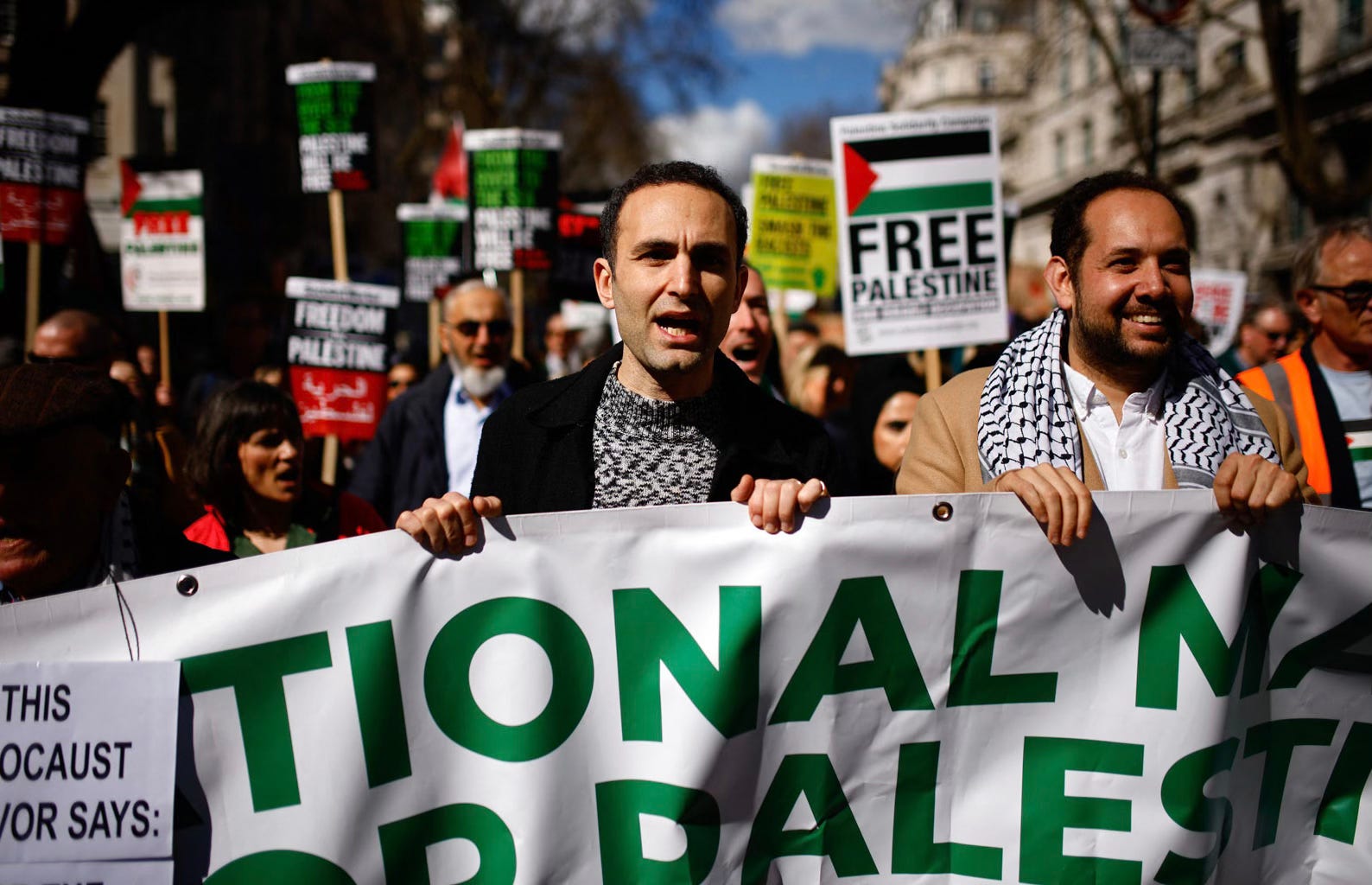
In recent years, Abdalla’s life has increasingly revolved around activism for Palestine and the genocide unfolding in Gaza. He has been summoned to attend a so-called “formal interview” by the Metropolitan Police in connection with a pro-Palestine protest in March last year. His public advocacy has unfolded amid a spate of police summonses, investigations, and warnings aimed at disciplining pro-Palestinian protest. Yet he has continued to use his popularity and actorly clout to explain what has been happening in Palestine, not only since October 2023, but long before that moment.
He insists on tracing the story back to the point at which Europeans decided to do a fateful bargain and outsource “their Jewish problem” to Palestine, resolving it through displacement and the systematic disregard of the indigenous population living on that land. Before 1948, Muslims or Arabs had no inherent problem with Jews.
Yani… That was a European problem, exported through colonial violence and imposed settlement. We just need to remind this historical record more often to make Europe’s threadbare moral standing in the face of Palestine more conspicuous.
It has taken a genocide, and unfathomable piles of human bodies, children among them, for awareness of what really happened in Palestine, and how we arrived here, to begin to deepen. That slow, belated recognition is what Abdalla says makes him hopeful, despite everything.
Believing in justice more than peace, he nevertheless ended his play with an origami dove, a peace cliché he once disliked but has grown accustomed to. He releases it with the wish that, somehow, it might find a place to land while flying from nowhere to somewhere.
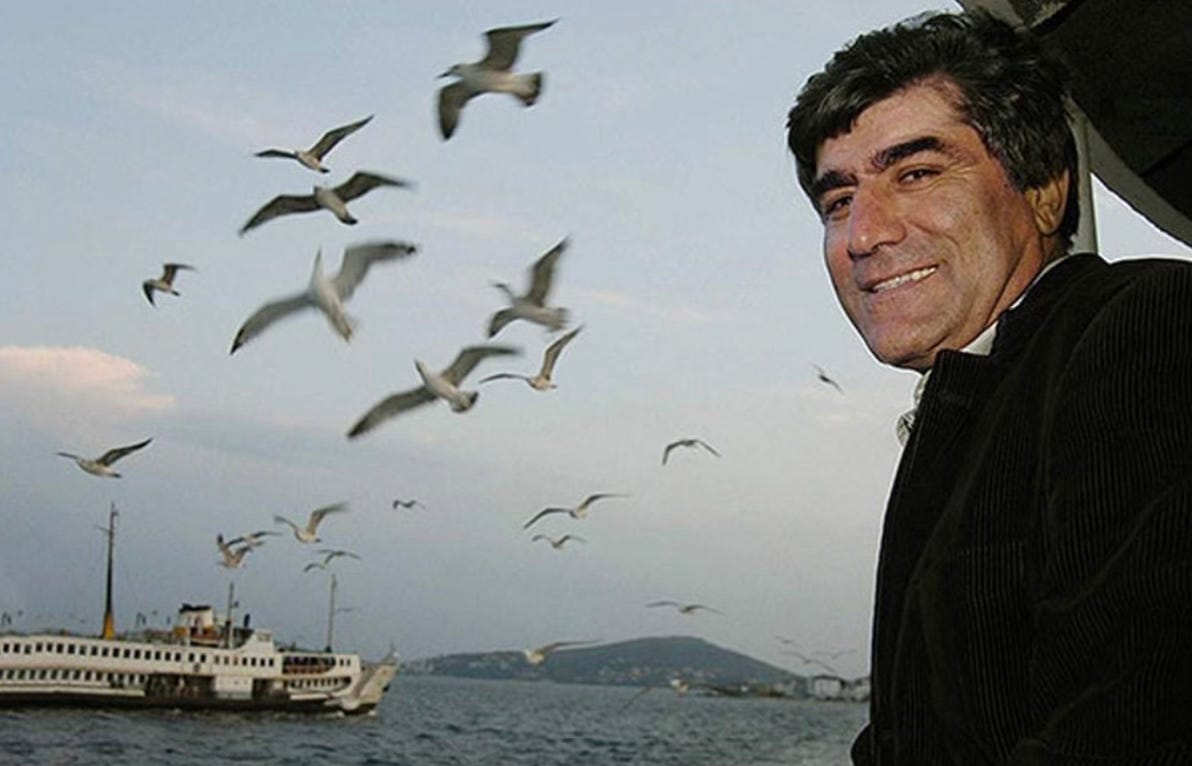
When Abdalla spoke about his contained hopefulness and his belief in a white dove, I thought of my dear Hrant Abi, a colleague, a mentor, and a friend. Hrant Dink, the Armenian journalist, was assassinated by the deep state in a busy district of Istanbul on 19 January 2007. He was an intellectual, a democracy activist, and a relentless believer in the basic decency and common threads of humanity.
After being indicted for “insulting Turkishness” — yes, there is such an offence in the Turkish Criminal Code, the same one once used against the Turkish-British author and beautiful soul Elif Şafak for her writing — and receiving countless death threats, he wrote the following lines. They were published in Agos, the newspaper he edited, on the very day he was assassinated:
What I have been going through is not an easy process.
Nor what my family and I have been through.There were moments when I seriously considered leaving the country and going far away.
Especially when the threats began to reach those close to me.
But then, if we were to leave, where would we go?
To Armenia?
And how long would someone like me, who cannot tolerate injustice, be able to endure the injustices there?
Wouldn’t I end up in even greater trouble?Living in European countries was never for me.
If I went to the West for three days, by the fourth day I would already be restless with longing, saying,
“If only this would end so I could go back.”
What would I do there?To stay and live in Turkey was both our true desire and a matter of respect
toward the thousands of friends, known and unknown,
who struggle for democracy in this country and stand by us.We would stay. And we would resist.
But if one day we were forced to leave…
we would set out just as in 1915.
Like our ancestors.
Not knowing where we were going.
Walking the same roads they walked.
Feeling the suffering, living the agony.I hope with all my heart that we will never be forced to experience such a departure.
We have more than enough hope not to live it.
And more than enough reason.Most likely, 2007 will be an even more difficult year for me.
Trials will continue. New ones will begin.
Who knows what other injustices I will face?But through all of this, there is one truth I will count as my sole assurance.
Yes, I may see myself in the anxious soul of a dove,
but I know that in this country people do not touch doves.Doves live on,
even in the very heart of cities,
even amid human crowds.A little timid,
but just as free.
Abdalla’s Nowhere insists that “nowhere” and “somewhere” are not opposites but conditions we move through together, shaped by violence as much as by care. The dove he releases, like Hrant Dink’s trembling one, carries no promise of safety, as we sadly discovered. So yes, we know that evil persists, often organised and protected, but so does solidarity, fragile, exposed, yet present. Just look at the overlapping journeys and narratives of people who carry the same belief in their hearts about humanity. Wallahi, it should be enough for now to keep us going.
Why did the protests in Iran ‘fail’? Or did they?
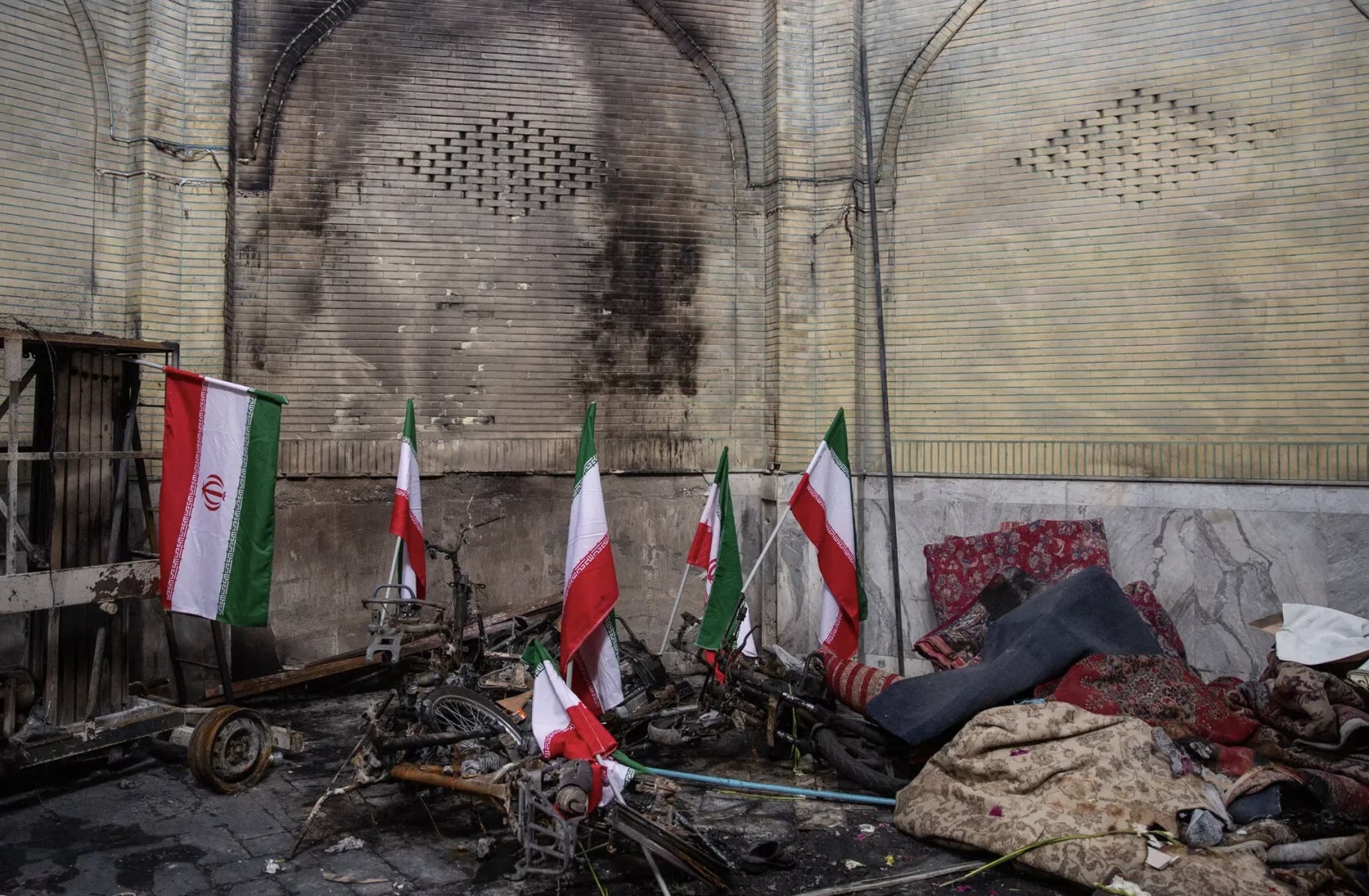
I have seen this question in almost every political commentary of the past week. I strongly believe that it is not the right framing. The question is not why, or how, or even whether the protests failed. The question is what systematic tools keep the Iranian regime in place. As I tried to suggest through Khalid Abdalla’s play in the previous section, protests may not achieve their ultimate goal of toppling an authoritarian regime in the first, second, fourth, or even eighth burst of collective mobilisation. But each time, they change something in society, and certainly within political institutions and the ruling class. These changes may not be immediately visible, and the way they accumulate or consolidate into something gargantuan enough to dislodge an equally gargantuan and brutal regime is never predictable. That is precisely why protests do not “fail.” Failure is the wrong threshold through which to understand what is unfolding.
The literature on contentious politics has long warned against reading protest cycles through the binary of success and failure and reminds us that mobilisation is episodic, uneven, and often indirect in its effects. Authoritarian regimes are resilient not because they are untouched by protest, but because they have developed sophisticated mechanisms to absorb, fragment, delay, and outlast dissent. These include coercion, of course, but also co-optation, elite bargaining, institutional redundancy, and the careful management of fear and exhaustion. Resilience is work. Laborious. And it is precisely this labour of survival that protest movements disrupt, even when they do not immediately overthrow the regime they confront.
Iran’s resilience, like that of many authoritarian systems, has less to do with some mystical durability of power than with the specific mechanisms the state has developed to absorb and contain dissent. Khamanei regime rests on a political architecture deliberately designed to withstand pressure from below. Power is highly personalised and organised in concentric circles around him, insulated from society and from formal institutions alike. Around this core stands a coercive shield led by the Revolutionary Guards (IRGC), a force created not to defend the nation but to protect the regime, decentralised enough to contain unrest locally before it accumulates nationally, and economically embedded in ways that tie its survival to the system it enforces. In such a configuration, elite fracture, an important condition for authoritarian breakdown, is systematically prevented.
In the latest protests, the regime combined severe repression with information control, cutting off internet access and mobile networks for days on end. So it disrupted coordination and to limit the spread of protest narratives both inside and outside the country. Security forces and intelligence organs have remained largely loyal to the clerical leadership, a fact that scholars of contentious politics identify as one of the most decisive factors in why mass mobilisation rarely dislodges entrenched authoritarian rule.
The state also deployed legal and psychological tools — from forced televised confessions to punitive sentences and the branding of protest as terrorism — to fracture solidarity and deter participation. These mechanisms do not make protest meaningless, but they do shape its evolution, often forcing it into unpredictable, horizontal, and decentralised forms that defy easy narratives of “success” or “failure.”
This is where theories of everyday resistance become useful. Iranian scholar of social movements Asef Bayat had come up with the term ‘refolutions’ almost two decades ago describing Iran’s Green Revolution during 2009.
There were moments of intense mobilisation from below coupled with a largely reformist horizon of change. Unlike the 20threvolutions that sought to seize state power and impose a new social order, these movements aimed to force existing regimes to bend, recalibrate, or reform themselves.
The result was an abundance of movement and a scarcity of structural change. High levels of solidarity, sacrifice, and creativity we saw in the streets were not matched by the emergence of unified leadership, organisational capacity, or a shared strategic vision capable of dismantling entrenched state power. Hence, another concept Bayat introduced : ‘revolutions without revolutionaries.’
What sustains these movements beyond their visible peaks, however, is the dispersed, everyday practices through which ordinary people quietly contest power, expand their room for manoeuvre, and reshape social norms without formal organisation. These forms of ‘everyday resistance’ by ‘social non-movements’ often remain illegible to the state. Which is good for their longevity. Yet they lay the groundwork for moments of mass mobilisation when the “political street” reopens.
Even when short protest cycles are crushed, Bayat insists, they contribute to a longer process by cultivating an active citizenry and what he terms the art of presence: the capacity to endure, to claim space, and to build alternative moral worlds over time.
Change, in this view, arrives less as rupture than as accumulation. Let us remember that contemporary Iran has been accumulating everyday resistance, revolutions without revolutionaries, and dusts of change since the end of the first decade of the 21st century. It should not be long before they begin to strain the system.