
The Armenians of Turkey and the newspaper that turned their voice public
Agos has done more than report on a community shaped by loss but has helped sustain a space in which Armenians could speak and be heard. Happy 30th birthday.

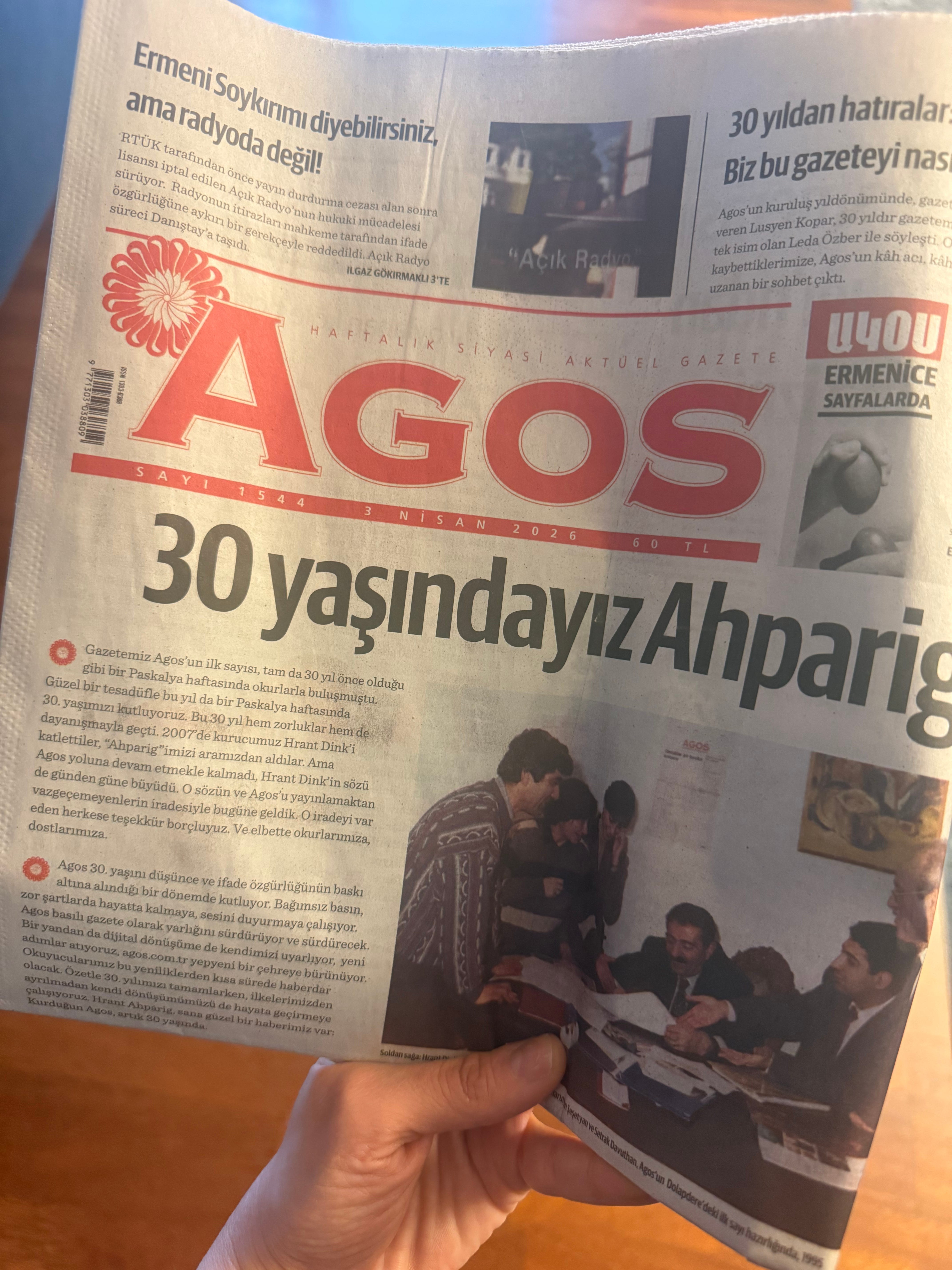
The newspaper I am holding does not move me simply because it has managed to remain a printed paper. It is the fact that it has endured, one way or another, in a harsh climate where the cold can be biting, the heat suffocating, and spring only rarely shows its face.
There is an irony here that is hard to ignore. The founding editor of this paper I hold in my hands is among those writers of modern Turkey who were taken by a brutal assassination. Yet its presence does not recall that violence so much as it instils a sense of assurance.
Much of that comes, of course, from the resilience and the peaceful character of Hrant Dink - Hrant abi - , the dear elder colleague who was murdered in 2007 in the very orbit of this newspaper, Agos. It also comes from the Agos team who treated his death as a grave turning point and chose to carry on with the same stubborn resolve.
Yetvart Danzikyan, who has been the editor-in-chief since 2015, and who is, to me, one of the most modest, kind, and clear-headed journalists I know (for me he is simply Yeto), described the labour behind the paper in these terms: ‘if you ask what the two strongest traditions of the Armenian people on these lands are, I would say the deeply rooted Armenian press and craftsmanship. During the Armenian Genocide, both traditions were cut back, more than that, cut down. Yet they were not extinguished. To publish a newspaper, and especially to publish Agos, has always felt to me like a form of craftsmanship. It connects both to a void I sensed in my own youth and to the history of the Armenian people. […] I do not know if those who founded and sustained Agos thought of it this way. We never spoke about it. But in practice we were bringing together two deep traditions. Art and craft are often confused. No, we were not artists. We were craftsmen. Craftsmen who kept a rooted press tradition alive. We would put on our glasses, lean over the table, and work the raw material in our hands together. In this way we reached thirty years. They took Hrant Dink from us, but we did not give up. Salute to those who did not.’
Since its founding in 1996, Agos has never been a newspaper concerned only with the issues of Armenians in Turkey. It has also offered Turkish society an Armenian perspective, and to Armenia, a way of reading Turkey from within. This double function established a line of contact that official diplomacy has often failed to produce. The fact that Armenia now appears in the Turkish press not merely as a hostile country or a distant neighbour, but as part of the everyday flow of political life, owes no small debt to Agos.
Another role Agos played, and a critical one, was in the matter of verification. What is now called fact-checking was, even if it went by another name, part of the paper’s daily reflex. From the 1990s onwards, the Turkish media circulated a steady stream of inaccurate, exaggerated, or plainly manipulative reporting on Armenians and Armenia. Developments in Turkey were likewise often distorted when conveyed to the Armenian public. On both sides, the language of enmity proved useful in domestic politics. Anti-Armenian sentiment in Turkey, anti-Turkish sentiment in Armenia, both could be mobilised with ease during election periods. Agos stepped in at these junctures. It tried, as best it could, to explain the substance of events to both publics and to place them on record. It is difficult to overstate the importance of this.
Looking back in 2006 on Agos’s first decade, Hrant Dink remarked that many of its ambitions had, in fact, been realised. There was, he said, hardly any issue concerning the Armenian community in Turkey that had not been brought to the attention of the broader public. Another achievement was the restoration of the word “Armenian,” which in the early 1990s had almost been turned into a term of abuse, to its proper meaning and dignity. Individuals within the Armenian community in Turkey were now able to express their identity without hesitation, even with a sense of pride, and for that, he suggested, they owed a great deal to Agos.
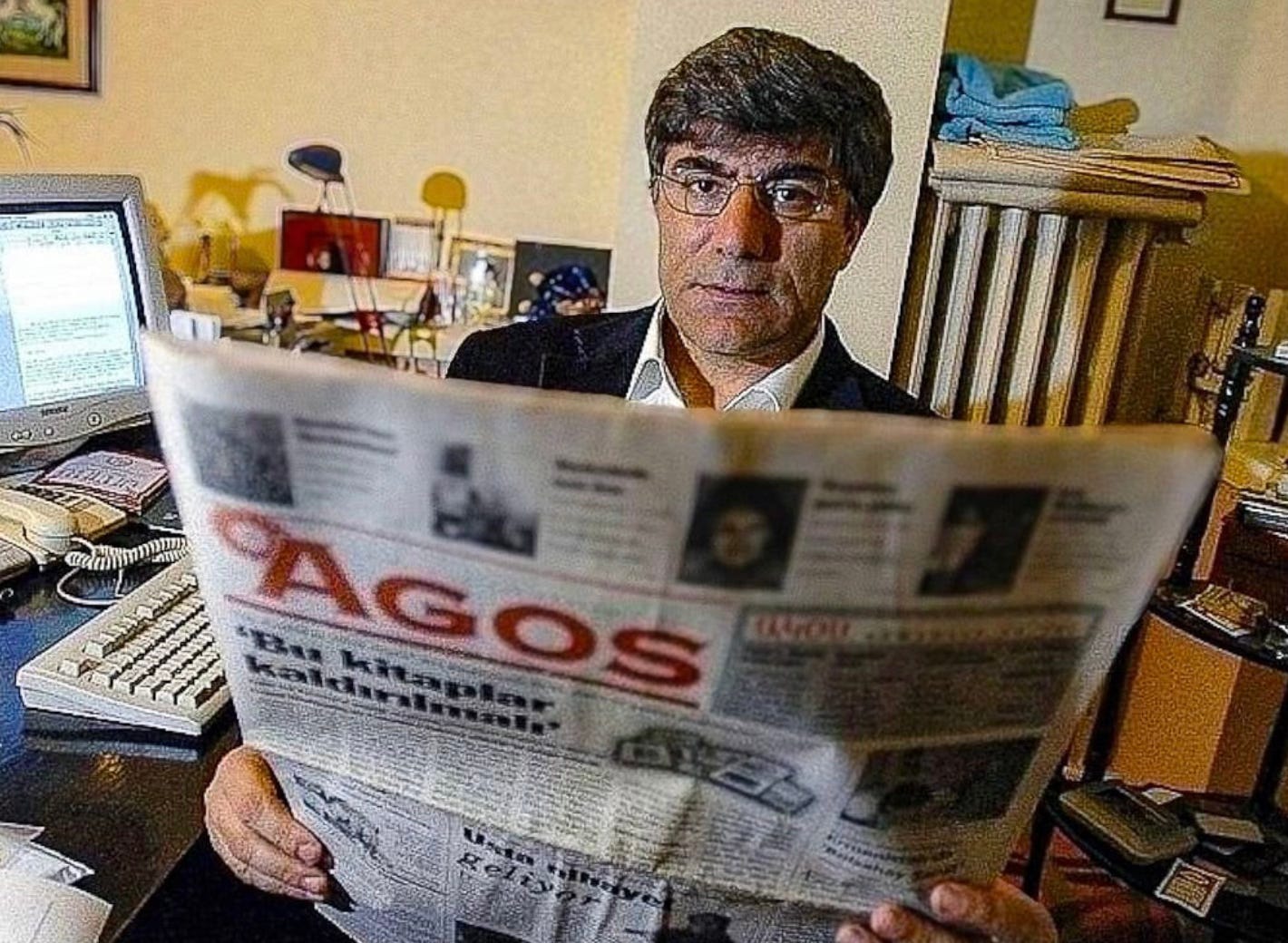
One of Dink’s most striking qualities was his deep attachment to Turkey, to being of this place. It was precisely this quality that the deeper structures of the state could not tolerate, and that led him to his death. As he put it, they had placed their Armenianness within their citizenship, and their citizenship within their Armenianness. They had not confined themselves to their own problems, nor limited their efforts to presenting those problems to the Turkish public. They had made Turkey’s problems the problems of Armenians in Turkey. ‘A paradise cannot be built through the resolution of one’s own issues alone. Unless the particular problems of those one lives alongside become one’s own, one’s own problems do not truly find resolution. Even when they appear to, something remains missing’ he concluded.
As Dink suggested, the scope of Agos was never narrow. A recent investigation published in the paper offers a clear example. It traced a chain of neglect and abuse involving 510 orphaned children brought from Ukraine to Turkey and placed in Antalya under the so-called “Childhood Without War Project.” That report, and the journalist behind it, Burcu Karakaş, were awarded the Uğur Mumcu Prize, one of the country’s most respected awards for investigative journalism. It carries its own grim echo. Uğur Mumcu, whose name the award bears, was, like Hrant Dink, assassinated outside his home for being a serious journalist who disturbed the dark arrangements that damage the country.
In Turkey, the paths that connect certain people, institutions, and communities are marked by deep sorrow. Yet they are also lined with forms of resistance that carry their own kind of inspiration. This country has often exhausted me, worn me down, brought me to tears. It has also, with equal force, etched into me the meaning of attachment and affection. For many of us, it is like this. It is so for those who founded Agos, those who produce it, and those who read it.
Rober Koptaş, who succeeded Dink as editor-in-chief, describes the effect Agos had, both on his own life and on its readers, in terms of a kind of rupture. Agos, he said, has been a school, not only for those who passed through its newsroom but for its readers as well. ‘It exceeded its own small hinterland and became a school for the whole of Turkey, even for different parts of the world if one includes the Armenian, Turkish, and Kurdish diasporas. As a young Armenian from Turkey, I learned not to be afraid, not to hide, not to conceal who I was in that school. In my first year at university I introduced myself to friends as Murat, the name on my ID, hiding that I was Rober, and lived for months under the strain of that secret. Agos changed that. For those who created it thirty years ago, it was a kind of Big Bang within their own atoms. After it, nothing would remain the same. From within a community reduced again and again, diminished, silenced, uprooted, there emerged a newspaper, like a final song, that insisted on rights and justice, on imagining another future, on a life together that is fair and free. It chose engagement over isolation, and, in Hrant Dink’s words, differentiation over fragmentation. In doing so, it showed how powerful the waves of change could be, how something born out of dark nights could become a star that signals the morning, for all the oppressed and for the country as a whole. This was the school Agos offered to anyone thinking about the condition of Turkey and the world.’
Agos is an Armenian newspaper. Agos is a newspaper of Turkey. Agos is the newspaper of a profession that has become scarce. It is a paper that, despite having been struck by one of the brutal killings of modern Turkey, gives me a sense of steadiness. One of the few assurances left in my Istanbul, in the Turkey I still believe in. It turned thirty. We were fortunate to grow with it, and to learn alongside it.
Why is Dink’s murder unresolved?
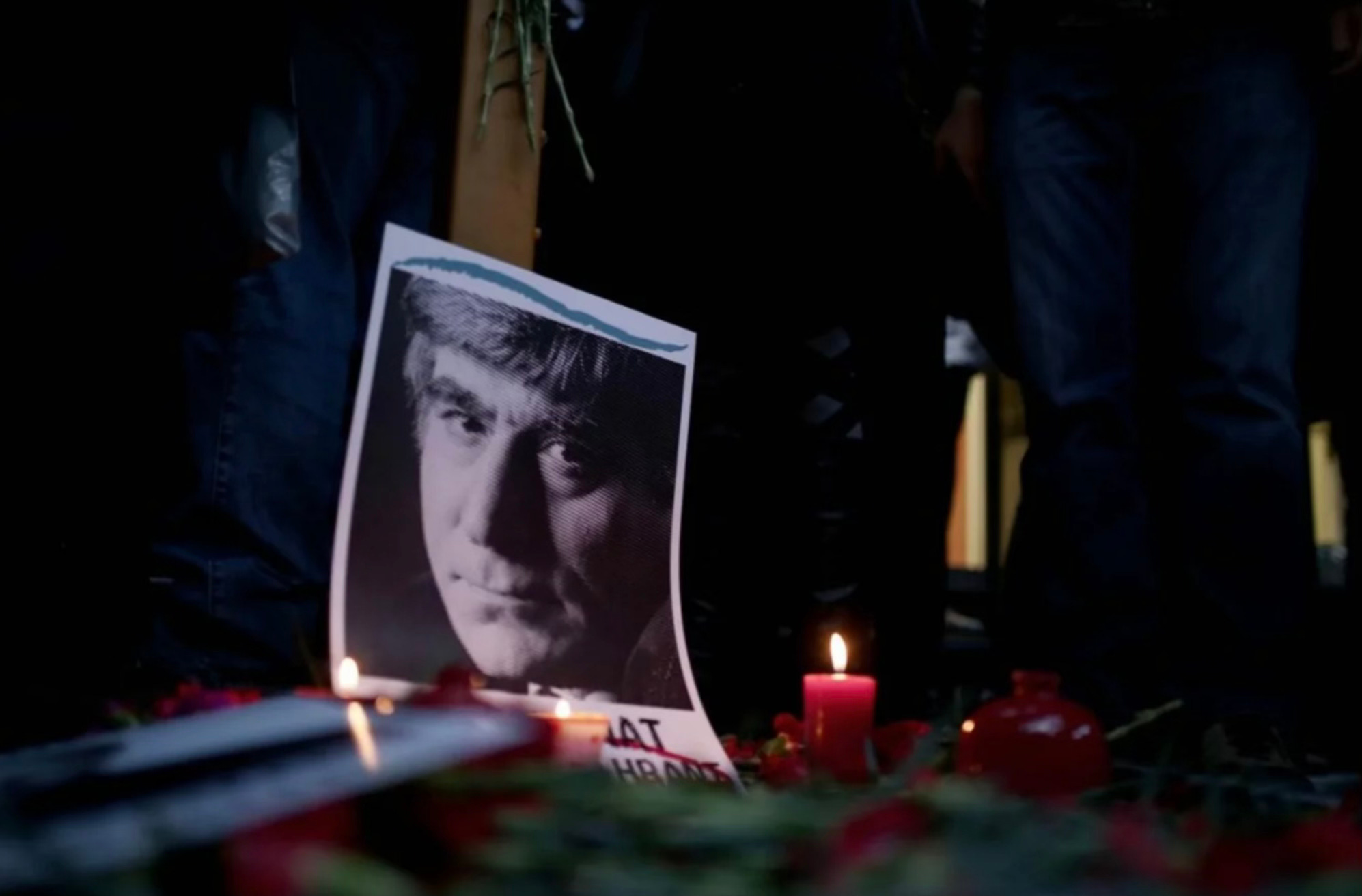
In a recent interview, Arat Dink, Hrant Dink’s son and Agos’s managing editor, recalled the threats his father received in his final days and the intense pressure the family lived under. He spoke about why they did not leave Turkey at the time:
“To leave or to stay? He [his father Hrant Dink] chose to stay. Perhaps instead of saying, ‘we are behind you, we will go anywhere with you, and if you want to stay, we will stay,’ we should have said, ‘we are leaving.’ Perhaps we should have told him that we could no longer live here. At a time when every attempt to assert our existence was met with accusations of betrayal, it was leaving that felt like betrayal to us. It is too late now to speak of these things.”
Hrant Dink was assassinated on 19 January 2007 outside his newspaper’s office in Istanbul by a 17-year-old gunman, Ogün Samast. The killing followed years of public targeting, legal harassment under Article 301 for “insulting Turkishness,” and repeated threats. In the months before his death, Dink had been summoned to the governor’s office, a meeting he later described as intimidation rather than protection.
The immediate account presented the assassination as the act of an ultranationalist youth and a small circle around him. Samast was quickly arrested and convicted, along with several associates linked to nationalist networks in Trabzon. For a time, the case was contained within this narrow frame, one that left state institutions largely untouched.
That frame did not hold for long. Evidence emerged that elements within the police and gendarmerie had prior intelligence about the plot and failed to act. Some officials knew the individuals involved and were aware of preparations for the killing. They did not intervene. In certain instances, the line between negligence and complicity blurred. The photographs of Samast posing with security officers after his arrest, smiling with a Turkish flag, became shorthand for that deeper entanglement.
Over the following years, the case expanded into a complex and fragmented set of trials. As political alliances within the state shifted, prosecutors began to pursue police and intelligence officials, some accused of allowing the assassination to proceed. In 2021, several former officials were convicted on charges ranging from aiding the murder through omission to membership in an armed organisation. Others were acquitted. Some suspects remain at large.
Ogün Samast himself was released in 2023 after serving his sentence, having been tried as a minor at the time of the murder. His release was legally defensible within the existing framework, but politically and morally jarring. The man who pulled the trigger walked free, while the broader architecture that enabled the killing remained only partially exposed and only selectively judged.
Therefore, the case is widely regarded as unresolved.
Part of the problem lies in the way the trial unfolded. The Dink case is better read not as a failure of justice, but as an example of how the legal system processes and contains a political crime.1 The task was less to trace the full chain of responsibility than to bring the demand for accountability within procedural bounds.
In practice, political questions were steadily recast as technical ones. The role of state institutions became a matter of admissible evidence. Intelligence failures turned into questions of jurisdiction. Responsibility narrowed to what could be established within the file. Over time, it shifted, dispersed, and in some instances expired. The length of the proceedings did its own work, stretching the process across more than a decade, eroding momentum through delay, fragmentation, and statutes of limitation.
The demand for accountability did not disappear. It was translated. Each step in the legal process reduced it to something more manageable, more precise, and further removed from the original question.
At the same time, the degree of coordination across different arms of the state remains striking. Institutions and mechanisms were aligned at multiple stages: in the lead-up to the assassination, in its execution, in the handling and suppression of evidence afterwards, and in the drawing of the limits within which the judicial process would operate. This alignment points to more than a series of failures. It suggests the presence of a durable apparatus, and a way of thinking, that not only made the crime possible but also normalised its aftermath and secured impunity.
We are not dealing with an isolated network, but with a structure that cuts across different segments, widely connected, insulated from scrutiny, and difficult to hold to account. Dink’s lawyers have long resisted the idea that this can be explained simply by an illegal organisation that infiltrated the state. They have pointed instead to the state itself, to its core institutions, the National Security Council, the intelligence services, the military, and the broader system they form together.
The targeting of Hrant Dink, the legal processes that led to his conviction, his eventual killing, and the blockage that followed in the prosecution of that killing all point in the same direction. They reflect a political logic rather than a breakdown.
During the trial, this became visible in another way. A state that is formally bound to protect the lives of its citizens has, at different moments, defined sections of those citizens as internal enemies. Once that line is drawn, the rules shift. Actions that the law defines as crimes, including murder, can fall outside the reach of accountability. Perpetrators are not punished. Officials who step beyond the law are left untouched.
The category of the “internal enemy (iç düşman)” rests on an idea of a homogeneous society, one that treats difference as a threat. In the Dink case, actors who took part, whether through action or inaction, converged around that understanding.
This is why the case has not been resolved. And this is why the continued existence of Agos matters. It stands as a form of resistance.
A previous post on Hrant Dink and state brutality is available here.
To follow Agos in English, this is the link.
Uğurcan Çelik, “Adaletin Nefesinin Tükendiği An: Hrant Dink Davasında Hukukun Yönetimsel Şiddeti,” Mülkiye Dergisi 50, no. 1 (2026): 97–135.
I cant thank you enough for this piece, and its genuine and original voice. Agos is one of my go-to papers for its quality and range. It is an inspiring accomplishment and contributes a lot to my life here with its window on the richness and diversity of life in Turkey. I also try to not miss Radyo Agos on Apaçık Radyo Saturday mornings, with wonderful guests on, again, a wide range of issues. Happy 30th, Agos!
wonderful... loved the paper... especially the article on Acil Radio.. I am sorry I don't have the accents... many thanks for the link.... wonderful