The Iranian Regime’s Best Enemy
The US-Israeli war on Iran was a godsend to a regime whose legitimacy was threadbare after the winter's protests. With the war resumed, what does the gift do to the regime, and to the Iranians?

Before the US-Israeli war with Iran resumed this week, for six days in July, the Islamic Republic of Iran buried the man the United States and Israel had killed four months earlier. Ayatollah Ali Khamenei, supreme leader for more than three decades, died on 28 February, when a joint American and Israeli airstrike hit his office in Tehran on the opening morning of the war.
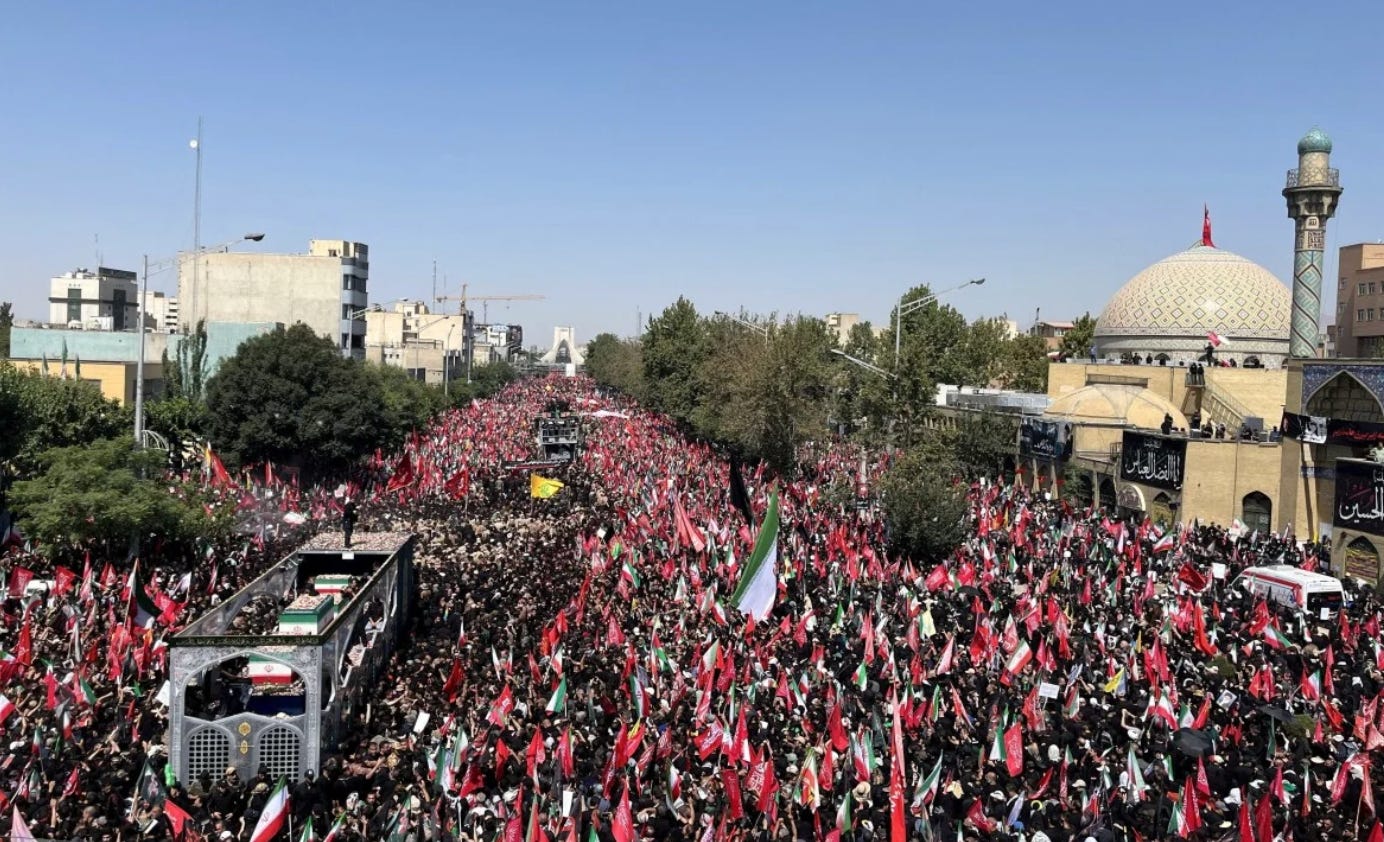
Islamic custom would have put him in the ground within days. Instead the regime waited until the bombing paused and staged the burial as a set piece. Khamenei lay in state on 4 July, the day the United States marked 250 years of independence. The ceremonies fell inside Muharram, the Shia month of mourning for the seventh-century martyrdom of Imam Hussein, and the casket was draped in a flag said to have flown over Hussein’s shrine.
Iranian state media reported 15 million mourners moving through Tehran, Qom, Najaf, Karbala and finally Mashhad, where Khamenei was buried at the shrine of Imam Reza. Independent wire reporting also described the scale of the attendance as more than impressive. For some it was somewhat surprising. One social media user commented that the scene of millions of people pouring in to pay their respects to Khamenei one last time showed the world that Iran does not consist only of an Iranian diaspora that is against the regime. Yes, it was true that the regime laid on transport, food and lodging to bring people in, but the outcome was even more than they imagined.
A regime that just several months ago was shooting its protesting citizens, piling their dead bodies for all to see so that the demonstrations would end, now showing the world millions who chant ‘Revenge, Revenge, Revenge.’
When the winter has come

Barely two months before the first missile, the picture looked different. Through the winter, watching the December protests and the killing that followed, many of us who study the region let ourselves believe the Islamic Republic might be nearing its end. HRANA, an Iranian human rights monitor, puts the number killed in that crackdown at 7,000 or more. The legitimacy of the regime was thinner than at any point since 1979.
That reading did not age well, did it? But not because of the readers! Because of the US-Israeli war, the regime that we thought would not be sustained even with this brutal crackdown on its people is back on its feet with the help of Israeli drones and American bombs.
An external threat of this scale hands an embattled regime a way to recast every domestic grievance as collaboration with the enemy and to call back the wavering middle and the undecided. This is the reflex we call the rally-round-the-flag. The tendency of a population under attack to close ranks behind even a government it dislikes, disagrees with or despises. The bombs that killed Khamenei turned him from a failing autocrat into a martyr and gave his heirs a plan for performing national unity. In that narrow and cynical sense, the war was a godsend to the very regime it was meant to punish.
Haters and mourners on the same side
Whatever the war has given the regime, it has taken everything from ordinary Iranians. The strikes displaced people across whole provinces, flattened parts of cities, and cut power and water in a country whose economy sanctions, mismanagement and corruption had already broken. The dead run into the thousands, the wounded into far more.
Reporters who reached the mourners for Khamanei found they wanted to talk about themselves rather than about Khamenei. They were exhausted. Their families were split between those who grieved him and those who could not. They were still frightened of him, four months after he died.
Yes, the rally-round-the-flag reflex buys time and cover. However, it does not feed a ruined economy or bring individual liberties. On the contrary. The war closed off every exit for the anger and sealed the pressure inside. That is not sustainable but for how long?
The top scholars of contentious politics spent their careers asking why people confront their governments, and late on they decided the field had been asking the question wrongly.1 The old answer was that people protest when the political system gives them an opening. An opportunity structure had to emerge first, they contended, and then people would push at it. That turned out to be partly true.
Openings or, let’s say in this context, cracks in the regime, matter, but only once people read them as openings, as crack. In December the opening was not a split in the leadership or a stolen election. It was the currency and the electricity. Iranians came out against a system that had shown them no weakness at all, because by then staying at home cost more than leaving it.
Then consider what the war did. Before it, Iranian politics was organised around one division above all others. On one side stood the people, on the other the men who rule them. Divisions of class, region and piety mattered, and there were for sure other cross-cutting cleavages but they mattered less than that one.
On 28 February, when Khamenei was killed, the United States and Israel imposed a second division from outside. It runs between Iranians and the countries bombing them. This division does not care what any Iranian thinks of the Supreme Leader. It puts the people who hate him on the same side as the people who mourn him.
Prospects of protests
A New York Times investigation published on Monday revealed that Mossad had a plan to send Kurdish militants into Iran to trigger a popular uprising, bring down the regime and install the former president Mahmoud Ahmadinejad in its place. The groups involved were Iranian Kurdish opposition forces based in northern Iraq, but not PJAK or anything else tied to the PKK, presumably so as not to attract Erdoğan's ire.
It may be shocking that Mossad wanted to work with Ahmadinejad, whom US and Israeli media had long portrayed as one of the hardliners of the regime. He denied the Holocaust, repeatedly and in public, and in 2006 he convened a conference in Tehran to question whether it had taken place. He said the regime occupying Jerusalem must vanish from the page of time, which the world read as a call to wipe Israel off the map, and he never withdrew it. He is the epitome of an antisemite. Mossad spent four years cultivating him to run Iran.
‘Bloody hell, ladies and gentleman’, or as we say it in Turkish, ‘Vay anasını sayın seyirciler…!’
The rest of the plan, which did not go through, should not surprise anyone, as we know that the US and Israel made no secret of their intention to work with Kurdish groups and to rely on the protesters to topple the regime while they bombed the regime’s infrastructure. It turns out that Erdoğan’s immediate response via Trump, that he would not tolerate a Kurdish group-led uprising in Iran, derailed the initial plan. But that was just one part of the plan. The main component, relying on the anger of the Iranian people, did not work.
Because for an Iranian audience under bombardment, support from the men dropping the bombs is a liability and leads to the delegitimation of the protesters’ demands. This is something the royalist diaspora, mainly living in the US and led by Pahlavi, failed to understand for some time. I think they now do, but it is a tad late.
What now?
The anti-government movement is now suspended, especially with the war resumed. But it is not destroyed. Verta Taylor studied American feminists between 1945 and the 1960s, a period everyone had written off as the movement’s dead years. She found the opposite and named the condition abeyance.2 A small and determined network had kept the activists, the tactics, the arguments and the shared purpose intact through those years and passed all of it on when conditions changed. Iranians have done the same repeatedly. In 2009, in 2017, in 2019 and in 2022 after Mahsa Amini died in police custody, the networks went underground and came back. The movement that took to the streets in December was built out of what those years left behind.
The difficulty now is that the war cannot end in any way that serves the Iranian people first. A settlement, when one is made, will let the regime say it faced down the United States and Israel and is still standing. If the bombing continues, as a protracted conflict, the division between Iranians and the countries attacking them holds, and so does the charge that anyone in the street is working for the enemy. Iranians who want this regime gone are waiting for something that will strengthen it the moment it arrives. They cannot hurry it and they cannot choose which version of it they get.
And of course, the waiting has a cost, because movements lose people. Some emigrate. Some are arrested. Others decide privately that they have already given what they had to give. Whether enough of the movement survives to matter when the war ends is not something anyone can answer.
So at this point, the war ending is the best thing that could happen to the Iranian people by a very wide margin. Yes, the regime would use the narrative of resistance once again, but the movement would at least have the leeway to breathe and to strategise for the mid and long term.
Botched coup and godsend snakes!

There is a recent precedent for a leader turning an assault on the state into the foundation of his own power. Sits next door to Iran.
Ten years ago this week, on the morning of 16 July 2016, hours after officers who had spent decades burrowing into the Turkish military tried and failed to overthrow him, President Erdoğan stood at Istanbul’s Atatürk Airport and called the coup attempt “a gift from God,” because, he said, it would let him “cleanse” the army. He meant it.
The men who put tanks on the Bosphorus Bridge that night belonged to FETÖ, the Fethullahçı Terör Örgütü, the Fethullahist Terror Organisation. The name is the state’s. Its followers used to call the movement Hizmet in their parlance, which means service, and most Turks simply used to call it the Cemaat, the community. Polarised as it may be into camps of pro-Erdoğan and anti-Erdoğan, Turkish society has had a rare consensus for some time that FETÖ was an extremely dangerous organized crime entity with foreign entanglements. But nobody in their right mind imagined they would go as far as a coup.
Its founder was Fethullah Gülen, a preacher from Erzurum in eastern Anatolia who came out of the Nurcu tradition of Said Nursi, an Islamic scholar of the late Ottoman and early republican years whose followers gathered in circles to read his commentaries on the Qur’an. Gülen turned reading circles into an empire. Schools, university prep courses, dormitories, newspapers, a television network, a bank, a business federation, spread across Turkey and more than a hundred countries. He left for the United States in 1999, settled in rural Pennsylvania, and never came back. He died there in exile in 2024, denying to the end that he had anything to do with the coup.
What made this organization different from every other religious community (tarikat/tariqa) in Turkey was the second thing it built. From the late 1980s its young recruits were steered into the police academies, the courts and the officer corps, and told to keep their piety invisible, to drink when drinking was expected and to pray where nobody could see. They sat the entrance examinations, in some cases holding the questions in advance, and they rose. This was the decades-long sickness in modern Turkey’s bureaucracy, judiciary, security and military apparatuses, and Erdoğan and his party spent their first decade in office feeding it.
They fed it because they needed it. From 2002 the AKP had the votes, the cemaat had the cadres and the brains, and both wanted the same thing, an end to the army’s tutelage over Turkish politics. And power. Their joint instrument was a pair of mass trials, Ergenekon from 2007 and Sledgehammer (Balyoz) from 2010, in which prosecutors and police close to the movement charged hundreds of officers, journalists and academics with conspiring to bring down the government. Gülenist newspapers and TV channels ran the leaks, AKP legislation cleared the ground, and the officer corps was hollowed out and refilled. Much of the evidence was later shown to have been fabricated and the convictions were overturned, by which time the men who mattered were already in their cells and their replacements already in place. Then the common enemy ran out. The snake they had fed had turned and bitten them. Almost like a good old fable.
The coup was not a fatal blow in the end. On the contrary, it was a gift from God, exactly as Erdoğan, sagacious statesman that he is, said at the airport that morning. Within two weeks Turkey had arrested some sixteen thousand people and dismissed tens of thousands more. A two-year state-of-emergency followed, then a purge reaching the judiciary, the universities, the press, the business circles and the civil service, and then, nine months after the coup, a referendum that abolished the parliamentary system and handed Erdoğan the executive presidency he had wanted for a number of years. More than 4000 judges and prosecutors went. Erdoğan rebuilt Turkey around him, with his yes men and his family at the centre. Ten years on, with the anniversary falling this very week, he is still in his prime, still ruling by the machinery that the organized crime gang clothed as a religious movement perfected for him.
Whether Iran's rulers can do what Erdoğa did, and convert the blow the US-Israeli war dealt them into the instrument of their survival, is what the coming months will settle. Surely, the contexts are different and the comparison only stretches so far. Erdoğan survived the night and spent the next decade collecting on it. Khamenei did not survive the morning, and his successor son has not been seen. Erdoğan's enemy was inside the state and he could finish it. Iran’s enemy is overhead and regime’s resources are under threat. The war has consolidated the regime's base at home and pushed the anger off the streets.
Whether it has done anything else is not yet clear.
Doug McAdam, Sidney Tarrow, and Charles Tilly, Dynamics of Contention (Cambridge: Cambridge University Press, 2001).
Verta Taylor, “Social Movement Continuity: The Women’s Movement in Abeyance,” American Sociological Review 54, no. 5 (1989): 761–75.


