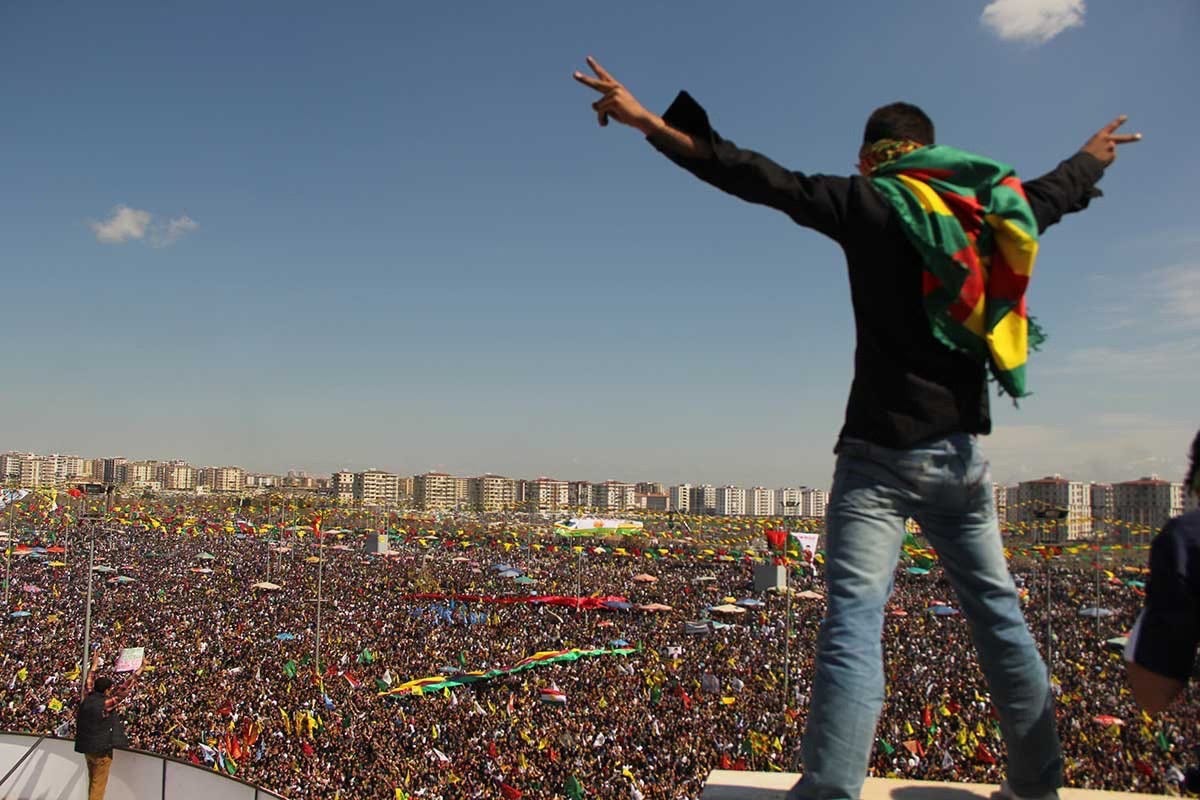
The Kurdish Mood After Rojava
For negotiations between the Turkish state and the Kurdish movement to progress, the emotional aftershock of Rojava’s contraction must be recognised.
In politically charged communities, the interpretive charity, yani the willingness to read what someone actually wrote rather than to verify which side they are on, has largely collapsed. When people are sufficiently certain of who their enemies are, they no longer read. They search for confirmation if you are among them. It is as old as the polis. So we move on. With those who listen, and for them.
I spent a tiresome week battling the label 'jihadi-lover' (meaning, apparently, a sympathiser of Ahmad al-Sharaa or his HTS, I don’t know) after publishing my field observations from Damascus and appearing on a YouTube politics programme to discuss them. A group who claim to follow my work on the Kurdish issue were deeply disappointed. Apparently my reporting from Syria had made me look like one.
How so? I asked with a genuine, if fleeting, hope that perhaps I had said something intellectually interesting. But no. The two pieces I wrote in which I said little about Ahmad al-Sharaa and much more about public life in Damascus led some Kurdish nationalists to conclude that I support al-Sharaa, that I disregard the massacre in Suweida, and that by noting the resentment toward the SDF’s former rule in Arab-majority cities such as Raqqa and Deir ez-Zor among almost everyone I spoke to in Damascus, I had somehow crossed a line.
The only substantive point I made about al-Sharaa on the programme was that he presents an intriguing jihadi portrait. His transformation represents a localised/downward scale shift within what was once a rigidly totalitarian ideology. More strikingly, he has openly expressed respect for the Egyptian Arab nationalist Gamal Abdel Nasser. Nasser remains a kind of litmus test for Islamists. During my doctoral fieldwork I interviewed many of them; very few showed any sympathy for Nasser.
One Twitter user who initially accused me of being a “Jolani-lover” later took pity on me, having seen how gobsmacked I was by the backlash. He offered what he thought was a useful warning: “Ezgi Hanım, you cannot read the rising nationalism among Kurds. Kurds are angry. Even Apoists are looking for somewhere to run. Choose your words carefully, otherwise you will hear things you cannot handle. Look at the comments under DEM Party MPs’ tweets. You’ll see.”
Apoists, yani followers of the imprisoned PKK leader Abdullah Öcalan, known by his nickname Apo, are the traditional bedrock of Kurdish political mobilisation. The DEM Party, the main Kurdish party in Turkey, is currently engaged in shuttle diplomacy between parliament and Öcalan himself. That even this constituency was unsettled told me something.
And I immediately recognised what that Twitter user was describing. Since the latest negotiation process began, colleagues who follow the Kurdish issue closely had been noticing them too : a group of activists based in Europe who defected from the ranks of PKK some years ago and have since built followings on Twitter, YouTube and, apparently, TikTok. They criticise Öcalan and the PKK leadership in Qandil in language that is, to put it generously, offensive.
One could, if inclined to optimism, interpret the gradual erosion of the cultish pedestal on which Öcalan has long stood as a sign of internal pluralisation, an opening toward a more contested and therefore potentially healthier political space. Falan filan.
Yes, that would be the charitable reading.
A less indulgent assessment would see not the emergence of deliberative plurality but something more like a creeping, entangling hostility. Akin to poisonous ivy spreading through the undergrowth, impeding any meaningful bargaining with a state authority, whether in Syria or in Turkey.
The senior PKK figure Remzi Kartal has also acknowledged these circles in a recent interview, describing them as activists who “advocate the classic nation-state concept of a ‘United Independent Kurdistan’, while a larger segment mobilises primarily around opposition to the PKK and Öcalan.” They attempt to wage a counter-campaign against the negotiation process in Turkey, he argued, but are not decisive within Kurdish politics or society.
Perhaps. But the atmosphere on social media is, like I said, poisonous, and I had not fully registered how deep and wide this anger now runs.
14 years ago this month, in February 2012, I had interviewed a prominent Kurdish politician at the start of tentative peace talks for my now-defunct liberal-left newspaper Radikal. Erdoğan was prime minister then and appeared determined to resolve the conflict, adopting at times a messianic, Blair-esque posture. He even claimed to have “drunk the poison hemlock”, signalling that he understood the political risks yet would proceed regardless. He did not, as I recount in my 2017 book Frontline Turkey.
The politician I spoke to was the late Şerafettin Elçi, who in 1979 had been imprisoned for more than two years simply for declaring in parliament: “Kurds exist, and I am Kurdish myself.” I found myself returning to that interview this week while navigating the anger of Kurdish activists scattered across the diaspora.
When I had asked Elçi back then whether he believed Turkey’s Kurdish conflict could be resolved, he had replied:
“My generation absolutely has to see it. Because it will not be possible to resolve this problem with the next generation. Those of us who have thought seriously about this issue have, one way or another, lived together with Turks. We have many friendships, social interactions, commercial ties.
“But there is also a generation born entirely into war, raised within the logic of war — a generation for whom the word ‘Turk’ signifies nothing but the gendarme, the police officer, the prosecutor who makes life harder. It is a very angry generation, filled with resentment and bitterness.
“For that reason, the state must set aside emotionalism and chauvinistic nationalism, and act rationally to resolve the issue with our generation as soon as possible. This is the last chance.”
Elçi’s foresight now seems extraordinary, doesn’t it. He argued that the most basic definition of a resolution would be to satisfy the Kurds while persuading the Turks: some form of autonomy for Kurdish-majority areas, the free use of Kurdish in public life, education in the Kurdish language.
More than a decade passed. Then Syria happened. Then Rojava happened. Everything shifted.
Öcalan’s model of democratic confederalism was partially realised in north-east Syria after the United States partnered with the PYD, the PKK’s Syrian offshoot, under the umbrella of the SDF to defeat ISIS. For a time, the experiment held.
Then the Assad regime fell, and Ahmad al-Sharaa’s HTS rose to power as the interim authority, moving swiftly to consolidate control over Syria’s fragmented territories and to impose a semblance of central command over a landscape long defined by competing militias and external patrons.
Over the course of the past year, the balance of power shifted markedly, as regional and international actors recalibrated their positions in light of the new configuration on the ground, most notably the United States and Israel.
Turkey, which for years had been determined to curtail Kurdish military autonomy along its southern border (and had already launched two major cross-border military campaigns to that end) intensified its diplomatic and strategic pressure in favour of an arrangement that would subsume Kurdish forces within a re-centralised Syrian state structure.
The most recent negotiations with Sharaa government over the integration of Kurdish forces and the future of the autonomous administration failed to deliver what Kurdish actors had hoped for. There are many reasons, some of which I explored in an earlier post. The Kurds lost control of Arab-majority cities and were left with Kobani and a reduced autonomous administration.
As Mazloum Abdi recently put it in a PBS interview, this may not have been the outcome Kurds envisioned, but it is the best available under current conditions.
He is likely correct. Yet, as we have all witnessed in one way or another, common sense struggles to assert itself in the present global climate. On the Kurdish question in particular, the space for measured judgment has narrowed considerably. This contraction reflects not only the angry Kurdish generation Şerafettin Elçi once described — those born into and shaped by the violence of the 1990s — but also the emotional shock produced by Rojava’s contraction. For many within the Kurdish movement, including its radical splinters, Rojava had come to occupy a near-symbolic status, invested with aspirations that exceeded its territorial boundaries.
We may design rational-actor models in academia to make sense of political change. In practice, most of us — all of us, really — are led by emotion far more often than we admit
If the Erdoğan government intends to pursue this negotiation process — improbably initiated and bizarrely pursued by the nationalist hawk Devlet Bahçeli — it will have to reckon with Kurdish emotions in the aftermath of Rojava's contraction. This is the accumulated weight of a generation raised in war, a political experiment lost, and a peace process that has already failed once.
Arrogance and underestimation would be grave miscalculations if the intention is genuine progress in this conflict.