

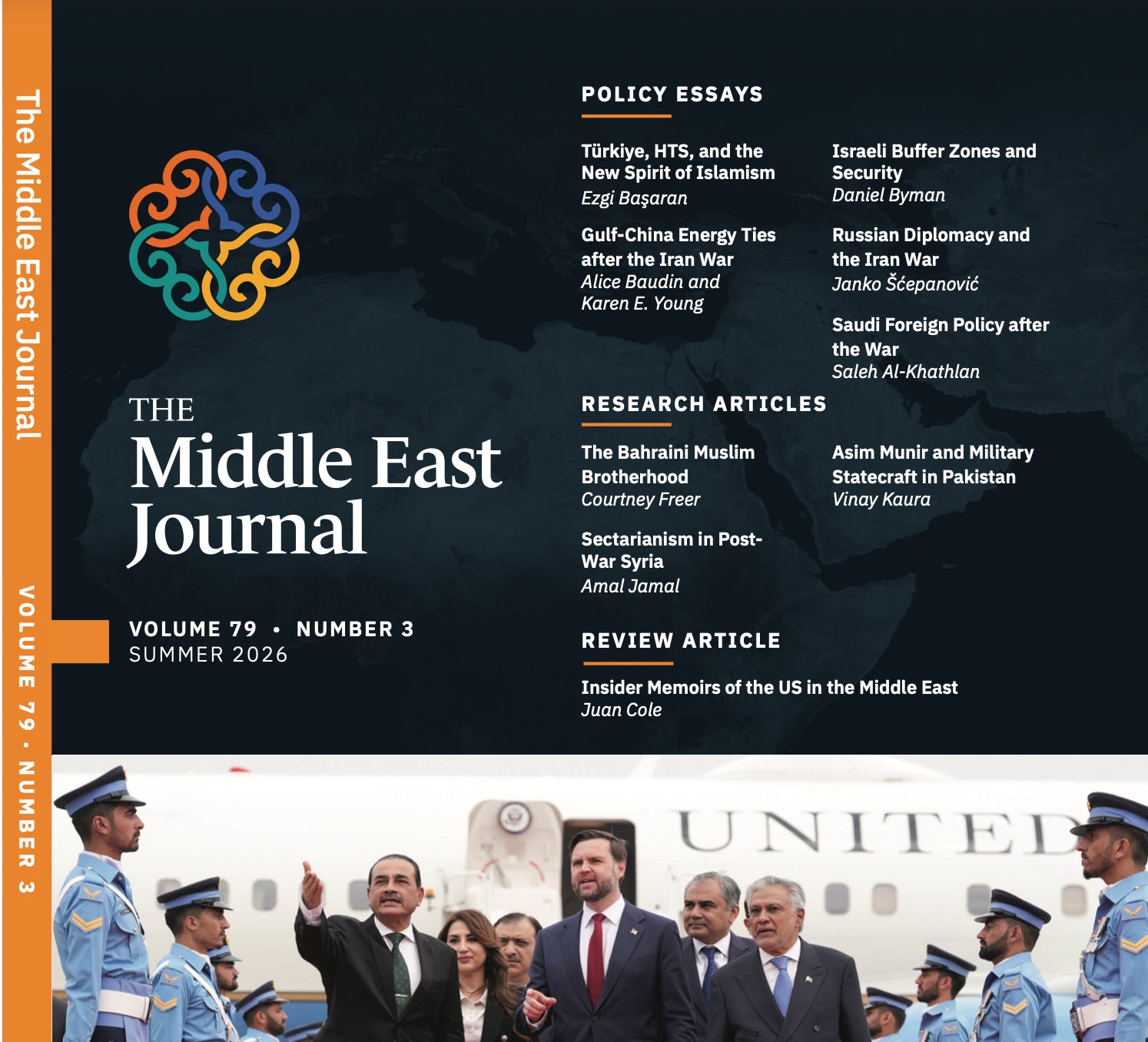
My long essay, “Türkiye, HTS, and the New Spirit of Islamism,” is out in the Summer 2026 issue of the Middle East Journal (MEJ). It is the fullest version I have put on paper of an argument I have been making for a few years now, in my 2024 book and across this column.
When Ahmed al-Sharaa, the former jihadist commander once known by his nom de guerre, al-Jolani, entered Damascus in December 2024 at the head of Hayat Tahrir al-Sham (HTS), and turned within months into a suited head of state, Türkiye was standing close behind him. Hakan Fidan, who ran Turkish intelligence for thirteen years before becoming foreign minister, had been in contact with al-Sharaa since 2019. İbrahim Kalın took over intelligence when Fidan left it. The first foreign minister to reach the new presidential palace was Fidan. The first intelligence chief to pray at the Umayyad Mosque was Kalın. The first gift to arrive was a suit from Vakko, Istanbul’s most established luxury house, and the photographs of the fighter remade as a statesman have been circulating ever since.
I read this as the third time Recep Tayyip Erdoğan’s party has tried to help build a legitimate Islamist government abroad, after the Muslim Brotherhood in Egypt and Ennahda in Tunisia. Between 2018 and 2021 I interviewed seventy people across the three movements (the MB, Ennahda and the AKP) to work out what actually passed between them. What travelled from Ankara was a method, a set of practical lessons and tactics in how to win, hold power, manage a crisis, and build a loyal Islamic business class that could bankroll the project and outlast the old regime’s networks. The Egyptian and Tunisian attempts collapsed, but they were shut down by force, by the 2013 coup in Cairo and by President Kais Saied’s dismantling of Tunisian democracy after 2021, rather than simply falling apart in office. Syria is the third act, with one difference that matters. The Brotherhood and Ennahda chose to learn from the AKP. HTS was pushed into Türkiye’s arms by the war itself and had rehearsed its transformation years earlier while governing the province of Idlib.
My larger claim also engages with a decade-old argument. The case that Islamism as an ideology has exhausted itself, argued forcefully by some scholars again this year, reads the electoral defeats, the policy failures, and the authoritarian turns as an ending. I read them as a change of form or a rearrangement of the main political concepts within the ideology’s core.
I believe what describes the transformation of Islamists’ goals and aspirations is a combination of post-Islamism with the forces of the market. Asef Bayat’s idea of post-Islamism describes what happens when Islamists, through long trial and error, take on the working idioms of the post-Cold War world, civil society, non-violence, and reform. Add to that a second component, that is, the ethos of neoliberalism and managerialism.
What I am pointing at is not new. It is a correlating and methodically similar process to capitalism, which keeps renewing itself era by era by absorbing its own critics. Islamist leaders started to behave as ‘CEOs of Islam.’ Why? Because that is how a political agent becomes ‘legitimate’. Concomitantly, what began as survival tactics hardened, under sustained pressure, into a structural condition. Across a considerable number of cases in the realm of Islamist entities, the pattern is one of crisis and transformation.
As a result, the Islamist movements, the AKP included, over decades, have shed their maximal demands and kept just enough of the core to stay recognisable, throwing off currents that accommodate and currents that refuse.
That is a rough summary of my essay. I want to give the rest of this column to two other essays in the same issue of the MEJ that I found genuinely interesting.
A Brotherhood That Works for the Palace
The first is Courtney Freer’s “The Myth of a Transnational Muslim Brotherhood: The Case of Bahrain.” A brilliant scholar, Freer studies Islamism in the Gulf and in this essay takes aim at a habit built into the think tank and policy circles, even seen in some part of academia. Because scholars learned the Muslim Brotherhood through its Egyptian mother branch, they came to treat the movement as one thing everywhere: a mass opposition that fights the status quo, mobilises society against the regimes, and belongs to a single transnational project run from Cairo. Israel and its think tanks in the US see great value in promoting this idea, which really explains half the reality.
Freer looks at Bahrain, where the Brotherhood is not the regime’s enemy but its instrument. Founded in the 1930s, tied by intermarriage to the Sunni merchant elite and even to the ruling Al Khalifa family, the Bahraini branch of the MB has spent its life inside the state rather than against it, staffing ministries, running the education sector, and serving as a Sunni counterweight the monarchy could deploy against the Shia majority that makes up most of the island’s population. Its candidate managed 73 votes in the 1973 election. This was never a movement built to win crowds but to be useful to the palace.
What Freer draws from that is a warning against explaining things through ideology where you should be considering local circumstances. The Bahraini and Egyptian Brotherhoods came from the same root and went opposite ways, one loyalist and one oppositional, because the ground under them differed, in sect, in oil, in the shape of the regime, and not because one betrayed a shared creed. Islamists, she argues, behave like any other political bloc. I totally agree with Freer. That is what I try to explain from another perspective in my book The New Spirit of Islamism actually.
Islamists borrow heavily from nationalism, and they take the shape of the place that made them. Inclusion does not tame them. They fall into line because loyalty is rewarded. Bahrain breaks from the palace only once, and the exception is revealing. When the government normalised relations with Israel through the 2020 Abraham Accords, the Brotherhood went into open opposition and stood alongside Shia and secular figures against that foreign policy. On everything a rentier bargain can buy, the Bahraini Brotherhood stays loyal. On Palestine it does not. Freer closes with a warning for the Western policymakers who keep hunting for a single Brotherhood conspiracy. Look at the national branches one at a time. A loyalist Islamist can be a partner rather than a threat, and the transnational monolith is something they have talked themselves into.
The Land Israel Took, and What It Costs
The second is Daniel Byman’s “Will Israel’s Buffer Zones Advance Its Security?” Byman, who works on counterterrorism at Georgetown and CSIS, examines the roughly one thousand square kilometres Israel has taken across Gaza, Lebanon, and Syria since October 2023 and asks the plain question of whether the territory actually buys the safety it promises. A buffer zone, the belt of controlled or emptied land a stronger state carves inside a weaker neighbour to keep attackers at arm’s length, does deliver real military goods. First, it slows infiltration, buys warning time, and pushes short-range rockets and anti-tank fire back out of reach of the towns behind it. Byman accepts all of that. His argument is that the same zones carry costs heavy enough to outweigh what they deliver. The zones demand permanent occupation, and troops who stop moving become targets, as a retired Israeli general he quotes points out. They displace enormous numbers of people, over a million in Lebanon alone. They tend to grow, and they harden, from Israel’s 1981 annexation of the Golan to a chief of staff already calling the Gaza “yellow line” a new border. The yellow line is the boundary Israeli forces pulled back to under the ceasefire that took effect in October 2025, the first stage of a phased withdrawal that still leaves them holding a little more than half of Gaza. And they hand the very militant groups they target a nationalist grievance to recruit on.
The comparison Byman leans on hardest is Israel’s own history, the security zone it held in south Lebanon from 1985 to 2000, remembered in Israeli parlance as “the Lebanese mud.” That zone stopped infiltration but produced a steady bleed of casualties, killed far more of Israel’s local proxies, failed to stop the longer-range rockets Hezbollah was getting from Iran, and gave the group a reason to fight that outlasted the occupation. According to Byman, the “buffer zone” in Syria is a mistake, and Israel should pull back to the pre-2024 line, because the al-Sharaa government is proving a usable counterterrorism partner and should not be undercut. Lebanon has more justification given Hezbollah’s continued attacks, but the zone risks the same blowback, so keep it small and monitor rather than depopulate, Byman says. The essay concludes that a buffer zone is a component of diplomacy and not a substitute for it, and that a zone with no stated exit condition is just an occupation.
To read these essays and more, here is the link.
Policy essays, including mine are all access whereas for the rest, you may need an institutional login.
Angle, Anchor, and Voice is taking a two-week break so that I can prepare for the next academic year, mark a few theses and inshallah read some books from my fiction pile. See you soon and take care. Best, Ezgi.
Religious indoctrintion aligned with the state's poltical outlook is manageable if worked in a certain equilibrium.
In most cases, it is a recipe for disaster, as pretexts take hold and extremism is established.