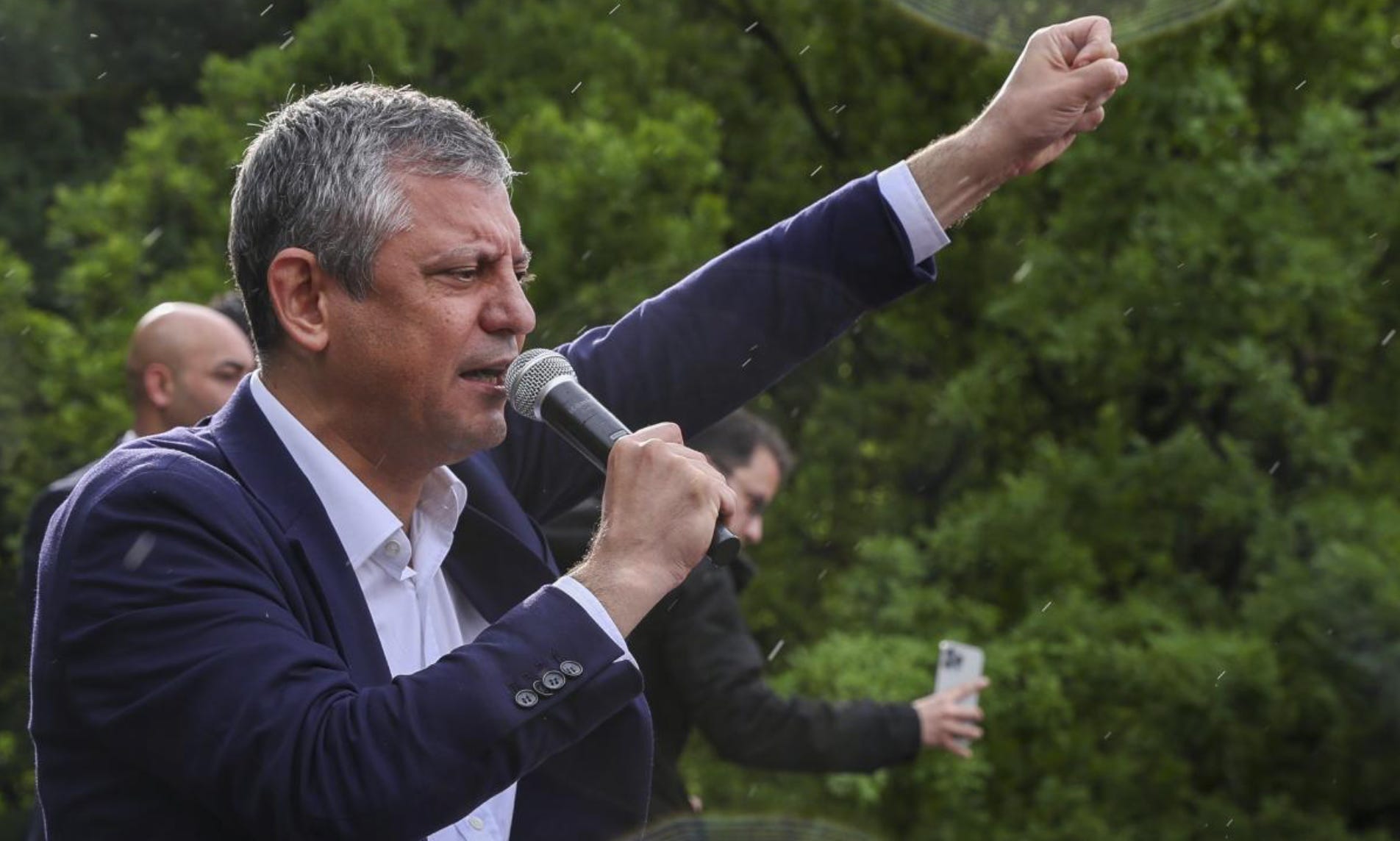
The Odysseus of Turkey's Opposition
Özgür Özel and his colleagues have left the party Atatürk founded to build a new one, one of the most consequential breakaways in Turkish political history. Will they be allowed a fair election?

Özgür Özel resigned from the Republican People’s Party on Friday together with 90 of his colleagues in parliament. A court had removed him from the party leadership in May and restored Kemal Kılıçdaroğlu, the man he had beaten in a party congress in 2023, to the post. The 91 filed the founding petition of a new party the same afternoon, the 103rd anniversary of the Treaty of Lausanne, which fixed the borders of the Turkish republic in 1923 and which the CHP has always treated as its own inheritance. The party is called Yeni Parti, the New Party. This is the largest single break in the history of Turkish party politics, and its consequences run well past the CHP.
It also mattered in many households whose CHP membership dates back generations. My late father-in-law was a devoted CHP member. I am glad that he did not see these days, when Kılıçdaroğlu worked as an accomplice to the Erdoğan regime and, for his own ambitions, derailed the CHP with a court order. My husband, who had worked for the CHP during his university years, also resigned with a heavy heart and a battered sense of purpose.
Do you know what the collapse of opposition movements or parties does to the resilience and the hope of ordinary citizens in authoritarian settings?
Well, we know, we the people of Turkey. That is why so many shoulder each other to keep the faith and support Özgür Özel, who fights with all his might no matter how arduous his undertaking is and how clear it is that the moment he and his movement look like they are winning, the regime will throw more obstacles at them. Because the regime can. Because the regime needs them to fail.
How it came to this
Let me recap for those who did not follow it closely.
In May an appeal court in Ankara ruled that the CHP’s 2023 ordinary congress, the one at which Özel took the leadership from Kemal Kılıçdaroğlu, had been void from the moment it opened, on the claim that delegates had been bought with money, jobs and promises of candidacy. Kılıçdaroğlu had led the party since 2010, lost every national election he contested, ran as the presidential candidate of a six-party opposition coalition in 2023 and lost that too, and had to be removed by a congress vote because he would not go on his own. The ruling wiped out that congress and everything the party had done since, including its statute and programme changes. Özel and the executive elected with him were suspended, and Kılıçdaroğlu and the organs he had headed before 2023 were put back in place.
Turkish courts have been removing politicians from office and closing parties since the multi-party system began, and the past two years have been an intensive stretch of it. Ekrem İmamoğlu, the mayor of Istanbul and the only opposition figure who polled ahead of Erdoğan, was detained in March 2025, days before he was to be confirmed as the CHP’s presidential candidate, and has been in prison ever since. The operations then spread from Istanbul to CHP municipalities across the country, and by the CHP’s own count more than two dozen of its mayors, elected in the local elections of March 2024 that the party won outright, are now in detention or removed from office. All of that is familiar. Banning parties, jailing candidates and seizing municipalities are the ordinary instruments of an elected government that has stopped being willing to lose.
Installing the loser of an internal leadership race at the head of the party he had lost is a different order of intervention. The mechanism itself is not unheard of, since civil courts have annulled the congresses of smaller parties before and handed them to trustee boards. What has not been done before is the use of that mechanism against the main opposition party, at national scale, at the moment its presidential candidate is in prison.
The state is no longer content to attack the opposition from the outside. It has started running it from the inside, deciding who leads the CHP, which of its congresses count, which version of its statute is in force, which of its governing bodies legally exists. Other elected strongmen have jailed rivals and banned parties. None of them has sat down and rebuilt an opposition party from its own paperwork upward. Turkey is where that is being tried first.
What the CHP lost in an afternoon
The transfer was not confined to people. With 91 deputies gone, the CHP dropped to forty-four seats and fell to fifth place in parliament, losing the position of main opposition for the first time in twenty-four years. It is an important loss, because the main opposition party has the right to ask the Constitutional Court to annul legislation. That power is the only instrument the main opposition actually holds against a government majority, and the CHP no longer holds it. The New Party takes the position instead, so the power has moved sideways rather than out of opposition hands, and it now depends on a party that will spend its first months proving it legally exists. Forty-four deputies remain with Kılıçdaroğlu, and by most accounts roughly half of them object to the manner in which he returned and want a congress as soon as one can be arranged.
The identity of the New Party

The CHP is the party that founded the republic. Atatürk built it, ran the country through it as a single-party state from the 1920s, and gave it the Six Arrows as its emblem, six principles that were also meant to be the principles of Turkey itself: republicanism, nationalism, populism, statism, secularism and reformism. Written into the party programme in 1931 and into the constitution in 1937, they stood for a republic in place of a monarchy, a nation in place of a religious community, a state that drove the economy, and above all a strict separation of religion from government.
For a century the CHP was the party of the state. It was the establishment party, close to the military and the security bureaucracy, the civilian arm of the Kemalist order that the generals took themselves to be protecting, and it stayed that way until the early 2010s, when it began, unevenly, to loosen that bond and reach toward the people the old party had treated as suspects. Its longest quarrels with itself run straight out of that history. Whether it can open its doors to religious conservatives without ceasing to be the party of secularism. And what to do about the Kurds, whose distinct identity the founding republic refused to recognise and whose demand for it the party has never decided whether to meet or to fear.
Özgür Özel’s movement and the New Party he founded made a claim on that inheritance in symbols. They chose 24 July as the founding day, the anniversary of the Treaty of Lausanne that fixed the republic’s borders in 1923. That let him claim the founding moment without having to defend the single-party CHP of 1931 or anything that came after. The day opened with Friday prayers at the Hacı Bayram Veli mosque in Ankara, which Özel tied not to religion but to 23 April 1920 and the opening of the First Assembly, so that a gesture to devout voters could be displayed as loyalty to Atatürk rather than argued as a change in the party’s relationship with Islam. From the mosque theywalked to that First Assembly building and were photographed there, inside the story of the war of independence.
The message of the whole day was that Özel now owns the CHP’s founding legacy, with one adjustment. The republic stays. The century of quarrels with the pious does not come with it.
I think the party’s name carries the same logic. Calling itself Yeni Parti, the New Party, it has placed itself nowhere on the left-right spectrum and pushed the question of where it stands to a congress in the autumn and to a programme stitched together in the meantime from the CHP’s 2025 platform and material drafted by the office of İmamoğlu, the jailed presidential candidate. Özel describes the target as the Türkiye İttifakı, yani the Turkey Alliance, a formula he first used before the 2024 municipal elections. It is meant to gather social democrats, nationalists, conservatives and Kurdish democrats under one roof, and the only entry test he names is having no quarrel with Atatürk and the republic. Which can be a tad bit problematic for the Kurds. But nevertheless.
Who is likely to vote for it
The obvious answer is the coalition that won the municipal elections in 2024, the secular urban middle class together with a substantial number of conservative and nationalist voters who moved on the cost of living and on a diffuse sense that the country is being run unfairly. Pensioners, wage earners, small tradesmen and the young are all inside that description, and Özel’s first statement after the founding addressed those categories in sequence.
Two parts of that coalition are less secure than the polling suggests. The Kurdish vote in the western cities went to the CHP tactically in 2024, and it is now attached to a negotiation between the Kurdish movement and the state that has its own timetable and its own incentives, so it cannot be assumed a second time. There is also a hard core of voters for whom the CHP emblem is the point, who will not mark a ballot without the Six Arrows on it. They are small in number but loud in public. But against those losses, I believe the New Party can reach voters the old one could not, because a party without a hundred years of accumulated grievance attached to its name is easier to vote for once, as an experiment, in a way the CHP never was.
What will be done to stop it

As I said above, Özel’s road is filled with obstacles. A nostos, either to reclaim the CHP or to rise to power as the New Party, though the harbour he is steering for is simply an election he is permitted to fight. An odyssey out of Homer, or out of Nolan’s version of it, which to my eye is less about the monsters than about what home turns out to be and what a man learns from looking hard at himself. But whichever version we are watching, we can be sure of the rest. Cyclopses, witches, sirens, distrust, doubt, and mutiny on his own ship.
The first obstacle is money. Under the Political Parties Law a party receives treasury funding on the basis of its vote in the last general election, with a threshold of 3 per cent, and a party that did not contest that election receives nothing however many deputies it holds. The CHP’s allocation for this year, a little over 1.8 billion lira, stays with Kılıçdaroğlu. Devlet Bahçeli, leader of the MHP and the AKP’s partner in the governing alliance, has helpfully observed that the money ought to be divided in proportion to the deputies who left. That would require a change in the law which his own alliance could pass in an afternoon and has not. With no treasury money, the New Party can raise funds only from private donations, and the law caps those at roughly 634,000 TRY per person a year.
The second instrument is the calendar, and it is the one that is most lethal. A party can contest a general election only if it has organised in at least half the provinces and in a third of the districts within each of them, and has held its founding congress, all of it completed six months before polling day. Until the amendment of March 2022 a party could qualify simply by having a group in parliament, and that door was closed four years ago. A snap election called this autumn would leave a party holding ninety-one seats unable to put a list on the ballot. This is why a reserve party with existing electoral qualification is being kept ready, and why the organisational work is being done at speed rather than carefully.
The third is prosecution. The immunity files are sitting in parliament and Özel’s own is among them, though the general view is that the government will not want the cost of removing him for now, which was also the general view about the congress case before 21 May. Ekrem İmamoğlu, the mayor of Istanbul, has been in prison since March 2025 and is being tried on three separate tracks, with the espionage case resuming in September, and the municipal investigations have continued steadily against mayors in Istanbul and beyond.
What the remnant CHP will do is a smaller question than it looks, in my opinion. It keeps the name, the emblem, the buildings, the membership rolls, the archive and the money, and it can go on describing the whole affair as a cleansing. Its capacity to damage the New Party lies mostly in electoral arithmetic, since a proportional system with an alliance threshold punishes duplication, and a CHP list running at 4 or 5 per cent in every province wastes votes that would otherwise be seats. Beyond that, Kılıçdaroğlu’s position inside his own building is not comfortable. Of the forty-four deputies who stayed, around half want a congress, some are willing to run candidates against him for group positions, and what they actually want is a leadership that neither he nor Özel would choose.
The prospect and hope
Whether Özel reaches port safely or not, we cannot predict. Set against him are all sorts of traps and perils. But let us remember…
There are still reasons for hope. The first is that this break from the CHP happened at all. The whole apparatus, the frozen funding, the rigged calendar, the waiting prosecutors, was built to make leaving unthinkable, so that no one would dare walk out and start again. 91 people walked out anyway.
The second is that there is considerable support for this new party. Under this much pressure a beaten movement usually falls apart This time people moved towards each other instead. Resigning with a heavy heart but resigning all the same because they party was wherever Özel was standing.
The third is Özel himself. He can count the odds better than anyone, he knows exactly what is waiting for him, and he has chosen to go regardless. That matters because a regime like this one does not only want to win. It wants the opposition to give up on its own, to decide the fight is pointless and go quiet. A man who refuses to despair is the one thing it cannot stand.
That is not a promise that Özel or his movement prevails. However, it is the refusal to accept that all has already lost matters the most. The monsters are real and they are waiting. But so is the shore. Vira Bismillah.


The tighter the tyrant squeezes, the more slips through their fingers. Very informative. I’m also surprised by the average age of the rebels in the photo, if this were the US they would definitely be younger.
Well done Ezgi hanim. Gives one hope at a time when we could use some