

Last week, I was writing about how sordid, sad and nauseating politics have become in Turkey, and elsewhere too.
A few days later, Francesca Albanese, the UN Special Rapporteur on the situation of human rights in the Palestinian territories occupied since 1967, who has been sanctioned by the United States and subjected to relentless attacks by Israel, came to Oxford. Students began queuing an hour before her talk. The line grew and grew, like a beanstalk towards humanity, spilling out of the auditorium, down the stairs leading to it, and all the way to the entrance of the Middle East Centre building.
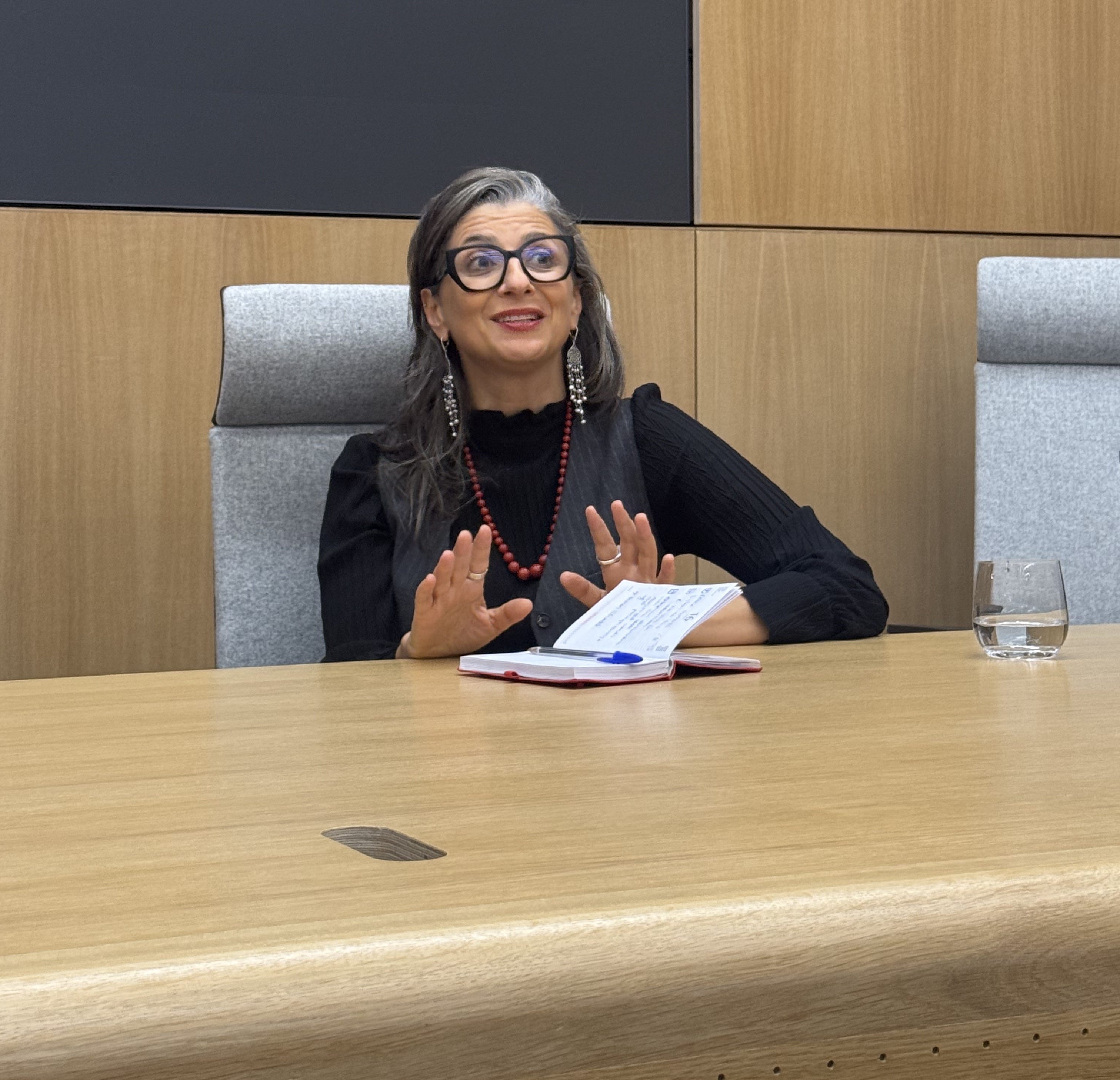
I have not seen such an outpouring of admiration and affection for a speaker at St Antony’s, Oxford’s most international, busy and public-facing college, in more than a decade. Perhaps Noura Erakat, the international lawyer and Palestinian activist, received a similarly warm reception a couple of years ago. At that talk, the Middle East Centre’s director, the historian Eugene Rogan, remarked that he had never seen such a crowd, perhaps only for Edward Said, whose lecture two decades earlier had drawn queues outside Oxford’s gigantic Examination Schools.
Now consider the thread connecting these crowds years apart and the scholars they had come to hear, all of whom have devoted their careers, and much of their lives, to explaining the injustices endured by the Palestinian people.
When Albanese entered the auditorium, perhaps only a quarter of those who had come to hear her had managed to get inside. I was one of the fortunate ones and witnessed the thunderous applause that greeted her as she stepped in with an almost bashful smile and repeatedly mouthing, “Thank you, thank you.”
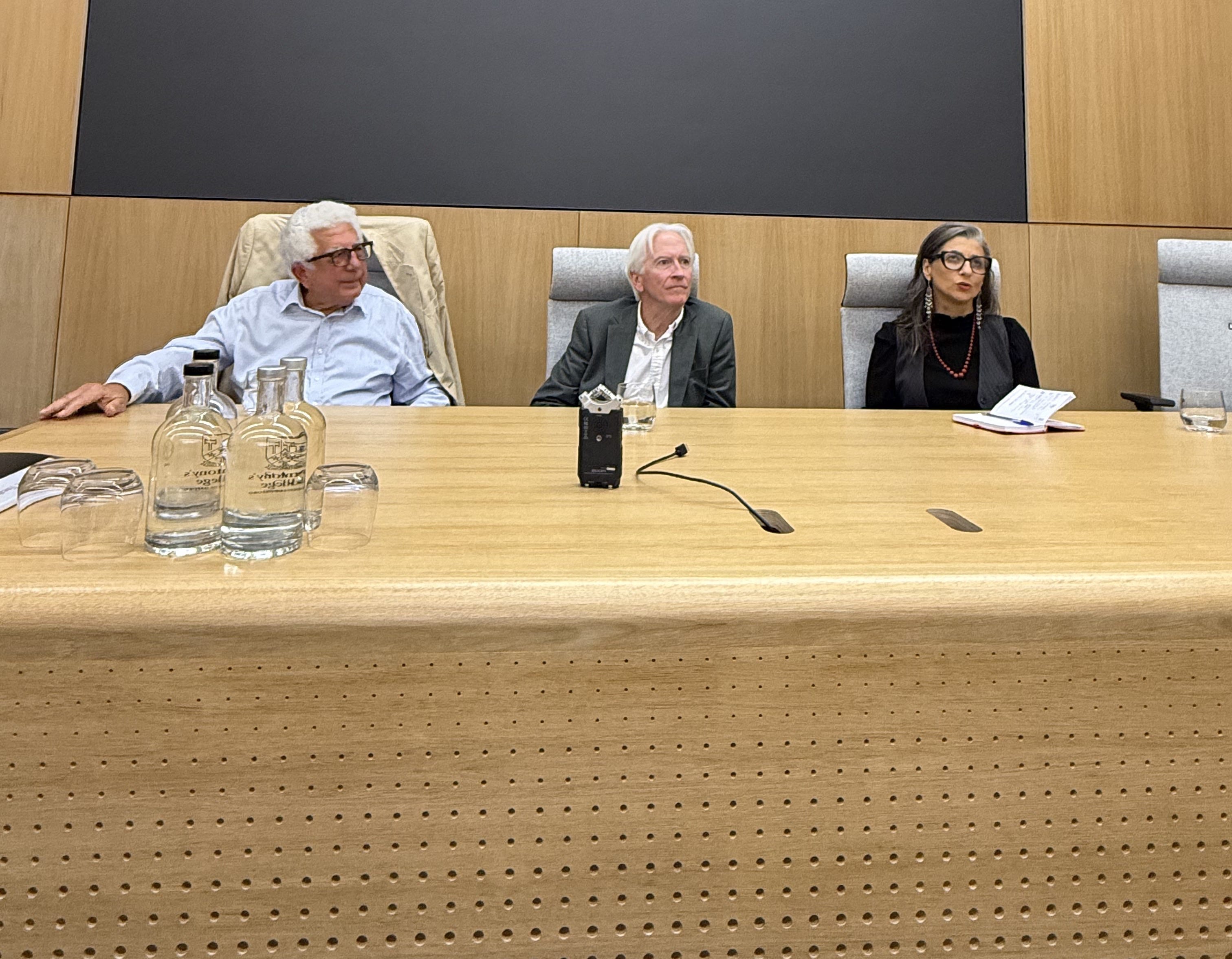
Another formidable advocate for the Palestinian cause, the Israeli-British historian Avi Shlaim accompanied her on stage. He began by recalling how extensively he had read the reports and commissions concerning the Arab-Israeli conflict, going back to the British Peel Commission of 1937. He praised Albanese’s characterisation of Israel as an apartheid state and the culmination of a settler-colonial project and above all, her civic courage.
Avi Shlaim recalled: “My wife Gwynne once said to me, ‘Francesca isn’t afraid to raise her head above the parapet,’ and I said to her, ‘Francesca never lowers her head below the parapet.’”
But no. This was not about courage, Albanese insisted. It was about decency.
The courageous ones were the journalists in Gaza facing mortal danger, such as Anas al-Sharif, and the parents risking their lives under fire to find food for their children.
For a European carrying the historical shame of the Holocaust, Albanese said, it was simply a matter of decency to make “never again” an imperative, even a life’s work, this time for the Palestinians.
“This is not my battle,” she said. “My battle would be with my husband at home. This is our battle. Humanity’s battle.”
She was neither performing false modesty nor reciting a carefully rehearsed script. It seemed genuinely to be how she understood her place in the world.
She recounted a recent dinner with a former colleague who had known her 20 years earlier, when she was starting her UN career. The colleague remarked that they would never have imagined her becoming the person she is today, because she used to be “so shy”, barely speaking even on critical issues.
I found this anecdote particularly revealing. It offered a glimpse into her earlier character, someone apparently neither drawn to the limelight nor consumed by her own importance.
“So they created a monster,” she joked.
A monster, perhaps, whose offence is to remind us of the moral obligations that come with being human.
Dogs Barking at Aeroplanes
Avi Shlaim had detailed Israel’s increasingly hostile relationship with the UN and international legal institutions since 7 October 2023. He recalled the attacks on UN Secretary-General António Guterres for stating that the attacks of 7 October “did not happen in a vacuum”. It was a modest and tad bit timid attempt to provide historical context but alas… It prompted Israel to demand for his resignation.
Shlaim also discussed the allegations Israel levelled against UNRWA, the UN agency for Palestinian refugees, which precipitated the suspension of funding by major donors and severely disrupted its work, alongside Israel’s sustained antagonism towards the International Criminal Court (ICC). And behind much of this stands the US, Israel’s indispensable patron.
Albanese has had more than her fair share of hostility from both governments. She described what she sees as concerted attempts by organisations, officials and media outlets to destroy her reputation, drawing on the Italian term mascariare, the deliberate soiling of someone’s name, literally ‘muddying’ someone. A technique associated with mafia-style intimidation, designed to discredit a person, isolate them and eventually silence them.
She argued that these attacks are especially vicious because she is a woman documenting a genocide.
There is, in other words, a gendered dimension to hasbara, the Hebrew term commonly used for Israeli public diplomacy and efforts to explain or defend the state’s policies internationally. In its more polemical usage, the term refers to propaganda intended to justify or obscure state violence. Albanese described male diplomats behaving with extraordinary rudeness towards because she first and foremost a woman who refuses to be schooled by those denying the genocide she has documented.
She also spoke of intimidation through personal information, of threats to destroy reputations, of smear campaigns and strategic lawsuits against public participation, known as SLAPPs, which use costly litigation to intimidate or silence critics. Together with lawfare, the deployment of legal processes as instruments of political pressure, these methods can exhaust even the most determined opponents.
And yet, she insisted, the experience had made her stronger.
If there was one word she wanted the young people in the auditorium to take away, it was perseverance.
She said she felt stronger now than at the beginning of her mandate, sustained by networks of solidarity and by the conviction that retreat was no longer possible.
As for those who spend their days trying to discredit her, she offered a wonderfully dismissive image: “Dogs barking at aeroplanes.”
The auditorium erupted in laughter.
Who Rules the World?
What makes Albanese so exceptional to many of us, and so intolerable to Israel, the United States and those at the commanding heights of global wealth and technological power, is that she does not confine her accusations to individual leaders and governments. She seeks to expose the system that has enabled the destruction of Gaza, armed its perpetrators and allowed powerful actors to profit from it.
Her argument is that the genocide in Gaza cannot be understood as an isolated atrocity. It belongs to a much larger structure of exploitation, militarism and impunity.
She identified several mutually reinforcing elements of that structure.
First, militarism. Israel, she argued, operates within a global political economy that profits from war, death and destruction. The United States, with its vast network of military installations across the world, is central to this order. Military power sustains political dominance, while the industries that equip it acquire an ever-greater stake in its perpetuation.
Second, predatory elitism and corruption. Albanese described a world in which the wealth of a tiny class of billionaires, corporate magnates and technological oligarchs rivals the economic resources of entire countries. Decisions affecting millions of people are increasingly shaped by private concentrations of wealth rather than democratic representation. Fossil-fuel extraction and financial systems that reward accumulation reinforce these hierarchies.
Third, the erosion of international legal norms. Albanese traced the contemporary assault on international law to the aftermath of 11 September 2001, when the United States normalised practices that had previously been recognised as grave violations of fundamental rights: torture, extraordinary rendition and indefinite detention. The expansive interpretation of self-defence advanced during the War on Terror weakened restraints on the use of force and established precedents that could be invoked by other states.
And finally, the colonial inheritance of the international order itself. The institutions of post-war multilateralism were established by states many of which still possessed colonial empires, and the assumptions of that era survived within institutions claiming universal principles. Even the early project of European integration accommodated the colonial possessions of its founding members.
Her conclusion was that the international system that was supposed to prevent such crimes has helped create the conditions in which they can be committed. In her account, Israel’s passage from decades of occupation and apartheid to genocide has depended on the military assistance, diplomatic protection and economic participation of other powerful states and corporations.
This, I think, is the most consequential part of Albanese’s work. It shifts the question from who is committing the violence, from Netanyahu et al. or Trump et al. to who makes that violence possible, who benefits from it, and why the institutions supposedly designed to restrain it have proved so ineffectual.
The Israelisation of Global Societies
Albanese also described a process she calls the Israelisation of societies. The diffusion of methods and technologies developed through Israel’s occupation and control of Palestinians into other societies around the world.
Surveillance systems, drones, biometric identification and technologies of data capture and population management are increasingly deployed against people deemed undesirable, dangerous or expendable.
Refugees are among the most obvious targets.
She spoke about what she had witnessed only weeks earlier on Italy’s southern frontier, including Lampedusa, where she said the technologies and equipment used to surveil and contain migrants had all been exported from Israel.
The danger, according to her analysis, is that techniques developed to administer an occupied population become models for governing other populations. What is first tolerated at the periphery eventually finds its way into the political centre.
The multilateral order is crumbling. Younger generations will inherit the consequences: accelerating climate breakdown, militarised borders, diminishing democratic accountability and political systems increasingly beholden to elites - oligarchs- whose private fortunes exceed the annual economic output of entire nations.
And this brings me back to the young people queuing outside the Middle East Centre at St Antony’s.
I had spent the previous week writing about the debasement of politics, the venality of those in power and the exhaustion that comes from watching impunity become ordinary. Then I found myself surrounded by young people who had come to listen to a civil servant speaking about international law, complicity, decency and perseverance.
They had come to hear someone insist that the powerful can be held accountable, that moral obligations still exist, and that the institutions created to protect human beings must be made to answer for their failures.
I do not want to romanticise a queue of Oxford students or mistake the enthusiasm of an auditorium for the prospect of political change. None of the structures Albanese described will be dismantled by applause. Sure, I know. Or by the moral clarity of a single speaker. But moral clarity can be contagious and creeps in. Also, the extraordinary turnout revealed something that the daily parade of political cynicism can make easy to forget… The fact that there are young people who are paying attention, who recognise injustice beyond their own borders and who are willing to listen to arguments about their own societies’ complicity in it.
As you know I closed last week wondering how much further politics could descend into moral squalor. I began this week thinking about Albanese’s insistence that decency is an obligation rather than an extraordinary virtue. The despair I felt last week was about the people who hold power. The line at St Antony’s Middle East Centre was made up of the people who will one day, inshallah, replace them.
Francesca’s Advice to the Youth
Almost every question from the young people in the audience was a call to action. What can we do, Francesca? How should we act when supporting Palestine and denouncing genocide are increasingly being criminalised? How do we resist intimidation, especially when even words such as intifada are treated as grounds for suspicion?
Albanese told them that the system’s reaction was to be expected. Precisely because those in power could see the growing awareness and political awakening of a younger generation. It is they, she argued, who are paying the price for the myopic, sometimes absurd decisions of people born in the previous century. They will not enjoy the same luxuries or comforting platitudes that her generation could afford. They will have to take bolder steps, stick together, think together and resist the divisions and isolation that make intimidation so effective.
Here is a list of practical steps she recommended:
Boycott, divest and sanction. Follow the guidelines of the Boycott, Divestment and Sanctions (BDS) movement. Examine where your money goes, from banks and insurance companies to pension funds, businesses and travel services, and withdraw support from institutions complicit in violations of Palestinian rights. Use the power of your pocket, and help build economic alternatives.
Demand an arms embargo. Make stopping arms transfers to Israel a central political demand. Without interrupting the supply of weapons, expressions of concern and condemnation will remain largely ineffectual.
Use your privilege to protect others. Those who enjoy greater security, particularly in Western societies, have a responsibility to stand alongside and help shield people who face greater risks of repression, including those of Arab descent who are especially vulnerable to discrimination and intimidation.
Keep mobilising. Continue protesting, organising and exerting public pressure. Political change rarely follows a single demonstration; it requires sustained civic engagement and collective action.
Defend the law and its institutions. Support legal assistance, including pro bono representation, for those subjected to anti-Palestinian racism or penalised for lawful political expression. Defend the International Criminal Court, the United Nations and other international institutions against attempts to weaken or delegitimise them.
Persevere, and do not allow yourself to be isolated. Smear campaigns, legal intimidation, doxxing and reputational attacks are designed to make individuals feel alone and powerless. Seek solidarity, trust your peers, organise collectively and refuse to let fear determine the limits of your political participation.
The recurring message was solidarity, organisation and perseverance. Albanese reminded them that the stakes extended beyond Palestine and beyond their own lifetimes. They would inherit the consequences of decisions taken by a political generation that had treated the planet, international law and human lives with extraordinary recklessness. Their responsibility was also to those who had yet to be born.
For me it was reassuring to see those young wanted to know what responsibility required of them. Also how to discharge it in a world increasingly hostile to dissent. Albanese offered no promise of easy victories. She asked them to organise, to protect one another and to persevere. Frankly for a generation being handed the consequences of so many political and moral failures, that may be the most useful advice of all.
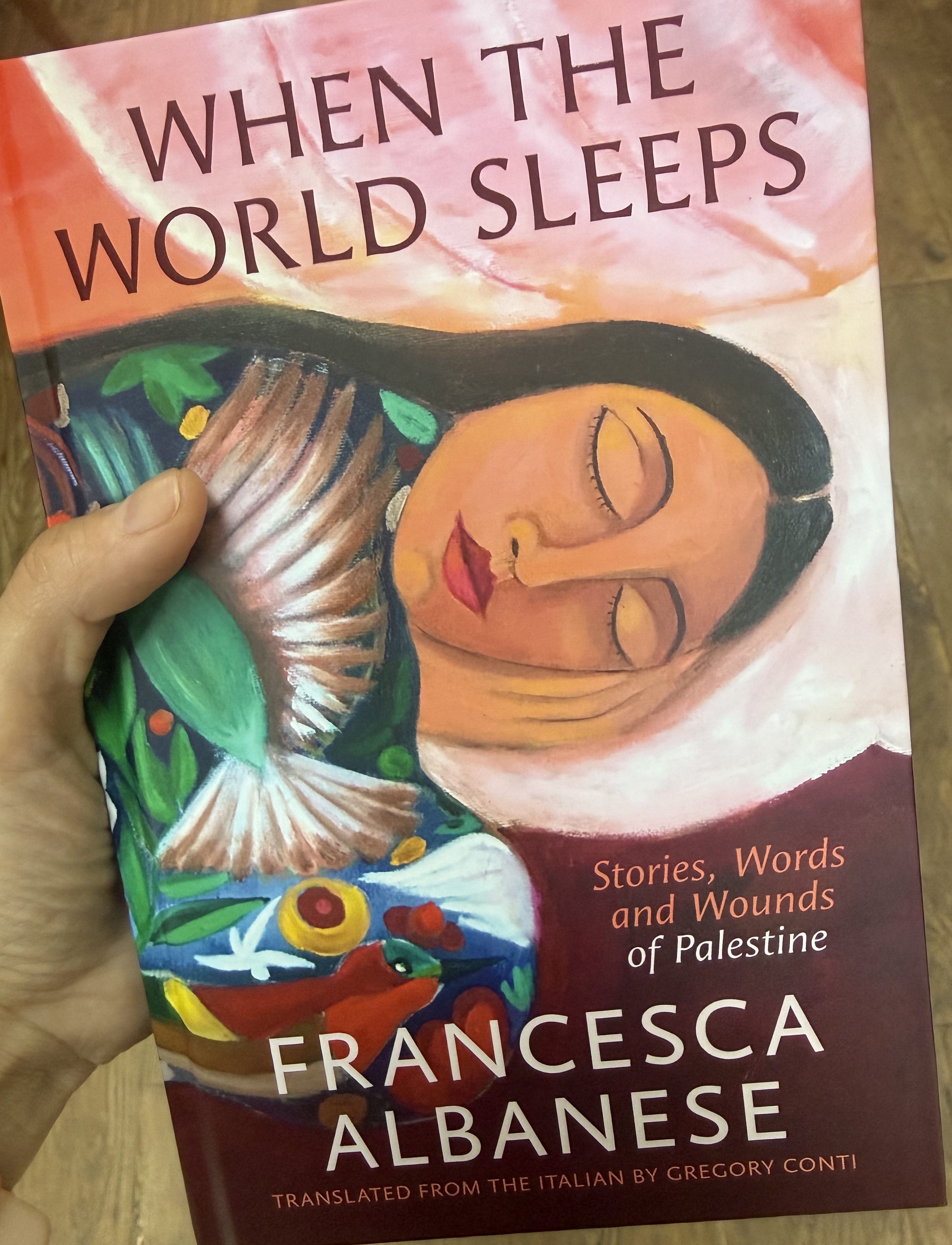
For Francesca Albanese’s books here is the link. You can find her reports on the UN website. Here is a link to one of her most foundational reports, Anatomy of a Genocide, published in July 2024.
Superb article!
Uplifting to read, thank you for sharing your report on this!