The Uses of Unreality: Gaza + The idea of a Jewish Homeland and the objection of Britain's only Jewish minister
Ceasefires, committees, and boards proliferate around Gaza. The gap between material conditions and the political fantasy surrounding them continues to widen.
We are in a period in which we are asked to doubt what we see with our eyes, hear with our ears, and feel in our hearts.
We witness a murder carried out by a state official, and are told by senior ministers that it was an act of self-defence against a man - an emergency nurse- lying flat on the floor. We saw this in Minnesota.
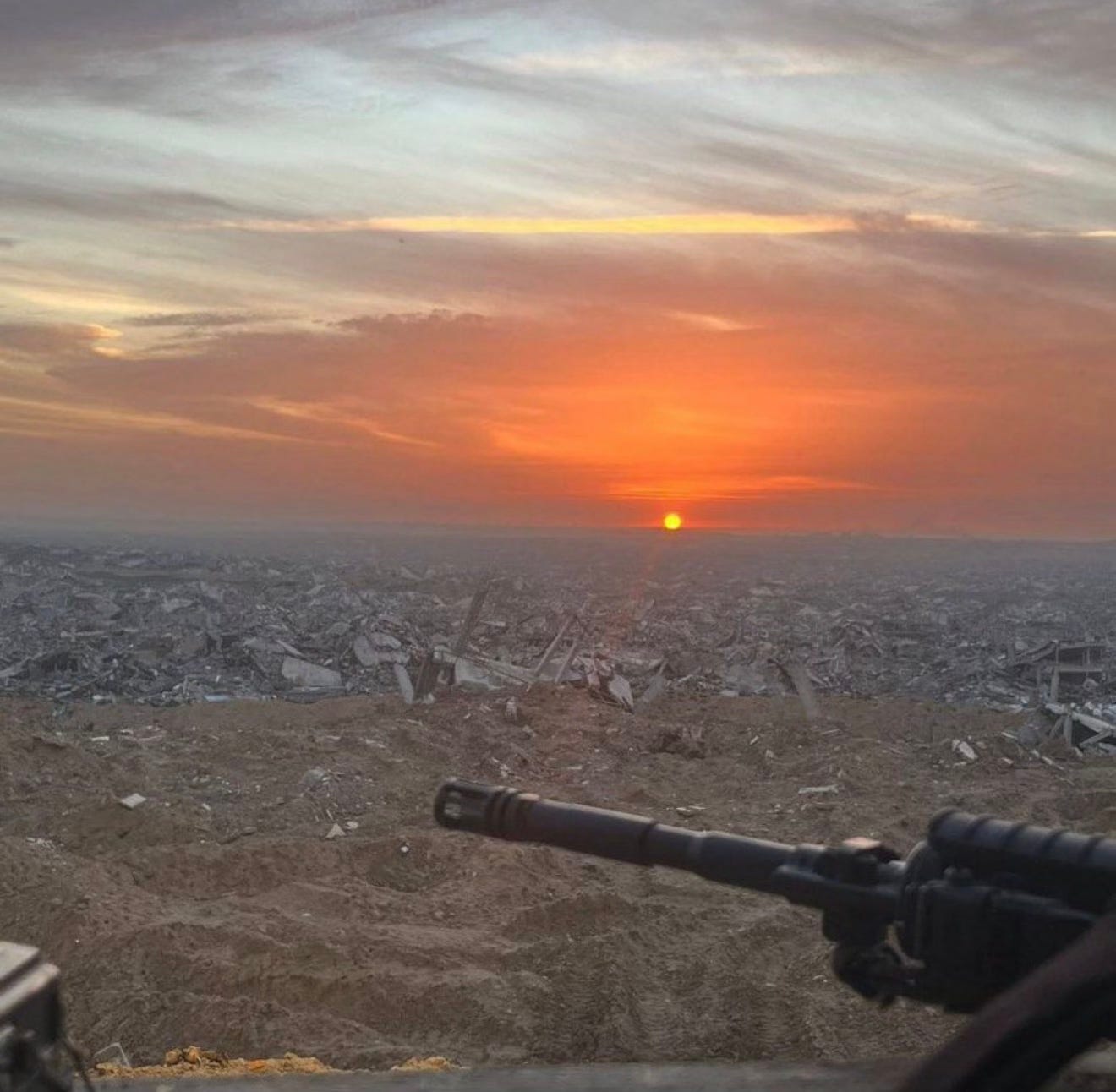
This is a time lifted straight from the canon of political dystopias. A time of euphemisms pushed to the edge of absurdity, to the point where we seriously begin to question our own sanity. We have been seeing this in Gaza.
We are told there is a ceasefire, and yet we continue to hear otherwise.
For the past two and a half years we have been systematically gaslighted by Israeli officials and IDF spokespersons. We were instructed not to trust figures or narratives coming from Gazan authorities. We were told it was not a genocide. There was no famine. It was a hoax. We were even told, astonishingly, that there were “chubby mothers” who were simply choosing not to feed their babies or even ‘eating their babies’. Yes, these were actually claimed in Israeli media. We were told the death toll was inflated.
Last week, however, Israel admitted that the death figures released by the Gaza Health Ministry were accurate. I suspect this was a slip rather than a considered confession. A senior Israeli official misspoke, and for a brief moment the truth surfaced.
As I briefly outlined during my presentation at the Gaza Tribunal in Sarajevo last year, any narrative emerging from Gaza has been treated as suspect, while statements issued by Israeli officials have been granted automatic factual authority.
All testimonies and presentations from the Gaza Tribunal are now available in digital form. They are essential reading if one wants to keep the record straight. Its final verdict, which builds upon oral and written testimony, expert evidence, and months of research and analytical work, also reminds us of a crucial fact: the genocide continues.
There may be less bombing, but there are still deaths, abuse, hunger, illness, and displacement every day. The scale of destruction remains overwhelming. Around ninety per cent of housing has been damaged or destroyed. Roughly seventy per cent of infrastructure no longer functions. Almost all schools are unusable. Fewer than half of hospitals are operating, many only barely. Sanitation systems have collapsed, wastewater networks are broken, and winter flooding has turned parts of Gaza into a public health hazard that will linger long after the fighting stops.
Meanwhile, in a parallel universe shaped by American real-estate logic and Western colonial reflexes, the arrival of “Phase Two” of Trump’s plan was announced.
In late January, the United States declared the creation of a National Committee for the Administration of Gaza, a supposedly technocratic Palestinian body meant to oversee daily governance. On paper, this looks like progress. In practice, almost everything that would make it viable remains undefined.
This so-called technocratic committee reportedly consists of fifteen members from Gaza and is led by Ali Shat, a former Palestinian Authority minister with close ties to Ramallah. Members based outside Gaza have been unable to enter since their appointment, which already tells us something about the limits of this arrangement. Israel continues to insist on “no Hamas, no Abbas,” and the committee’s relationship with the Palestinian Authority is deliberately opaque.
What is this committee expected to do? Mundane but essential tasks: utilities, rubbish collection, education, basic services. In reality, Gaza’s devastation is so extensive that restoring even minimal functionality would require thousands of staff, layered administrative structures, and sustained funding. None of this exists. The committee itself sits low in a broader hierarchy, overseen by a Gaza Executive Board and, above that, a newly created Board of Peace whose logo looks very much like UN’s but in gold.
It is at this point that the whole project turns surreal. The Board of Peace borrows the language of UN conflict-management mechanisms but is firmly centred on American authority which last week authorised four arms sales to Israel totalling around 6 billion dollars!
The US president chairs this Board, controls appointments, and decides renewals. There is also a provision allowing states to purchase indefinite membership with a one-billion-dollar contribution. A what? Like, seriously? Excuse my Turkish, but this is precisely where one says: bu kadarına da oha!
Then there is Rafah. The crossing has partially reopened, but only for limited pedestrian movement. A dozen people were allowed to pass. This is not only symbolically hollow for Palestinians hoping to return home; it does nothing to alter Gaza’s humanitarian reality. Rafah cannot handle goods at the scale of Kerem Shalom. Egypt and other regional actors have insisted that any reopening must be bidirectional, to avoid the appearance of a one-way exit or forced displacement. Who will control the crossing on the Gaza side, now or later, remains unclear, despite earlier commitments.
What stands out most is how far announcements have raced ahead of reality, and how likely they are to remain there given this mindset. Claims that Gaza can be meaningfully rebuilt within three years, a favourite assertion of Jared Kushner and his fellow real-estate visionaries, sit uneasily with UN estimates suggesting that rubble clearance and demining alone could take seven. On-the-ground assessments point to around 7 years under right conditions. The UN estimates that Gaza is buried under 61 million tonnes of rubble as a result of Israel’s destruction. 61 million! Tonnes!
We cannot even agree on how to describe what is happening. With falsehoods issued from the highest levels of power, we are left ontologically and epistemologically lost.
As promised earlier, I have prepared the post below on the Balfour Declaration. Over the past couple of years, I have realised how few people actually know what the Balfour Declaration was, how it facilitated the mass migration of European Jews, and how it contributed to the displacement of the indigenous Palestinian population at the end of the First World War. Even fewer know about the only British cabinet minister at the time who was Jewish, and his opposition to the idea of a Jewish state.
So here it is. Do share liberally.


