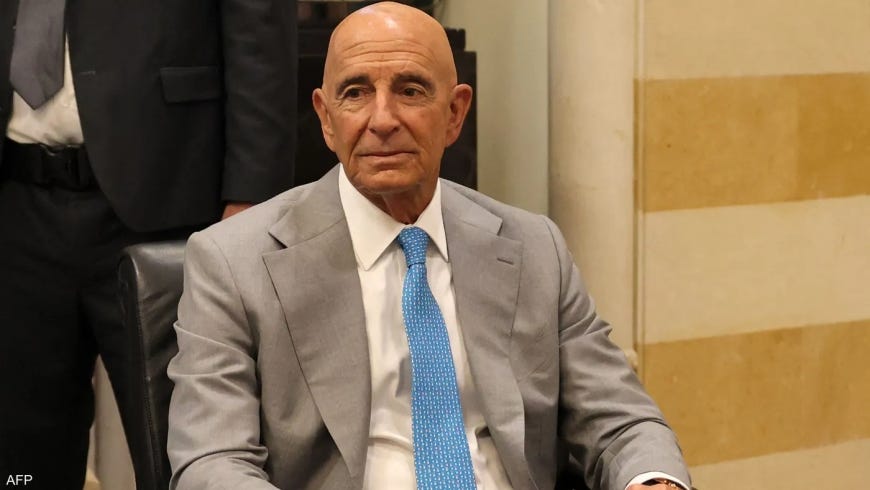
Tom Barrack, Great Unifier(!)
He has done what no summit or peace plan could. Turks, Kurds and Arabs now agree on something.
What, in these times, could possibly have brought Turks, Kurds and Arabs into rare agreement?
There is a kind of achievement that eludes negotiators, summits and the whole machinery of regional diplomacy, and Tom Barrack has managed it without appearing to try. The peoples of the region agree on very little, and have spent the better part of a century disagreeing violently. They now hold one thing in common. They cannot stand him.
Oh, the extent of the contempt. Scroll the replies piled beneath any of his posts, if you can spare the time, and you will find dislike in all its variations.
Wallahi maşallah to Barrack. After decades in real estate, he has turned what may prove a brief diplomatic stint into the kind of achievement many diplomats never manage in a lifetime.
Barrack, a Lebanese-American property billionaire, a friend and fundraiser of Donald Trump, and since last year the US ambassador to Turkey and the president’s envoy to Syria, had his brief widened again on 1 June. In a Truth Social post written in the familiar register of personal favour, Trump named him Special Presidential Envoy to Iraq as well, on top of Syria, while keeping him in Ankara and, the president added, with the full backing of the State Department. The appointment formalised something already visible in practice. Barrack is now Washington’s broker across the northern tier of the Middle East, where Turkey, Syria and Iraq are increasingly treated as one connected field, to be arranged from a single desk.
In a post marking the new role, he set the doctrine out in his own words.
‘In the tradition of those who have long studied the Levant and Anatolia — Iraq, Syria, and Turkey remain the strategic fulcrum upon which any enduring Middle East stability must pivot. Balancing these three nations requires a single, consistent point of American contact and leverage — transcending tribal, religious, or sectarian differences ... weaving its disparate threads into one coherent tapestry of order and mutual interest.’
That is the spine of the whole controversy. Every group that has dealt with Barrack has heard a version of it, and every one of them has recoiled.
The Barrack Doctrine
The post is only the latest in a long line, and to see why it lands as it does, it helps to know how Barrack talks about the region when he relaxes. ‘There is no Middle East. There are tribes and villages,’ he told reporters last September, explaining that the modern states were lines drawn by Britain and France after 1916. He returns often to Sykes-Picot, the secret 1916 accord by which the two powers carved Ottoman lands into spheres and mandates, and to the Ottoman millet system, the arrangement under which religious communities ran their own affairs with limited autonomy, what the sociologist Karen Barkey calls the empire’s system of diversity management.1
He may have private reasons for the nostalgia, I don’t know. His family came from Zahlé, in what was Ottoman Syria before the new borders made it Lebanon. The worldview is coherent, and it is old. It treats the peoples of the region as communities to be balanced from above rather than as citizens of sovereign states, and it casts the American envoy as the balancing hand. Each faction that has met him has caught that note, and each has heard it strike a different historical wound.
The Kurds heard abandonment. For a decade the Syrian Kurds, organised in the Syrian Democratic Forces (SDF), were Washington’s most effective partner against Islamic State, and they buried thousands for it. On 20 January Barrack announced on X that the group’s original purpose as the main anti-ISIS force had largely expired, and that Damascus was now both willing and able to take over security in the northeast. That Damascus is governed by Ahmed al-Sharaa, a former jihadist commander once on the American wanted list, installed after the fall of Bashar al-Assad and backed throughout by Turkey. Barrack pressed the SDF to fold itself into al-Sharaa’s new army, and when American diplomats on the Syria desk resisted, three of them were reassigned. Mazloum Abdi, the SDF commander, accepted a ceasefire announced on television, travelled to Damascus, and, by one Syrian researcher’s account, found a different document waiting for him and concluded he had been deceived. Barrack called the eventual deal a profound and historic milestone of reconciliation, unity and enduring stability. The Kurds called it what their grandparents would have called it: Betrayal.
The Arabs heard the colonial officer. In August, at the presidential palace in Baabda outside Beirut, fresh from a meeting with President Joseph Aoun about disarming the Iran-backed Hezbollah, Barrack lost patience with Lebanese journalists calling out questions over one another. He told them to be quiet, warned that the moment things turned ‘animalistic’ he would walk out, and instructed them to act civilised, kind and tolerant, ‘because this is the problem with what’s happening in the region.’ He then asked, on camera, whether it was economically worth his while and his deputy’s to sit there ‘putting up with this insanity.’ It was bad. So bad.
The Union of Journalists in Lebanon called it an expression of ingrained colonial arrogance. He refused to apologise, dropped his planned visits to the south, and offered only a grudging clarification days later. A man informing the people of Beirut that their incivility explains their wars, a hundred years after the French arrived to civilise them, needs no gloss.
The Turks Hear Sèvres
The Turks heard 1920. The reaction looks disproportionate until you know its origin. Modern Turkey was forged against the Treaty of Sèvres of 1920, the post-war settlement that would have partitioned Anatolia among the Allies, the Greeks, the Armenians and an autonomous Kurdistan, and against the war of independence that tore that treaty up. The conviction that foreign powers are forever conspiring to revive Sèvres and break the country apart is so durable that Turkish political scientists have a name for it, the Sèvres syndrome, and very little is needed to set it off. Barrack sets it off repeatedly, simply by being himself. Last summer, in an interview with Turkey’s state news agency, he praised the millet system as an arrangement with lessons for the present, and the opposition heard a proposal to dissolve the unitary nation state into religious compartments, to ‘Lebanonise’ Turkey, as I wrote at the time. His latest statement, seating Turkey in the same breath as Syria and Iraq and casting all three as a single field to be balanced above tribe, religion and sect, landed worse still. One Turkish commentator wrote that he approaches the country like a late-nineteenth-century orientalist, as though the intervening hundred years had not occurred.
Another objection came from a retired brigadier general who once served at NATO’s command in Naples. His complaint was with the flattery rather than the threat. Where Greek and Israeli commentators read Barrack’s post as proof that Turkey’s influence was widening, he argues the reverse, that the praise conceals a trap. To tell a country that its natural place is the Middle East is to confine it there. Behind the pattern, according to him, lies a single concern, the security of Israel. Iraq’s Shia turn, Assad’s fall and a Damascus that cannot align with Tehran, and now the drawing-in of Turkey, all of it belongs, he contends, to one design, with the Abraham Accords part of the same architecture. The calculation, he writes, is still that of Sykes-Picot. Barrack denounces the borders of 1916 while assembling their successor, and the part reserved for Turkey, on this reading, is to be one thread in someone else’s carpet.
The sharpest response came from Özgür Özel, leader of the main opposition Republican People’s Party, the CHP, the party Atatürk founded. In April, after Barrack told the Antalya Diplomacy Forum that the systems that had endured in the Middle East were the strong-handed ones, benevolent monarchies and monarchical republics, while the states pushed toward democracy and human rights had simply evaporated, Özel declared him persona non grata for Turkish democracy and accused him of coming to the republic of Mustafa Kemal to disparage democracy and flatter monarchy.
That exchange has gained a sharper edge from what then happened to Özel. As I wrote last week, an Ankara court ousted him as chair of his party and reinstated his predecessor, Kemal Kılıçdaroğlu, whom Özel’s supporters accuse of making common cause with the government, as caretaker leader pending appeal, a textbook case of an authoritarian government turning the courts against its opponents. Ekrem İmamoğlu, the elected mayor of Istanbul and the opposition’s likely candidate against Erdoğan in the next presidential election, if there is one, follows the argument from prison.
Raison d’état Returns
The quarrel that has since broken out inside the opposition over how to read all this leads straight back to Barrack. A veteran of the party and a close associate of Kılıçdaroğlu for decades gave an interview suggesting that a ‘devlet aklı’, a reason of state or precisely ‘raison d’etat’, by which he meant the collective judgement of the security, finance and intelligence bureaucracy, was quietly preparing for the turbulence it expects once Erdoğan is gone. He reached for a historical analogy.
‘During the First World War, in the final years of the Ottoman Empire, there were three main forms of politics: Islamism, Westernism and nationalism ... The state mind of the time, the Committee of Union and Progress(CUP), brought these together, entered into a struggle, and then the Republic of Turkey emerged. I see something similar now ... There is nationalism in it, a form of state nationalism, and there is also Westernism.’
Özel heard in this the voice of the thing he had been fighting. This kind of state thinking, he said, ‘grants legitimacy to the deep state and describes a regime of the kind Tom Barrack has outlined, then seeks a role within it. They are describing a monarchy. It is a historical misfortune.’ He was reaching back for the older name for that unaccountable apparatus, the deep state of the Gladio years, the Cold War counter-guerrilla network first exposed in the 1970s and revived in the dirty war of the 1990s.
One powerful strand of scholarship on modern Turkey gives that apparatus a longer genealogy. It argues that the apparent succession of doctrines, Unionism, Kemalism, Turkism, the Turkish-Islamic synthesis and political Islam, has often concealed a more durable ideology of the state.2 Its lineage runs from the CUP’s ascent after 1908 through the republic and into the Erdoğan years. Its two central tenets are the supremacy of the state over the society it governs and the policing of who is allowed to belong to the nation. Its recurring method, especially in moments presented as emergency, is to bind an internal enemy to an external patron and name the result a fifth column. Armenians were cast in that role, then Greeks, communists, at times Alevis, and now Kurds, increasingly described as clients of the United States or Israel. The deep state Özel invokes is the clandestine face of this apparatus. Devlet aklı is its self-description. To hear a senior figure of the republican opposition describe that apparatus as something preparing, almost benignly, for the post-Erdoğan order, and to reach back to the CUP for the analogy, is to see why Özel was alarmed.
Much of the Turkish reaction over Barrack assumes that the danger to the republic comes from outside, from an American envoy with a nineteenth-century map and a taste for benevolent sultans. The quarrel inside the opposition points to something else.
The opposition points to reports that Trump was told of the move against İmamoğlu before the mayor’s arrest and raised no objection. Whether or not this proves coordination, set beside Barrack’s remarks, it has hardened a conviction on the opposition benches that Washington’s design for a new Middle East is being enacted inside Turkey. By dismantling the only force capable of beating Erdoğan at the ballot box. In part by reshaping the CHP, the party that founded the republic.
And so the rare consensus holds. Turks, Kurds and Arabs agree that Barrack is the wrong man, dispatched by an erratic and narcissistic president, with the wrong century lodged in his head. They are right, in my honest opinion.
What they have not settled is where to aim their anger, at the envoy and his map, or at the domestic machinery of state power he flatters across Turkey, Lebanon, Syria and Iraq. Until they do, the man with the wrong century in his head keeps winning, along with the strongmen whose company he seems to enjoy.
The Kurdish Process After the Latest Turmoil
Last week, I was interviewed by Amargi, an online magazine that focuses on the Kurdish issue and rights in the Middle East. I tried to analyse the process between the PKK, its imprisoned leader Abdullah Öcalan, the Kurdish DEM Party and the Turkish state. The process, which culminated in the PKK’s announcement that it would not only lay down arms against Turkey but also disband, heeding Öcalan’s call, has been spearheaded by Turkey’s nationalist leader Devlet Bahçeli. Elif Sarıcan from Amargi and I talked about Bahçeli’s latest intervention, what it means for Erdoğan, the latest attack on the CHP, and how all this might shape the process with the Kurds.
My three points were:
First, Devlet Bahçeli is no ordinary nationalist commentator on the Kurdish issue. He is the leader of the Nationalist Movement Party (MHP), Erdoğan’s indispensable coalition partner, and the man who has become the public face of this new process. His latest intervention is therefore not just an opinion piece. It is an attempt to give the process an institutional shape. He proposes a central mechanism for dissolution and disarmament of the PKK, with Abdullah Öcalan as its sole coordinator, but the framework is tightly controlled by the state. Öcalan is elevated just enough to deliver the PKK, but not recognised as a Kurdish political representative. The Kurdish DEM Party is allowed into politics, but only if it stops acting as an explicitly Kurdish political vehicle. This is the strange irony in Bahçeli’s language. He calls it politicisation, but much of the roadmap does the opposite. It depoliticises the Kurdish question by recasting it as a technical matter of organisational wind-down, logistics and controlled reintegration. That is why the praise for Bahçeli needs to stop by now, or at least become more sober.
Second, Erdoğan has kept himself deliberately in the back seat. For a politician with his instincts, ego and appetite for political authorship, this is striking. Since Bahçeli’s handshake with DEM MPs in October 2024 and Öcalan’s call in February 2025, the visible architecture of the process has belonged to Bahçeli. Erdoğan speaks about it occasionally, but he has not made himself its face. This gives him room to manoeuvre. Bahçeli carries the risk with the nationalist base, while Erdoğan keeps the option of accepting the framework, revising it, or slowing it down. The question is whether this is caution, calculation, or a sign that parts of the state apparatus are still pulling in different directions.
Third, the dismantling of the CHP changes the moral and political lens through which the Kurdish process is being watched. The same judicial machinery long used against Kurdish parties is now being deployed against the main opposition party and the historical party of the republic. That does not mean the Kurdish process is fake, or that it should be opposed. The process was never primarily about democratisation. Who said it was? No one.
It is transactional, security-driven and regional, tied to Syria, Iraq, Iran and the reordering of Kurdish power across borders. But it does mean that no one should confuse a possible end to armed conflict with a democratic opening. The regime may finalise some version of the Kurdish process and still continue dismantling the opposition. In fact, once it is done with the CHP, there is every reason to expect pressure to return to DEM. The hard task is to hold both truths together: the process may produce something real and necessary for Kurds, while changing very little about Turkey’s authoritarian trajectory.
Here is the link to the interview.
Karen Barkey, Empire of Difference: The Ottomans in Comparative Perspective (Cambridge: Cambridge University Press, 2008).
Kerem Öktem, “Ruling Ideologies in Modern Turkey,” in The Oxford Handbook of Turkish Politics, ed. Güneş Murat Tezcür (Oxford: Oxford University Press, 2020), 53–74. Öktem builds on Metin Heper’s account of the “strong state tradition” (The State Tradition in Turkey, 1985), Erik-Jan Zürcher’s thesis of continuity from the Committee of Union and Progress (The Young Turk Legacy and Nation Building, 2010), and, on the reason of state, Ömer Turan, Devlet aklı ve 1915 (İstanbul: İletişim, 2018)


