Turkey is already ‘part’ of this war
Israel’s regional strategy increasingly places Turkey within the logic of the war. The Kurds, meanwhile, are being pushed into an impossible position within that same design.
Not ‘in’ the war, çok şükür. Not yet.
But ‘part’ of the war.
The regional war that Israel is intent on waging.
A few reasons for that.
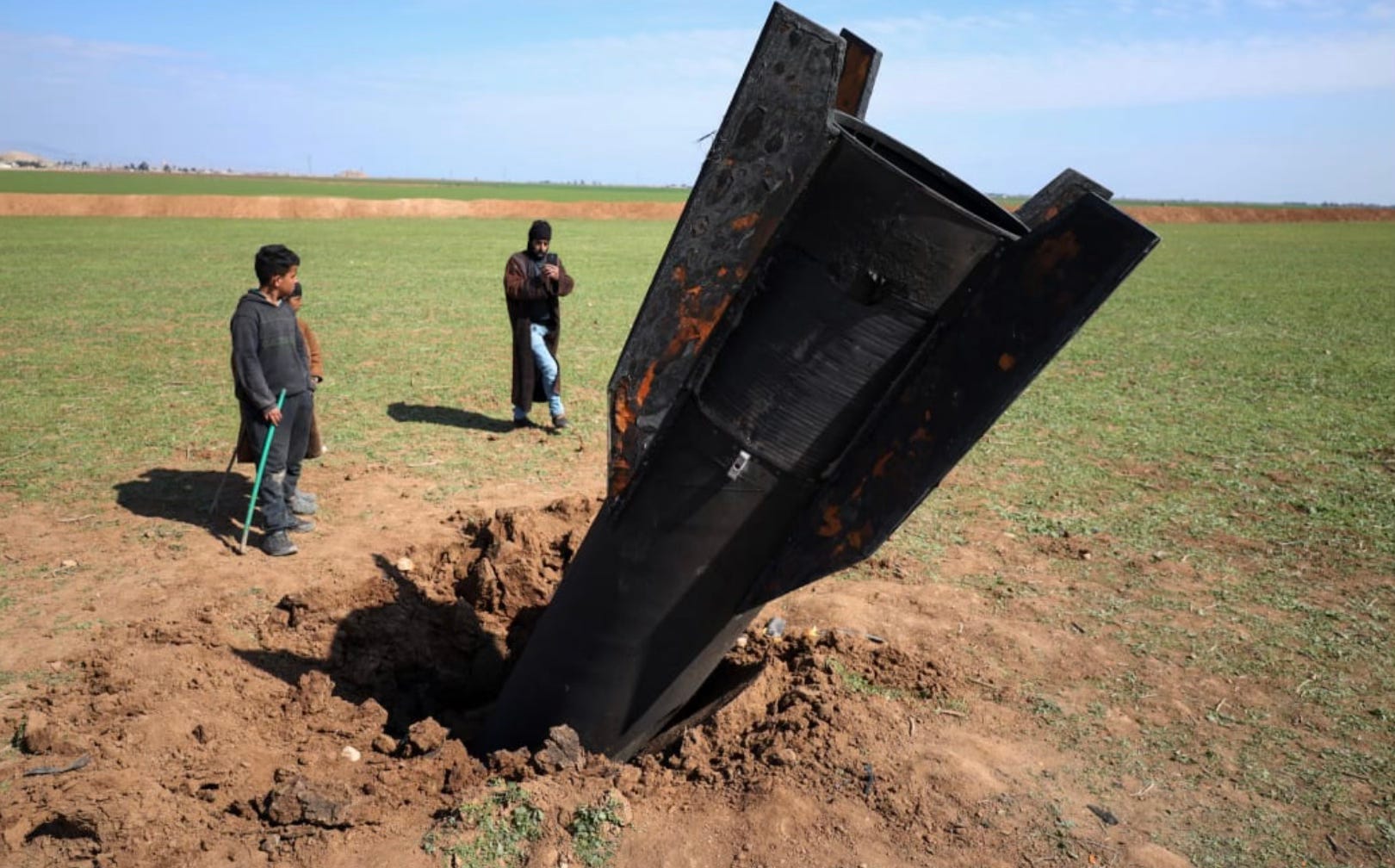
First, Iran also wants to escalate it to a degree that each and every country in the Middle East feels battered enough that they would do everything in their power to impede another cycle in six months. There have already been two missiles directed at Turkey’s US and NATO bases, both of which were intercepted. What happens, mazallah, if there is a third?
Second, if the war continues at this speed or turns into a protracted conflict between Iran and Israel, there will be a wave of migration from Iran to Turkey, which would make Turkey surely a part of the war as the most stable neighbour.
And finally, and most importantly, Turkey is part of this war because Israel wants it, is intent on it. And in this environment of impunity, Israel can take steps that many of us would say, “They would not go that far.” Oh yes they can. Oh yes they would. We are talking about a regime that has multiple fronts of conflict and a genocide on its hands.
Now let me explain this.
A couple of weeks ago, Netanyahu told his cabinet that Israel was working to build a regional alliance to counter what he described as two hostile axes, a hardline Shia axis and an emerging hardline Sunni axis. The proposed alliance would include India, Arab and African countries, Greece, Cyprus and other Asian states. The Shia axis needs little introduction at this point, I believe.
It is what remains of what was once called the axis of resistance. Assad’s Syria, Hezbollah in Lebanon, the Hashd al-Shaabi militias in Iraq, the Houthis in Yemen. A network of Iranian-backed forces that has been systematically dismantled over the past two years, first by Israel’s campaign in Lebanon and Gaza, then by Assad’s fall, and now by the war on Iran itself. Netanyahu is telling his cabinet, and the world, that having dealt with one axis, he is already naming the next.
Who leads the Sunni axis in his framing? Turkey. Alongside Qatar, Syria, and arguably Saudi Arabia and Pakistan. Netanyahu, as we know by now, does not make off-hand remarks. Countering the so-called Sunni axis is a strategic declaration.
Furthermore, Netanyahu is not alone in making it. We have enough information by now that this strategic vision is shared across the political spectrum and establishment figures. One example is the former Israeli Prime Minister Naftali Bennett, who is widely expected to run in Israel’s elections this autumn. He recently said at the Conference of Presidents of Major American Jewish Organizations in February that Turkey is emerging as a threat and should be viewed and dealt with as the new Iran. He said it with the cadence of a prepared line, pausing for applause before adding that Erdoğan is sophisticated, dangerous, and seeks to encircle Israel.
Bennett accused Turkey of trying to flip Saudi Arabia against Israel, of building a hostile Sunni axis with nuclear Pakistan, and of creating what he called a new choke ring with Syria and Gaza. Israel’s foreign minister went further still, posting in Turkish on X to accuse Erdoğan of being antisemitic and a threat to the region, urging NATO allies to take notice. Bennett repeated a similar narrative in an interview just a couple of days ago, claiming that ‘we need to ensure that Erdogan does not create an alliance of radical Islam.’
This is a sustained, coordinated campaign and it is worth being precise about what it is not. It is not an accurate description of Erdoğan’s Turkey. Of Erdoğan himself either. Erdoğa can be many things, but he is not the radical Islamist that Netanyahu purposefully portrays to attract the support of Islamophobic and Orientalist American decision makers, which probably describes 80 percent of that crowd. Erdoğan presides over a clientelist, oligarchic system with an increasingly authoritarian state apparatus, but calling him a radical Islamist is deliberately idiotic.
However, Erdoğan’s genuine enmity toward Netanyahu is well documented. He has said publicly that Israel is waging a genocide in Gaza and that it constitutes a terrorist threat. Those words were not empty, yani, they carried not only his real feelings but also the intention of giving his base the idea that he is standing up to Israel and morally superior. If only it meant anything. Because in material terms, trade between Turkey and Israel continued well into the conflict, and back-channel talks between the two governments persisted in ways that disappointed many of Erdoğan’s former base, those who still carry the expectations of an Islamist political project.
Like I tried to explain above, there is no Islamist project in Erdoğan’s game. I have not described Erdoğan’s AKP as Islamist for some time. If Islamism as an ideology had eyes and ears and looked at Erdoğan, it would not recognise him as one of its own.
But I agree that what he and his party represent is harder to pin down. An authoritarian right-wing ideology without a thick ideological core, malleable enough to resist easy categorisation, but closest, if one must label it, to nationalism with a Muslim conservative leitmotif. The nuances of this do not particularly matter for the Israeli political establishment. What matters is the utility of the framing.
That is why the accusation that Erdoğan is a radical Islamist, that Turkey under his leadership is a state sponsor of Hamas, that it represents a civilisational threat analogous to Iran, has been circulating for two years on Israeli television channels close to the government, in op-eds, in conference speeches.
The intent here, and I think the Erdoğan government has quietly understood this, is to manufacture a confrontation. To provoke Turkey into a response that can then be used to justify treating it as a hostile state.
Because it is simple logic. Israel sees itself as already having a dominant position in the region, so it will not want any country to challenge that in the future. And with Turkey’s greater influence in Syria and overtures in Africa, it does look like a thorn in Israel’s side. Especially with someone like Erdoğan, even though he has proved to be the most pragmatic leader in the region. Erdoğan can be pragmatic. Netanyahu much less so.
Turkey has so far met that provocation with considerable restraint. AKP spokesperson Ömer Çelik said this week that the Turkish government was closely watching statements by Israeli politicians who directly target Turkey, that it was under no obligation to respond to each one individually, and that it sees the bad faith behind them clearly. He also said something that deserves attention beyond the immediate context. That the world as we knew it is coming to an end, that the rules are changing, and that Turkey will take precautions and make its preparations.
Yes, Turkey is not in this war in the conventional sense. No Turkish soldier is fighting, no Turkish base has been used. Yes. But as I am trying to explain, it is part of this war in a deeper sense. Israel’s strategic vision, now stated openly, requires a submissive Turkey or a destabilised one. A Turkey that controls Syria’s transition, that has resolved its Kurdish question on its own terms, that maintains an independent foreign policy and harbours genuine hostility toward Netanyahu. That Turkey is incompatible with the regional order Israel is trying to construct. Because Netanyahu’s Israel is not hegemonic in the Gramscian sense but seeks domination.
The question is not whether Turkey will be drawn further into this war. The question is through which mechanism, and on whose terms.
The answer may come sooner than Turkey expects. Because the next front in Israel’s regional strategy is already open and it runs on two paths.
One goes through the Eastern Mediterranean, creating and leading Greece and Cyprus in a configuration that would pit them against Turkey in the energy theatre of the Eastern Mediterranean.
The other goes through the Kurds. The East Med card will mature further down the line. The Kurdish card, however…
The Kurdish Card Has Already Been Played
Kurds have been coerced by a fait accompli into an impossible situation, which I tried to convey in the conversation I had for Turkey Recap. I find it extremely important to understand, so I will explain.
On Saturday, Donald Trump told reporters aboard Air Force One that he had ruled out Kurdish involvement in the Iran war. “We’re very friendly with the Kurds,” he said, “but we don’t want to make the war any more complex than it already is.” The reversal came swiftly after what I am told was direct pressure from Turkish Foreign Minister Hakan Fidan on Secretary of State Marco Rubio. The Turkish government made clear that Kurdish involvement was a red line.
Many read this as a resolution. I beg to differ. I’m afraid it may be the beginning of a much more dangerous chapter for the Kurds, and understanding why requires going back to the moment the card was first played.

The CIA had been in discussions with Iranian Kurdish groups for months before the war began, working to arm them with the aim of fomenting a popular uprising inside Iran. When the bombing started, Trump called Kurdish leaders, Masoud Barzani and Bafel Talabani, the heads of the two main Iraqi Kurdish factions, and signalled enthusiasm for their ground involvement. Then came the CNN report framing Kurdish groups as prospective boots on the ground for a US-Israeli operation to topple the Iranian regime.
I believe that leak was deliberate. By publicly announcing that the Kurds would fight alongside Israel and the United States against Tehran, they placed Iranian Kurds in an impossible position before they had agreed to anything. Yani, the announcement does the coercion for you.
Look at what Kurdish leaders actually said in response when the leak happened. Not one of them expressed eagerness to serve as Israel and the United States’ boots on the ground. Not one said they would do it. The Kurdish movement, across all four parts of the region, is one of the most politically astute and strategically experienced actors in the Middle East. They know this script. They have lived it.
Also, you do not need to be sophisticated to track the pattern. The US instrumentalised Kurdish fighters in northern Iraq and then stood aside during the independence referendum in 2017, making the vote meaningless. Again, in Syria, the US could have pushed harder with both the Turkish government and Damascus to preserve at least some form of autonomous administration in Hasakah and Kobane. It did not. So the Kurds in Iran are not naive about what is being offered.
Trump himself had said when asked a month ago why the US abandoned the Kurds in Syria after they had fought against ISIS. He said the Kurds “were paid, had earned tremendous amounts of money. We gave them oil and other things. They did it for themselves.” In Trump’s thinking, Kurds would be soldiers hired for money if they were to fight against the Iranian regime.
Kurds understand this logic. But the problem is that understanding it does not give them an alternative now. They have been placed in a situation not of their making, and that situation has made them extraordinarily vulnerable, not only to the Iranian regime but also to Iranian nationalism, and at some point to Turkish nationalism more broadly.
This is worth dwelling on. Iranians are a deeply nationalist people. They take pride in never having been colonised after the First World War. They carry a deep-rooted anxiety about foreign powers conspiring to dismember their country. When the US and Israel publicly name Kurdish groups as the force that will topple Tehran, they are inscribing the Kurds into a narrative of foreign conspiracy that millions of Iranians tend to believe.
The consequences of this are already visible on social media. The grievances being generated within Iranian society toward Kurds, including among nationalists in the diaspora and supporters of Reza Pahlavi, will outlast this war considerably.
Now consider what Trump’s reversal actually changes on the ground. Iranian Kurdish armed groups, numbering around ten thousand men, are based in northern Iraq along the Iraq-Iran border. Iran has already been striking them, describing them as anti-revolutionary separatist forces. Trump and Netanyahu, by publicly signalling their intention to work with the Kurds, handed Tehran a justification for exactly this kind of military campaign, one Iran can now pursue under the cover of counterterrorism and regime security whenever it deems necessary, regardless of what Trump says.
The cruel logic here is that the Kurds may now need the very protection the leaked plan promised. There are already rumours that some Kurdish factions have asked for precisely that, US or Israeli cover against prospective Iranian strikes.
And if Iran presses its campaign against PJAK in northern Iraq, this will not stay contained. It will create serious problems for and within the Iraqi Kurdish Peshmerga, who cannot remain neutral indefinitely as Iranian missiles land in their territory.
There is a Turkish dimension here as well. PJAK is the Iranian affiliate of the PKK. Turkey is currently in the middle of a fragile peace process with PKK leader Abdullah Öcalan, one premised on a shared threat perception centred on Israeli regional expansion. The Turkish government has worked hard to keep that process insulated from regional turbulence. Fidan’s call to Rubio was part of that effort. But if PJAK is drawn into the conflict on the American and Israeli side, the geometry of that bargain changes in ways that will be very difficult to reverse.
The Kurds did not ask to be dealt this hand. They rarely do. What is particular to this moment is the speed with which the exposure was created and the breadth of it, military, political, and social simultaneously. A group that has spent decades trying to build legitimate political standing in a region that has consistently denied its birth rights and identity as Kurds has been thrust, without consent, into the centre of a war.
I am afraid unplaying this card would require exceptional leadership. I am not sure the Kurds have that person right now.


I love the way you have made "yani" into a respectable word in Mideast analytical parlannce!
Pretty mixed feelings about the piece. I strongly sympathise with some points, e.g. that missiles in Turkey are unacceptable and draw Turkey in or that the rhetoric with regards to Kurds is unacceptable. Some statements strike me as a bit strange, e.g. the fact that people might migrate to a country making that country part of the conflict. The part that worries me most however is the lack of Israeli perspective. You write for instance "Netanyahu, as we know by now, does not make off-hand remarks", but make no mention of the role of different parties within the Israeli government (or the fact that Netanyahu has formed coalitions with quite different parties and is in a way flexible). The role or different viewpoints of the war on Iran (What does the opposition think ? Bennet you mention but he is far from the only opposition figure). Then there is also the question of importance is Israel that focused on Turkey I'm sceptical. I sympathise with some broader points here as well, but I think it's quite important to understand the Israeli perspective deeply if one wishes to explain it. Particularly if one is worried about it. Overall interesting article though as usual.