
Turkey, NATO, and the Uses of Authoritarian Legitimacy
What Turkey wanted from NATO has changed, and so has what NATO is and represents. The 36th summit hosted in Ankara by a leader who jails his rivals, shows both at once.

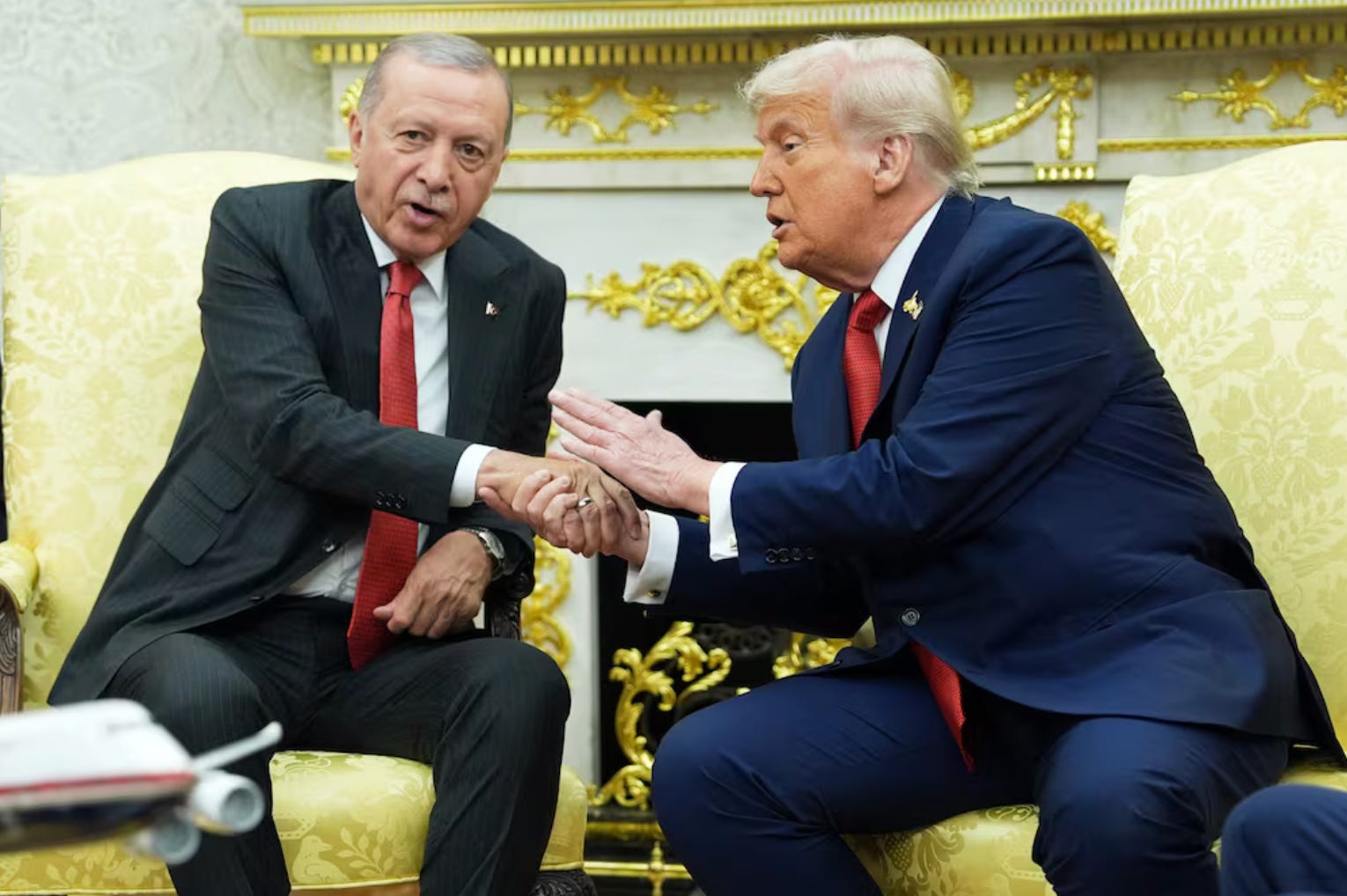
Next week, Ankara will host NATO’s 36th Summit.
It is an important meeting mostly because Trump threatened to quit NATO, as he has threatened to quit almost every alliance and treaty the US is party to. He also let it be known that he would only turn up because his good friend Erdogan is hosting! Masallah to this bromance.
A couple of years ago it was Erdogan who caused trouble by refusing to accept Sweden as a member; now he has become the glue, the linchpin that holds the alliance attached to Trump.
The conventional account of Turkey’s NATO accession in February 1952 is a security story. That is, the Soviet Union had made territorial demands on Turkey in 1945, the Truman Doctrine followed in 1947, and membership in the Atlantic alliance provided the formal guarantee that American power would stand behind Turkish borders. This is not wrong, but it is incomplete.
Turkey’s NATO journey
Turkey was twice refused NATO membership before being admitted (rejected first in 1948, then again in September 1950), and the security imperative alone was not sufficient to overcome Western resistance. What broke the deadlock was Turkey’s blood price: the deployment of 4,500 troops to Korea in July 1950, the first Turkish military operation beyond the borders of the republic in its history. When the NATO Ministerial Council finally invited Turkey to join at Ottawa in September 1951, the government newspaper Zafer declared that “the Turkish bloodshed in Korea has not been wasted. There was an honourable share of the blood of our Korean heroes in the signatories’ ink.”
This inaugural transaction established a template that would persist for decades: Turkey offering military service and strategic real estate in exchange for security guarantees and political standing. From NATO’s perspective, what Turkey provided was considerable. It held the Bosphorus and Dardanelles straits, denying Soviet naval passage to the Mediterranean. It hosted the Incirlik air base, which has housed American nuclear weapons since the 1960s. It fielded the second-largest standing army in the alliance. And it anchored NATO’s southeastern flank, the most geographically exposed arc of the Cold War perimeter.
When the Cold War ended and the Soviet threat dissolved, neither Turkey nor NATO was prepared for what their relationship required without it. The post-Cold War security ruptures followed a consistent logic. The first Gulf War left Turkey with billions in promised American compensation that never materialised, and a devastated trade position in the lower Middle East. The accumulated resentment erupted in 2003 when the Turkish Grand National Assembly refused to authorise US troop deployments through Turkish territory for the invasion of Iraq, a vote that shocked Washington and permanently altered the bilateral relationship.
Then came the Kurdish issue in Syria, which placed Turkey and its NATO allies on opposite sides of the most consequential battlefield of the 2010s. Turkey’s insistence that the SDF (YPG/PYD - the Kurdish militia the United States armed and trained to fight ISIS) was indistinguishable from the PKK created a structural divergence that no amount of diplomatic management could resolve. I have written about it from all its sides several times; you can find them in the archive if you are interested.
By 2017, Turkey had purchased the S-400 Russian air-defence system, a decision that made the interoperability of Turkish military infrastructure with NATO’s own systems actively problematic. There was a conundrum, because Turkey was calling for a stronger NATO presence in the Black Sea while at the same time attempting to reduce its dependence on the alliance. This has served Russian strategic interests regardless of Turkish intent.
The security relationship today is therefore a palimpsest. The original Cold War logic (Turkey as flank, NATO as guarantor) is overlaid by post-Cold War divergence, the Iraq rupture, the Kurdish impasse, and the S-400 episode. What holds the architecture together right now seems like mutual indispensability. NATO cannot easily replicate Turkey’s geographic and military contributions; Turkey cannot easily replicate Article V. The result is an alliance relationship defined by structural dependency and functional estrangement simultaneously.
The world order and identity
From the moment Turkey sought membership of NATO, the alliance was understood by Turkish elites as something more than a security arrangement.
When Foreign Minister Fuat Köprülü celebrated Turkey’s accession at the Democrat Party’s third Grand Congress in October 1951, he declared: “The Atlantic Pact is not just a military and political community, it is a community of civilisation, a community of culture, a community of democratic nations.” That formulation, NATO as civilisation and not merely alliance, addressed a long-standing anxiety in Turkish political culture about where Turkey belonged in the hierarchies of modernity that European powers had constructed. By gaining full membership, not associate status, not a Mediterranean annex, but equal membership alongside France, Britain, and the United States, Turkey was claiming its place in what the Cold War framework called the “Free World.”
This civilisational aspiration had a corollary that is equally revealing. Turkey insisted throughout the accession negotiations that it be categorised as European rather than Middle Eastern. For example, when Britain proposed a Middle East Command that would have Turkey serving under a British general alongside its Arab neighbours, Turkish diplomats, press, and politicians across the political spectrum reacted with fury. I believe this sentiment can be described as Ottoman Orientalism, in which Turkey deployed against its Arab neighbours the same hierarchy of civilisations that Europe had deployed against the Ottoman empire. NATO membership in a way legitimised and reinforced Arabs as the constitutive Other for the Turks.
Turkey’s relationship with NATO has also been about how Turkey positions itself within the international order, which institutions it defers to, which it contests, and which it attempts to shape. Turkey has consistently preferred action within multilateral frameworks and has been most cooperative when those frameworks provided clear legitimacy, and most difficult when they did not.
This preference for institutional legitimacy explains what might otherwise seem paradoxical about Turkey’s behaviour in successive crises. After September 11, Turkey granted the United States overflight rights and base access within an hour of being asked, because NATO had invoked Article V, providing unimpeachable multilateral authority. It then twice assumed command of the ISAF mission in Afghanistan, served as the first Muslim-majority NATO member to lead that coalition, and deployed troops to Lebanon under a UN resolution. These were not acts of reflexive loyalty to the United States; they were acts of institutional deference to the framework within which Turkey had chosen to operate. The Iraq War of 2003 fits the same pattern in negative. There was no UN mandate, no NATO decision, only American pressure, and Turkish parliamentarians, including former senior diplomats who knew the alliance well, voted against the request.
What Turkey has wanted from the international order is a place at the table where regional security is decided, not merely a role as the executor of decisions made elsewhere. This aspiration has shaped its behaviour across successive administrations.
Under the AKP, it crystallised into the "zero problems with neighbours" doctrine, which entailed, in theory, that Turkey would become a regional hub. Predictably, it proved to be a joke, because the doctrine collapsed majestically under the weight of the Arab Spring, the Syrian civil war, and the sectarian and ethnic politics that the AKP itself subsequently inflamed. By the late 2010s, Turkey was isolated from the Gulf states, at odds with Egypt, and operating in Syria through the Astana process, a trilateral arrangement with Russia and Iran that deliberately excluded the United States, the UN, and NATO. This was Turkey attempting to shape regional order not through its alliance commitments but around them.
The Ankara NATO summit of July 2026 represents a particular crystallisation of this tension. The summit is said to be an opportunity to deepen NATO’s engagement with its “southern neighbourhood,” a framing that Turkey has actively cultivated and that positions Ankara as the indispensable mediator between the alliance and the Arab and North African states to its south. So, Turkey is not only hosting NATO; it is attempting to redefine what NATO’s southern agenda means, in ways that serve Turkish regional influence more than collective Atlantic security.
Legitimacy for the authoritarians
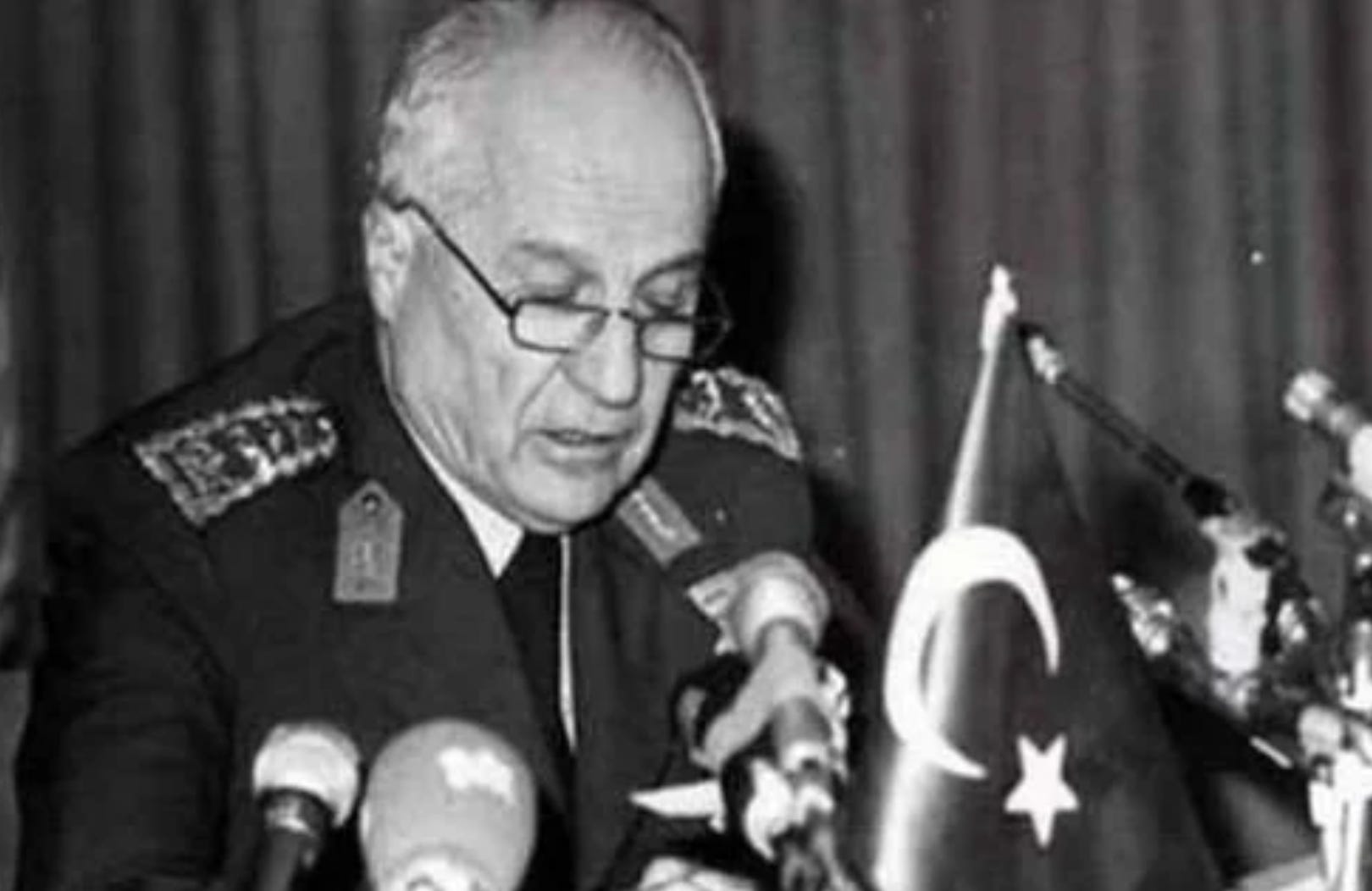
It is telling that NATO membership had provided legitimacy to the authoritarian practices in Turkey. The leaders of both the 1971 and 1980 coups in Turkey immediately and explicitly pledged their allegiance to NATO.
On March 12, 1971, Chief of the General Staff delivered an ultimatum forcing the resignation of Prime Minister Süleyman Demirel. Concurrently, the military leadership issued a public declaration assuring international observers that Turkey’s foreign policy remained unchanged. The incoming, military-guided technocratic government led by Nihat Erim explicitly reaffirmed that Turkey would remain a loyal and foundational pillar of the NATO alliance.
The declaration was even more immediate and direct during the September 12, 1980 coup led by General Kenan Evren. In the very first radio broadcast delivered to the nation hours after tanks rolled into Ankara, the National Security Council stated: “All our international agreements and commitments, including NATO, will be honoured. We remain loyal to all our alliances.” This declaration served to immediately reassure Washington and Brussels that the putsch would not result in an Iranian-style geopolitical shift, paving the way for immediate US diplomatic acceptance and subsequent military aid.
In both instances the mechanism was straightforward and simple. Western acceptance made the seizure of power respectable at home, and NATO membership was the visible proof of that acceptance. The generals understood that the fastest way to launder a coup was to reaffirm the alliance before anyone had asked them to. That mechanism did not retire with the Cold War.
What do you think is happening right now in Ankara with its NATO summit hosting? Let me tell you. In the lives of ordinary people of the capital Ankara, it is extreme frustration and resentment.
The city has been reeling from all kinds of Leviathan measures. Some of them are pure surveillance-state, some are so banal that citizens are embarrassed for the state.
Demonstrations of any kind are banned. Roads leading to the airport, the access to the places where the leaders will stay, and the venue where the summit will be held are closed. Literally closed, as in, some people need to find ingenious ways, such as, maybe being dropped in from the sky, to get to work and back.
The public parks are closed in case, in caseeeee(!), the French president wants to have his morning run there.
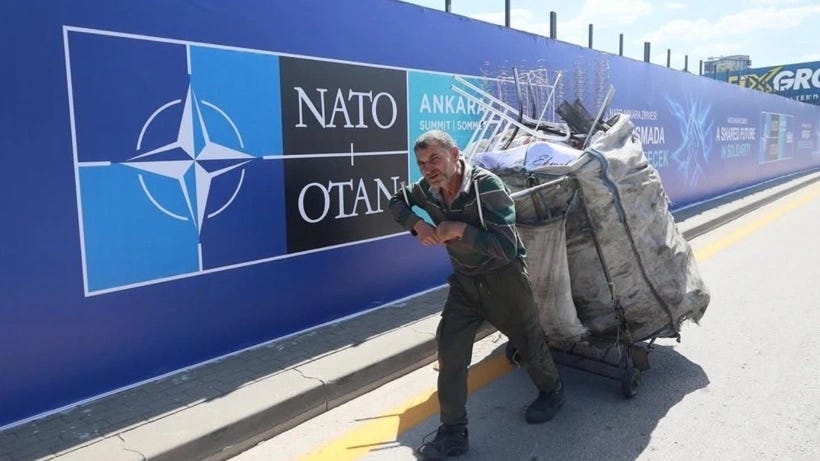
In addition to these… The government put up panels along the roads to block the sight of the shanty towns, a Potemkin screen so the 'leaders of the world' would be spared the 'eyesore'. What a remarkable twist of projection. It is embarrassed by the look of its poor, when the shame belongs to the planning it has presided over for twenty-five years, the missing services, the neglect that made them poor in the first place. Wallahi, if this were a fair world, a regime embarrassed by its own poor would be wrapped in a kitchen towel and shoved under the sink. Alas… Ah ah…
That is not all, I’m afraid.
Last week in overnight raids, the police arrested people who ‘may’ cause trouble during the NATO summit, trouble being taking part in demonstrations against NATO, among them political activists, lawyers, a prominent academic and an LGBT rights activist. Preemptive detention! If this does not belong in a dystopia, what does. For example, Philip K Dick’s Minority Report has as name for it: Precrime.
As if these were not enough to make one question the whole value system of the transatlantic alliance, and the social contract between citizens and the state, even more than before, we also learned that NATO rejected the accreditation requests of every single non-government Turkish media outlet and journalist, and its spokesperson said that “NATO relied on the host nation to provide assessments on journalists from their country to ensure access to the meeting site.”
Under Erdogan’s AKP, Turkey has imprisoned thousands of political opponents, dismantled judicial independence, and, as of 2026, used court orders to oust the leader of the main opposition party and keep its leading presidential candidate in pre-trial detention for over a year. You can read my detailed posts about these as well. Freedom House’s 2026 country report on Turkey reflects a political system that no longer resembles the ‘community of democratic nations’ that Köprülü invoked in 1951.
The identity architecture of NATO membership, the idea that belonging to the alliance meant belonging to the West, had quietly collapsed and been replaced by a transactional calculation. Turkey stays in NATO because the security guarantees and the political leverage are still worth having, not because membership expresses what Turkey believes itself to be.
This may be the most consequential shift in the relationship’s 70-year history. The original bargain was transactional and identitarian at once. Turkey paid in military service and strategic access; NATO paid in security guarantees and civilisational recognition. Today the identitarian half has largely evaporated on the Turkish side. Erdogan’s Turkey does not need NATO to validate its place in the world. It has built an alternative self-image as a regional great power with Ottoman roots and Islamic credentials. Membership is no longer constitutive of Turkish political identity in the way it was for the Democrat Party generation that sent soldiers to Korea to buy membership in ‘the Free World.’
But really, who cares? The most powerful member of NATO is led by a man who looks up to Erdogan as the ‘tough guy’ and envies the ease with which he consolidates power by eliminating every obstacle. Trump is openly interested in Erdogan’s authoritarian toolkit. And the alliance itself has no mechanism to expel anyone and cannot function without Turkish geography, so the door stays open regardless of who walks through it.
Here is the part that should trouble anyone who took Köprülü’s 1951 formula seriously. The identitarian bond did not drain out on the Turkish side alone. The club Turkey once paid to enter has stopped believing in its own membership criteria. A host jails the opposition leader and bars the domestic press, the most powerful member admires him for it, and no one at the table looks embarrassed. In 1980 the generals had to promise loyalty to the West to make a coup respectable. In 2026 the West hands over the respectability on a platter.
So when I look for the ‘free world’, the community of democratic nations that any country would want to belong to, I cannot find it.
I’m afraid, it dissolved while Turkey was still inside.