
Turkey with Lebanon, what is it, what it is not + Israel’s Beiruti tycoon
Closer ties between Lebanon and Turkey have revived the question of who inherits Lebanon after Iran. Let's unpack what Turkey can and cannot do, plus the forces coming from the US and Israel.

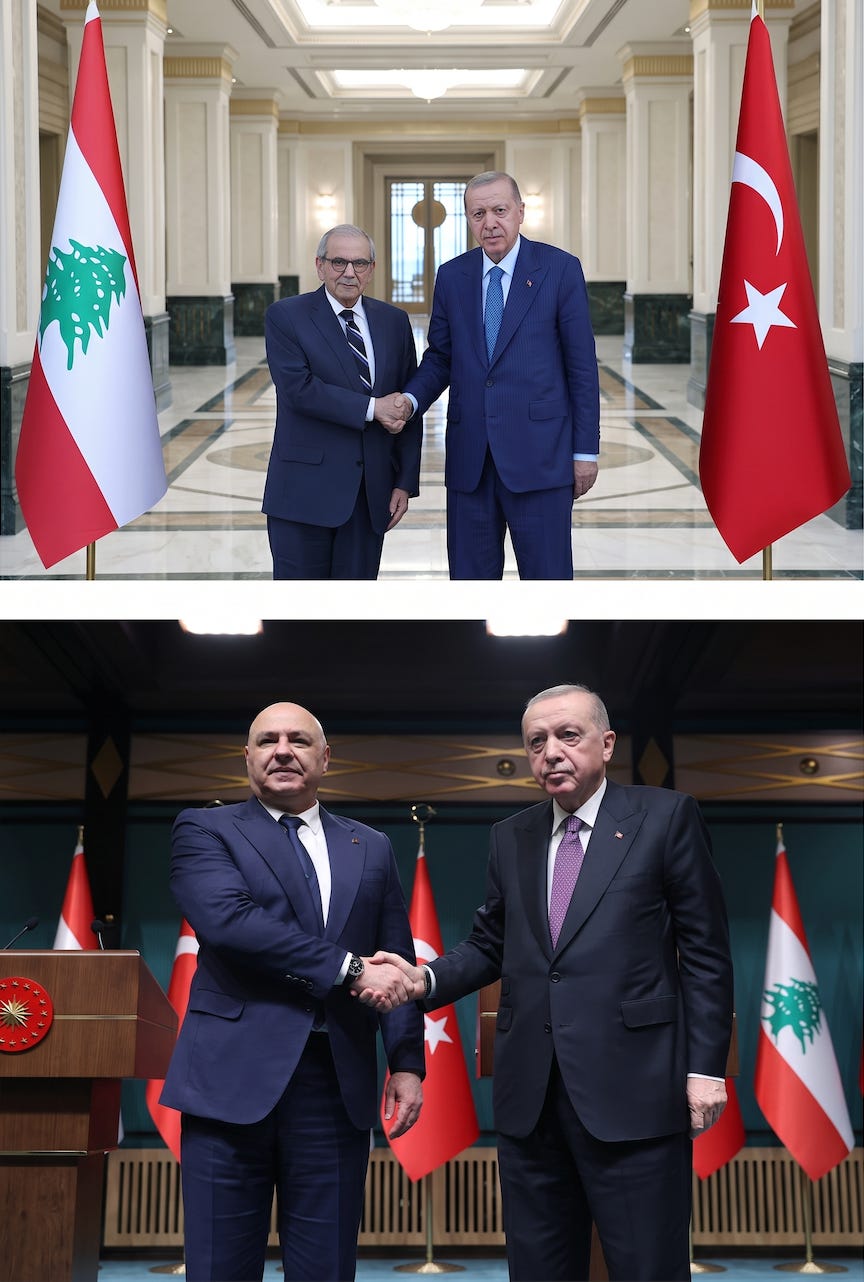
On 30 July, Joseph Aoun became the first Lebanese head of state to set foot in Turkey in seventeen years. Erdoğan received him in Ankara with full ceremony, promised “all possible support” for rebuilding the devastated south, and floated the idea of folding Lebanon into the regional security bloc Turkey is assembling with Syria’s neighbours.
Three weeks earlier the prime minister, Nawaf Salam, had been in Istanbul, pressing for the relationship to be raised to what he called the level of a strategic partnership. And in June, before either visit, Erdoğan had stated that Turkish security “does not begin in Hatay, but in Aleppo, Damascus and Beirut,” and called the two Arab capitals sisters of Istanbul.
From there the story more or less tells itself, and much of the regional press has been telling it. It has an ironic side to it as well. A year ago, Turkey was talking about sectarian politics taking over under the banner of the ‘Lebanonization of Turkey’. Now, there is great interest in the Arab and the US media about Turkey’s closer involvement in Lebanon. And the question forwarded is something along the lines of ‘is Turkey Tehran’s heir in Lebanon?’ Well, this was the actual question of a piece published in Carnegie’s Diwan in December 2025.
I would say, definitely not. Not because Erdoğan’s Turkey would not want it but because the equation is totally different with Turkey than with Iran.
The event that actually broke Iran’s hold on Lebanon did not take place in Lebanon but in Syria. When Bashar al-Assad fell and Ahmed al-Sharaa took power in Damascus, the overland route that had carried Iranian money and weapons from Tehran through Iraq and Syria to the Lebanese border was cut. Therefore, Hezbollah’s supply line closed.
In the aftermath of Assad’s fall, Turkey moved as the principal patron of the new Syrian government, and it is there, upstream, that Turkey does its real work on Lebanon. By keeping Syria in a Turkish rather than an Iranian orbit, Erdoğan keeps that corridor shut, and a closed corridor does more to weaken Hezbollah than anything Turkey could attempt inside Lebanon itself.
As for inside Lebanon… Turkey’s reach is shallow and its ceiling is low. We should see that. Yes, it can broker Beirut’s dealings with Damascus on the questions that divide them, the border, the return of Syrian refugees, trade across a long and porous frontier. And, yes, it brings reconstruction money and commercial weight at a moment when much of the south is rubble and the economy has not recovered.
Also, as a NATO member with an unusually friendly line to Trump, Turkey offers Beirut a measure of diplomatic cover, and a way to stop depending solely on France and the Gulf for that matter. This is a broad but, like I said, shallow form of influence compared to Iranian influence, exercised between states, and it is capped by an old rule of Lebanese politics, that no single foreign patron is ever allowed to dominate. France, Saudi Arabia and the Gulf, and now the American and Israeli track, all keep their positions. Turkey’s ceiling in Lebanon is therefore far lower than its ceiling in Syria.
The deeper reason Turkey cannot simply replace Iran is that Iranian power in Lebanon never worked the way people imagine outside influence working. Turkey operates through conventional soft-power networks, embassies, investment, humanitarian organizations and the like. Whereas Iran, over forty years, built Hezbollah on a Shia social base, a coherent ideology, a steady flow of money and an arsenal that outmatched the Lebanese army. That is a very particular instrument, and Turkey has nothing resembling it, and could not construct one if it tried. What Ankara can be is one pole among several, a broker and an economic partner alongside the Gulf, France and Washington. For Lebanon that is probably the healthier arrangement. It is also a much weaker form of leverage than the one it is being compared to, Iran.
The other patron's Lebanese man
Now the second side, which is the one I think matters more.
While the cameras follow Aoun to Ankara, an older and different outside project is under way in Lebanon, and it is being built inside the machinery of Lebanese politics. Its most energetic carrier is a Beiruti banker, Antoun Sehnaoui.
So who is he?
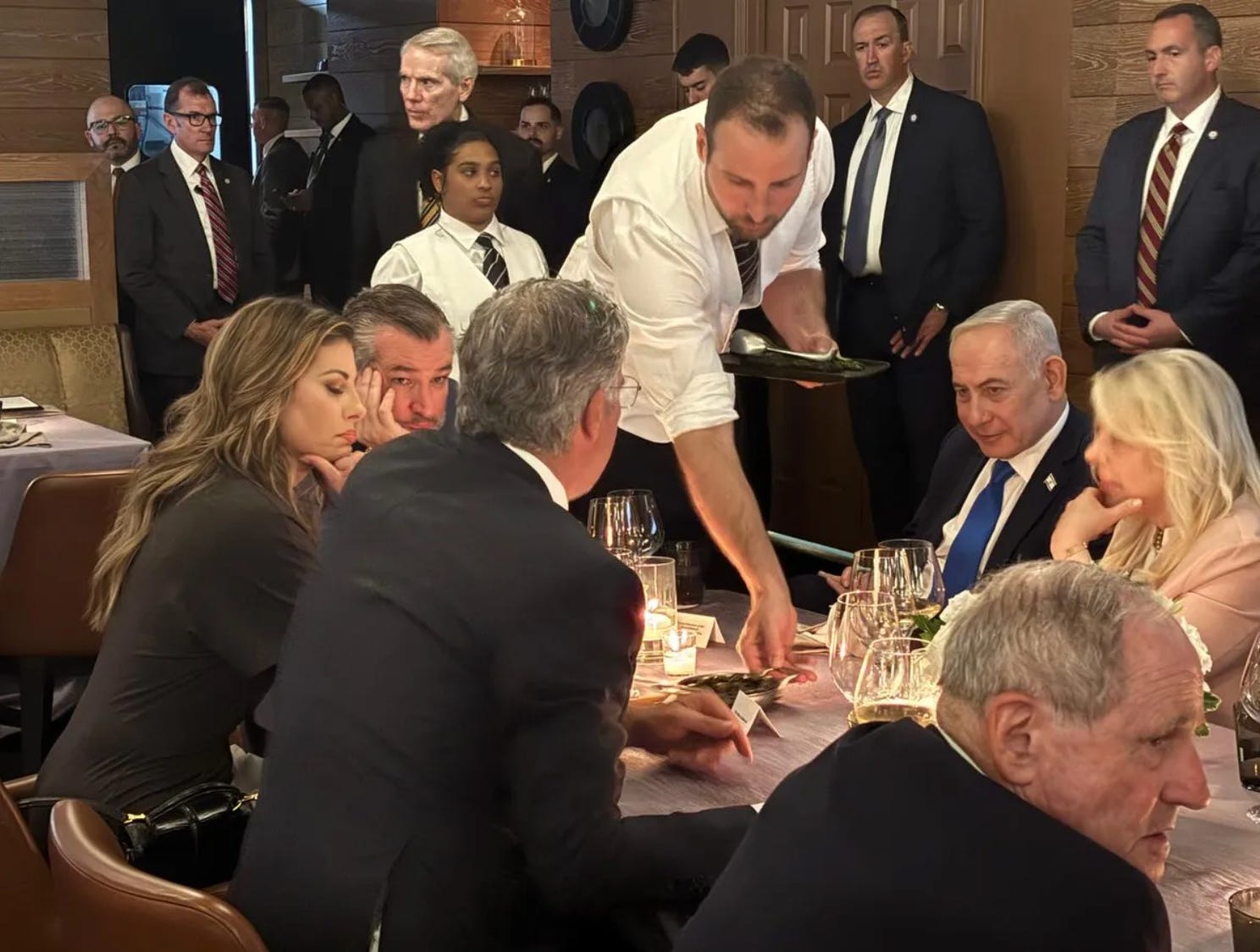
On 29 July, a judge of the Court of Cassation ordered security forces to detain and question Antoun Sehnaoui if he set foot in the country, on a charge of dealing with the Israeli government under a boycott law that has been on the books since 1955. The trigger was a photograph, published by the Axios correspondent Barak Ravid, of Sehnaoui seated near Benjamin Netanyahu and his wife at a Washington dinner held in memory of the late senator Lindsey Graham. The first instinct in Beirut was to assume the image was fabricated. Technical experts were asked to check and found it genuine.
Antoun Sehnaoui chairs SGBL, the Société Générale de Banque au Liban, one of the country’s largest banks. When Lebanon’s banking system collapsed in 2019, in what came to be understood as a state-backed pyramid scheme that left ordinary depositors locked out of their savings and blew a hole in the financial system now estimated at around seventy billion dollars, Sehnaoui was among the bankers who kept both their control and their fortunes intact. He fought the proposals that would have made shareholders absorb the losses first, and years later he has still not repaid depositors a cent. He also faces separate money-laundering charges tied to currency transfers his bank made as the crisis broke. Most of this is documented at length in a five-part investigation published in late July by the Lebanese daily L’Orient-Le Jour, whose reporting, drawn from named sources, court files and Sehnaoui’s estranged uncle Maurice speaking on the record, is the most careful account we have of him. Kudos to good journalism!
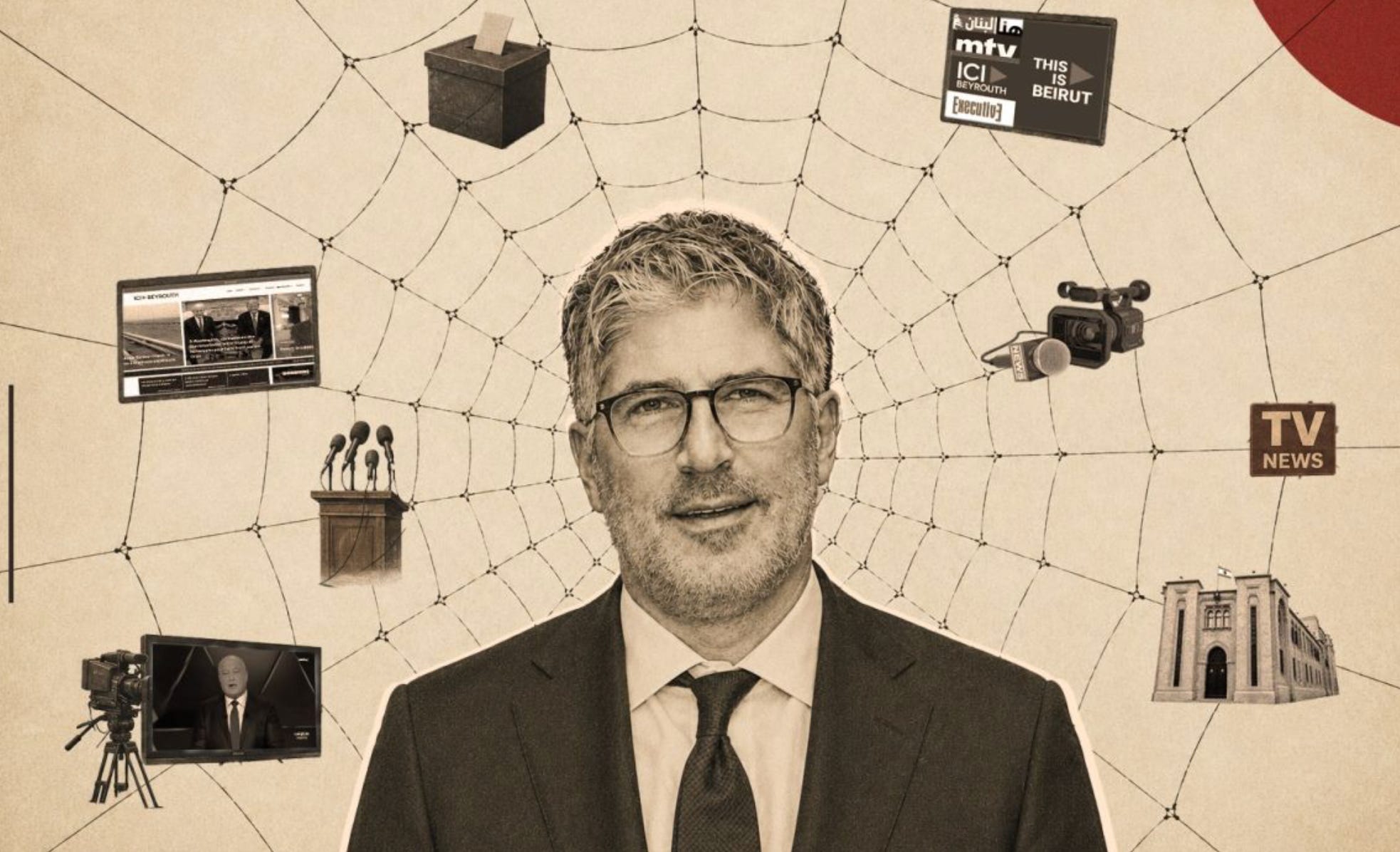
What that five-part dossier also lays out is the assembly of a domestic influence machine with a familiar shape.
There is money, the bank and the fortune preserved through the collapse. There is media. Since the crisis Sehnaoui has funded a cluster of outlets, the French-language Ici Beyrouth, the Arabic Hunna Lubnan and the English-language This Is Beirut, aimed in turn at the Lebanese public, the domestic Arabic audience, and the diaspora and Washington.
There is a political network, cousins and allied members of parliament, several of them seated on the finance committee that has quietly buried every bill on bank restructuring and the distribution of the crisis losses.
There is a hand in the state itself. In Lebanon, senior public posts are shared out among the sects, and behind the formal machinery they are shaped by private money and family connection as much as by government. Sehnaoui has reached into that process. L’Orient-Le Jour reports that he worked to secure the appointment of Nada Hamadeh as Lebanon’s ambassador to Washington, the most important diplomatic post for a country now negotiating its future with the United States and, through it, with Israel. And at the roughest end there is an alleged coercive arm. A small, black-clad, ultra-Christian group based in the Achrafieh district of Beirut, which calls itself the Soldiers of God, or Junoud al-Rab, first drew public notice in 2022 when its members attacked a Beirut Pride display and threatened the city’s LGBT community. Reporting has since linked its members to guarding SGBL branches and the offices of Ici Beyrouth, and to the fatal stabbing of an official of a rival Christian party, the Lebanese Forces, in 2024. Sehnaoui denies any connection to the group.
Then there is the direct line into Washington. Sehnaoui's partner is Morgan Ortagus, until this year Trump's deputy special envoy for the region and one of the American officials shuttling in and out of Beirut during the Israel talks. According to L'Orient-Le Jour, it was not long before he became known around DC as "the Lebanese AIPAC guy [AIPAC is the American Israel Public Affairs Committee, the main pro-Israel lobby in the United States]." His English-language outlet carry regular contributions from figures1 who hold posts at the Foundation for Defense of Democracies (FDD) and the Washington Institute for Near East Policy, the two pro-Israel think tanks that have done most to press the case in Washington for isolating Hezbollah's finances.
This is where the two halves of the story meet, and where I want to be precise about the join, because it is easy to overstate.
When I was asked recently by several journalists from Lebanese outlets about Turkey and Lebanon, I argued that Israel’s likely response to Turkey’s rise would run partly through Washington, through think tanks arguing that ‘an assertive, Islamist Turkey is a problem for American interests’, and partly through deepening its own arrangements with Beirut, above all the framework agreement signed in June. The framework agreement is the trilateral document that the United States, Israel and Lebanon signed in Washington on 26 June, at the close of the fifth round of American-brokered talks. Under it, the Lebanese army is to move into the south and take control of territory as Israel makes limited withdrawals from a handful of pilot zones, with the whole sequence conditioned on the disarmament of Hezbollah. Israel keeps its freedom to strike, and Hezbollah has rejected the agreement outright.
Both of those pressures pass through Sehnaoui’s network. In mid-July, as Aoun prepared for Ankara, the FDD published a piece arguing that Beirut’s turn to Turkey was really a way to avoid disarming Hezbollah. The same think tank supplies writers to Sehnaoui’s own newspaper. Several of the people who fill the pages of This Is Beirut hold posts at these same Washington institutions. Its columnist Hussain Abdul-Hussain is a fellow at FDD, and Hanin Ghaddar, named in the reporting as directing the outlet, is a senior fellow at the Washington Institute. So the analysts making the case in Washington against Hezbollah, and against a larger Turkish role in Lebanon, are the same people writing it up for a Beirut readership.
And the framework agreement itself was signed for Lebanon by Nada Hamadeh, and for Israel by Ambassador Yechiel Leiter, whom Sehnaoui’s This Is Beirut had hosted for an exclusive interview six months earlier. The American and Israeli track that I described in the abstract, as one of the outside poles contending in Lebanon, turns out to have a domestic Lebanese carrier, and this is Antoun Sehnaoui.
Now the caution. There is a second account of Sehnaoui, published by the American website the Grayzone, which casts him as the man running a fascist militia and doing Israel’s dirty work, and traces to him a coordinated campaign to strangle Al-Qard al-Hassan, the Hezbollah-linked lender that offers interest-free loans to poor Lebanese. Some of that goes well beyond what can be shown. The Grayzone itself concedes there is no direct proof that Sehnaoui moved against Al-Qard al-Hassan. Sehnaoui flatly denies any tie to the Soldiers of God and has sued outlets that assert one.
What I’m trying to understand is how the influence is structured, which may or may not have actual firepower. Surely Sehnaoui does not command a mass movement, nor an army, and his alleged muscle is a fringe group whose links to him he vehemently denies. But set these contested claims aside, and I believe the documented core is still substantial and important to watch. That is: A fortune shielded while a country was ruined, a media network, a bloc of friendly deputies, a name on the donor wall of the US Holocaust Museum, where Ortagus told the room that what he was doing was ‘technically illegal in Lebanon’, and two arrest warrants from his own state. Even reduced to what is proven, it is really hard not to consider this a patron-client apparatus, with the Netanyahu government as the patron, being built inside the Lebanese system. This apparatus sits below the level of states.
People keep asking whether Turkey can fill the space Iran left. It is a good question. In the sense that it is easily exciting. But incomplete, and through the wrong lens. The boring fact is that Turkey operates at state level when it comes to Lebanon. It did not do it this way during the Muslim Brotherhood’s stint in power and Ennahda’s rule in Tunisia. The Erdoğan regime had a strong below-state-level relationship with these groups between 2011 and 2013. But not with Lebanon. It cannot tap into Lebanon’s Sunni base, whose patron has always been Saudi Arabia.
There is a deeper obstacle too. The one part of Lebanon that answers to a single command is the Shia bloc Iran built around Hezbollah. Naturally, nothing else in the country is put together that way. Power outside the Shia bloc is scattered across too many hands at once, the sects and their movements, the urban notables, the local bosses who deliver their own districts, the business and banking families, the secular currents, and none of them takes orders from one authority. An outside power that reaches into a field shaped like that comes away with deals of convenience that last a for a period of time not with a client it can keep. You know what I mean.
So, maybe, just maybe… The influence that may reshape Lebanon from the inside is being built lower down, and may be by Israel, via Washington networks.
Hussain Abdul-Hussain is a research fellow at the Foundation for Defense of Democracies and a columnist for This Is Beirut, where his pieces run under the byline "Hussain Abdul-Hussain from FDD, Washington DC." Hanin Ghaddar is the Friedmann Senior Fellow at the Washington Institute for Near East Policy and appears as an author on the same outlet.