

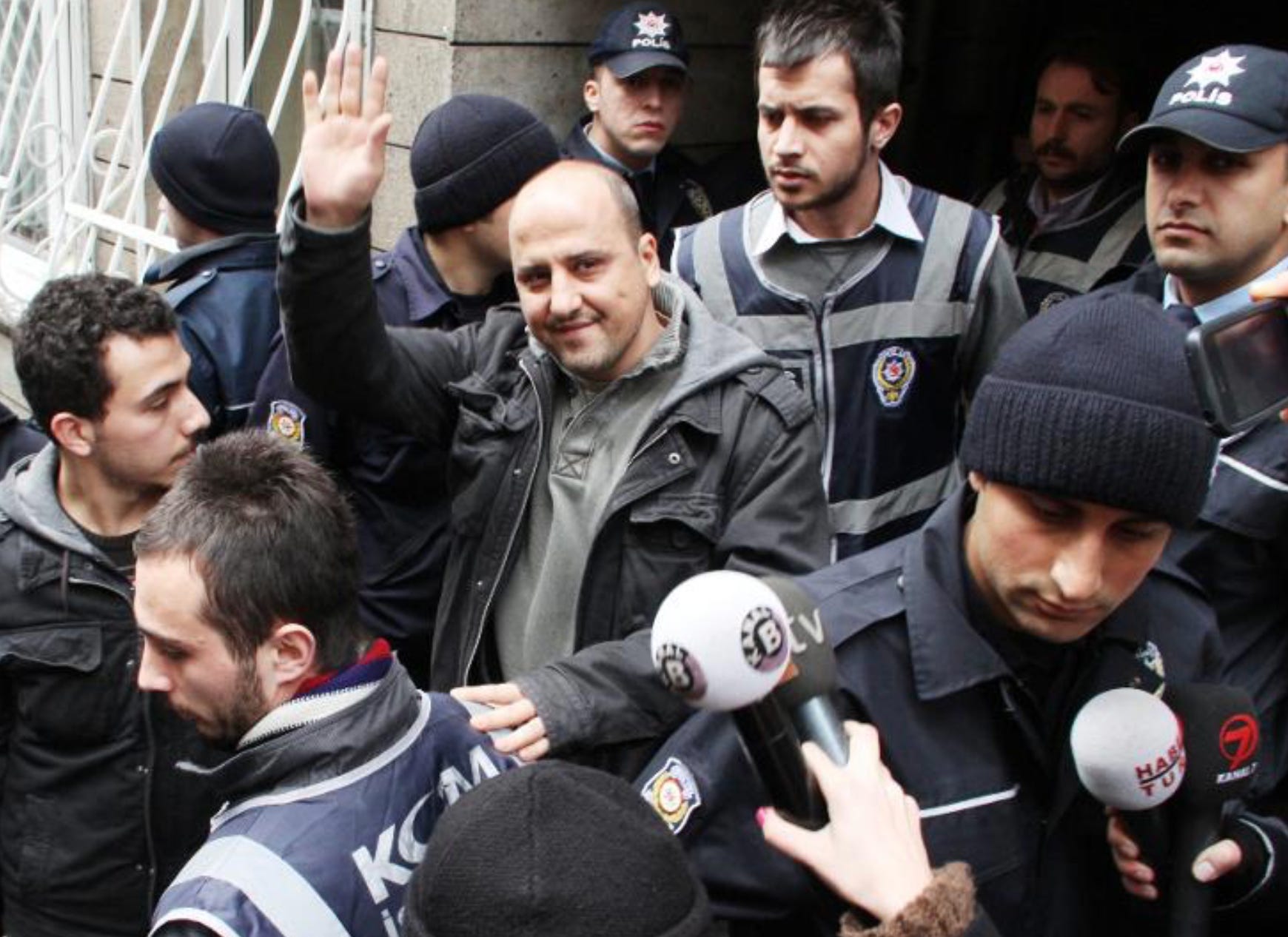
On the morning of 3 March 2011, the doorbell rang at Ahmet Şık’s flat in İstanbul. It was the barking of Pablo, their golden retriever, that woke his wife, Yonca, before she heard the police at the door. Ahmet, then an investigative reporter, was taken away that day as part of the sprawling Ergenekon prosecutions, which police officers and prosecutors loyal to the Islamic preacher Fethullah Gülen, then living in Pennsylvania, were using against anyone who investigated them. Ahmet had been doing exactly that. His unpublished manuscript, İmamın Ordusu (The Imam’s Army), described how Gülen’s followers had colonised the Turkish police. He spent a year in pre-trial detention. We, his colleagues, periodically took to the streets in protest, while facing threats ourselves from Gülenist police officers and prosecutors. It was the heyday of the Gülen-Erdoğan alliance, with sham trials such as Ergenekon and Sledgehammer orchestrated by the Gülen movement to curb the power of the military, judiciary and security apparatus.
Five years later, the state came for Ahmet again. Because Ahmet asks questions. Because he is a brilliant journalist. After the failed coup of July 2016 turned the Erdoğan government against its former Gülenist allies, Gülen became the ultimate terrorist and his network was designated FETÖ. What did not change was how the state treated journalists who investigated those in power. Police detained Ahmet again in December 2016 over his tweets and his reporting for the Cumhuriyet daily. This time he spent 14 months in prison on charges of terrorist propaganda. The European Court of Human Rights later ruled against Turkey over both detentions, finding in the second case that there had never been a reasonable suspicion that he had committed any crime.
In 2018, he was elected an MP for the pro-Kurdish HDP, and in 2023 for TİP, a small socialist party. His parliamentary seat has given him the one protection his journalism never could: parliamentary immunity. At least that is what we all thought.
The fund scandal
This autumn’s story begins with what is called in Turkey the fon vurgunu, the fund heist or the fund scandal. Over the past few years, Turkish savers, squeezed by inflation, put their money into investment funds, and some of the firms managing those funds allegedly used it to push share prices far beyond anything the companies behind them could justify.
In September, the bubble burst. The capital markets regulator ordered more than a hundred funds to be wound up, and around 455,000 people, many of them small savers, are now waiting to learn how much of their money they will get back. Prosecutors have since arrested fund executives, former regulators and a former AKP minister, and the justice minister, Akın Gürlek, has announced each wave of arrests himself. The government is trying hard to present it all as a clean-up.
Ahmet, being Ahmet, has been relentlessly questioning members of Erdoğan’s government about the scandal, the extraordinary share-price movements and the allegations of profiteering by politically connected figures. He has been directly targeting senior figures within the AKP who were allegedly implicated in the scandal.
Ahmet Şık’s questions plainly annoyed people in and around the AKP, and the first to pay for them was Ahmet Saymadi, his friend and partner in a meyhane in Beyoğlu. At the beginning of October, some fifty narcotics officers raided the place. They found no drugs but arrested Saymadı for allegedly “facilitating drug use” anyway! He has been in prison ever since. We later learned of an allegation that, while Saymadi was giving his statement, a bargain had been put on the table: “If Ahmet deletes that tweet [about the fund scandal], we will release his friend.” Needless to say, Şık did not delete the tweet, nor did Saymadı, who remains in prison, ask him to.
But the pressure continued, with higher stakes and threats aimed at securing Ahmet’s silence. An online campaign turned on Ahmet’s private life and family, and in October Ahmet, whose doctors had told him to avoid stress, needed heart bypass surgery. Pro-government outlets then turned their attention to Yonca, his wife.
After his friend, now his wife

This morning, 15 years after Pablo the golden retriever (who is no longer with us) woke Yonca on the day the police came for Ahmet, the police came to the flat again, this time for Yonca herself. Yonca Verdioğlu Şık, who has worked for years at the Turkey office of the Heinrich Böll Foundation, the political foundation associated with the German Greens, was detained on suspicion of “political or military espionage”. The absurdity of the accusation leaves me without words. After hours of interrogation, Yonca was released under a travel ban that prevents her from leaving the country.
Ahmet, Yonca and Ahmet Saymadi are all friends of mine, and have been for many years. In that time, Yonca has stood beside journalist after journalist who was detained or silenced, her husband among them, and for many of us she has been a kind, calm and strong presence through every one of those cases. So has Ahmet Saymadı, who is still in jail for allegedly facilitating the use of drugs that were never found!
Because they are my friends, this turn of events is harder for me to write about than almost anything else I cover. It also tells us something larger about the stage Turkey’s authoritarianism has reached, and about the many people outside my own circle of friends to whom the same thing is being done.
For example, Ahmet is not the only MP to discover where his immunity ends. Deniz Yavuzyılmaz, an opposition MP, has also been digging into the fund scandal. The day after he called on prosecutors to identify the politicians and officials connected to it, the Ankara prosecutor’s office opened an investigation into his wife on charges of robbery and fraud. Really unbelievable. Parliamentary immunity seems to offer MPs precious little protection at this stage.
Opposition mayors have encountered a version of the same method since Ekrem İmamoğlu the mayor of Istanbul, was arrested in March 2025. Waves of corruption operations against opposition-run municipalities have left those still in office facing what increasingly looks like a choice between the prospect of a prison cell and an AKP lapel badge pinned on by Erdoğan himself. By one count, this autumn at least seventy-five mayors elected to other parties had transferred to the AKP, many of them, I suspect, hoping to escape the fate of their detained colleagues. (Here is the post I wrote about this.)
Coercion-by-proxy
For the past decade, most scholars of Turkey have described its regime using a term coined by Levitsky and Way, competitive authoritarianism. Elections in such a regime are real, in the sense that the opposition can win them, but the playing field is tilted by courts, friendly media, and state resources. The Turkish scholars Berk Esen and Şebnem Gümüşçü made the case for Turkey in 20161. The opposition party’s victories in Istanbul in 2019 and across the country in the 2024 local elections confirmed that the competitive part still mattered. Hungary showed this April how much it can matter, when Viktor Orbán, long paired with Erdoğan as a textbook case, lost power after sixteen years. In the Journal of Democracy last year, Esen and Gümüşçü argued2 that İmamoğlu’s arrest signalled a possible shift towards hegemonic authoritarianism, the Russian and Venezuelan model, in which elections continue but the regime works to remove any real chance of losing them. Jailing the most popular rival candidate does precisely that at the top of the system.
With Ahmet Şık’s friends and family being targeted, the regime in Turkey has revealed another trait: coercion by proxy. The term describes regimes that arrest or threaten a dissident’s family at home to silence the dissident abroad.3 Between 2016 and 2019, twenty-nine Egyptian journalists and activists living in exile had relatives targeted in Egypt. But Russia has been particularly adept at the practice. In 2014, a Moscow court gave Alexei Navalny a suspended sentence and sent his brother Oleg, who had no political career of his own, to a penal colony for three and a half years.
The Turkish case adds something to this catalogue. As it always does, my beautiful country! Coercion-by-proxy is a tool for reaching people the state cannot physically touch, such as the exile in London or Washington. Ahmet Şık lives in Istanbul and sits in parliament in Ankara, but his immunity puts him legally out of reach. So the regime has repurposed a method that autocracies have often used against their diasporas.
It is cheaper than lifting immunity, since it requires no vote in parliament. Each case can be presented as an ordinary criminal matter: a drugs charge for a restaurant or bar owner, a robbery charge for a deputy’s wife, an espionage charge for a woman who works at a German foundation. Not only that. It changes the question an opposition figure has to ask. The question used to be whether he or she was willing to go to prison. Now it becomes whether that person is willing to see someone they love sent there instead.
What would you call a regime that seeks to silence its opponents by going after their families and friends?
Another threshold
There is a temptation to understand every new act of repression in Turkey as further proof of an authoritarianism whose character is already familiar. Another journalist arrested, another politician prosecuted, another constitutional guarantee reduced to a formality. And I know that people are tired of hearing these stories from different corners of the world.
But repetition can conceal a sinister transformation, which is what appears to be happening in Turkey.
The cumulative effect of these events may be changing the way political actors calculate the risks of opposition. The calculation becomes less individual, more intimate and more morally burdensome for anyone engaged in opposition politics. The question is no longer simply whether someone is willing to go to prison for something they believe. It is whether they are willing to expose the people they love to the possibility of detention, public humiliation or professional ruin.
That is an altogether different bargain. A brutal one.
We know that repression succeeds most completely when the state no longer has to issue a threat. People anticipate it themselves. They edit or delete their statements, decline interviews, abandon investigations and persuade one another that speaking is reckless. And they may have perfectly respectable reasons for doing so. A parent has obligations to a child. A spouse worries about the person sharing their life. A journalist cannot be indifferent to the possible imprisonment of a colleague.
This is a particularly pernicious form of authoritarian consolidation because it turns the moral commitments of individuals to their loved ones against their public courage. Nor does it necessarily require a single, centrally directed operation. Politicised judicial authorities, partisan media organisations, social-media trolls and opportunists within the governing coalition can contribute to a common climate of intimidation while pursuing their own interests. Some may seek political favour, others influence or personal advantage. Some may seek to protect themselves from prosecution or imprisonment. In such a setting, the abuse of power and the silencing of dissent can become self-reproducing.
What makes the Ahmet Şık story so disturbing is that he has lived through several transformations of Turkey’s political order. He was imprisoned when the Gülen movement was powerful, imprisoned again after it became the government’s enemy, and entered parliament in the hope that constitutional protections might permit him to continue asking the questions that had already cost him so much. Now those protections are being tested through the vulnerability of the people around him.
Turkey still has opposition parties, elections, MPs, some newspapers and courts. Their continued existence matters. Of course. But the democratic purpose of these institutions is gravely compromised. So compromised that the people who use them to challenge or check power fear for the liberty and security of their families.
There was a time when the price of opposition in Turkey was understood principally as the possibility of losing one’s job, one’s freedom or one’s political career.
Now love, friendship and family have been added to the list of political vulnerabilities.
Berk Esen and Şebnem Gümüşçü, “Rising Competitive Authoritarianism in Turkey,” Third World Quarterly 37, no. 9 (2016): 1581–1606.
Berk Esen and Şebnem Gümüşçü, “How to Fight Turkey’s Authoritarian Turn,” Journal of Democracy 36, no. 3 (2025): 106–120
Fiona B. Adamson, “At Home and Abroad: Coercion-by-Proxy as a Tool of Transnational Repression,” Freedom House special report, 2020.