

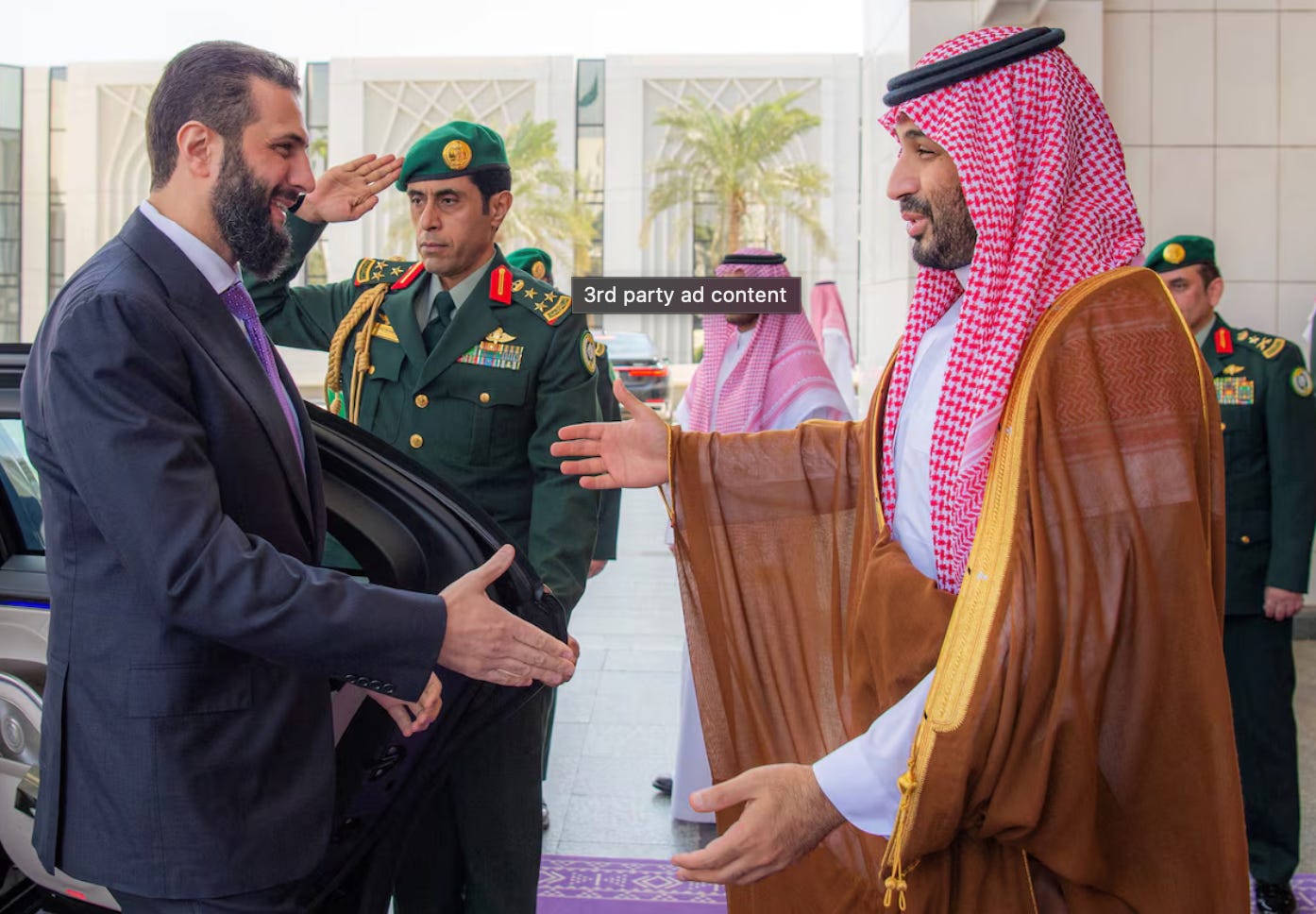
Saudi Arabia, under fire from the Houthis, would apparently like to borrow the Syrian army. Yemeni officials say some Syrian soldiers are already on the border flying drones, while Damascus insists its men have gone to Saudi Arabia only to train. But wait…What Syrian army, one might ask, if one has a good memory?
But less than two years ago, the US had still been offering a reward of up to ten million dollars for information about Ahmad al-Sharaa. The rehabilitation has been so quick, and so complete in Western capitals, that the organization he built, Hayat Tahrir al-Sham (HTS), and the men who fought in it have dropped out of the conversation. Those men and all the fighter groups were real concerns at the beginning. We’re talking about offshoots of al-Qaeda, ISIS, Turkey-sponsored groups… How would they integrate? Would they?
Before asking where they went, it helps to remember who they were.
Al-Qeada, ISIS, al-Nusra, HTS
Jabhat al-Nusra first appeared in early 2012, announcing itself with claims of responsibility for suicide bombings in Aleppo and Damascus. Its founder, then known by his nom de guerre Abu Mohammad al-Jolani and now known to us as Ahmad al-Sharaa, came out of the jihadi insurgency in Iraq and had risen in the Islamic State of Iraq, the organization that would later become ISIS. In 2013 its leader, Abu Bakr al-Baghdadi, claimed al-Nusra as his Syrian branch. Jolani refused, pledged allegiance to al-Qaeda instead, and made al-Nusra al-Qaeda’s official affiliate in Syria. The break with al-Qaeda came in July 2016, under a new name, and in January 2017 the group merged with several smaller Islamist factions to become Hayat Tahrir al-Sham, HTS. The al-Qaeda loyalists who rejected the break left and formed their own group, Hurras al-Din, in 2018. That same year the US designated HTS a terrorist organization, a status it kept until July 2025.
From 2017 HTS ruled Syria’s north-western province, Idlib, through a civilian structure called the Syrian Salvation Government, and spent the following years subduing or absorbing every rival in the province. By the end of the Syrian civil war about 5,000 foreign fighters remained there, from Xinjiang, Central Asia, the Caucasus, Iraq, Egypt, Jordan, France and Turkey. North of Idlib sat the Syrian National Army (SNA), a coalition of some 40,000 fighters armed and paid by the Turkish government, whose factions had spent years fighting one another and keeping HTS out of their towns. When Damascus fell on 8 December 2024, after an offensive that HTS had planned to take Aleppo in six to twelve months and which took the capital in under two weeks, this whole assembly of emirs, warlords, Salafis and foreigners came with it.
Then what happened?
No Syrian Libya
Afghanistan after 1992 and Libya after 2011 show what happens when a coalition of armed groups inherits a capital, and in Lebanon the militias turned the end of the civil war into a permanent share of the state. But, two years on, mashallah, there is no Syrian Libya, no rival government in Idlib or Afrin, no jihadi emirate on the Turkish border. The radicals did not evaporate, and very few were sent home. Yani?
Jérôme Drevon, a political scientist at the Graduate Institute in Geneva, has spent years interviewing HTS’s leadership, first in Idlib and now in Damascus, and in September he posted a working paper.1 His answer is that HTS put the factions on the state payroll one man at a time. He calls the result “integration without representation.” Every faction entered the new army, and none entered the new state as a political actor. Their commanders received ranks, salaries and postings as individuals. Their organizations received nothing, no reserved seats, no quotas, no constitutional guarantees, no say in the transition.
This is Weberian logic, played out in Syria. A bureaucracy can take the manpower of a rival organization and dissolve the organization itself, because an officer whose promotion depends on the ministry stops depending on the emir who recruited him. HTS applied this in stages.
In February 2025 it let the factions enter as whole units, renamed as numbered divisions and commanded by their own leaders in their own areas, because the new state was stretched thin and had no money to pay men recruited individually.
Then it began to take them apart. Division commanders are rotated so that their fighters’ loyalty does not settle on them. Units are moved away from their home ground. Recruitment is controlled from Damascus. Since June 2025 salaries go from the Defence Ministry directly to each soldier, so a commander can no longer hand out his men’s pay. A common programme of religious instruction, written to fit everyone from Salafis to men with no ideological training at all, teaches the legitimacy of the new government, relations with the West and the treatment of minorities. The faction clerics were brought into a single Moral Guidance Authority inside the ministry. By mid-2026 the army was being regrouped into five or six corps, and every corps commander comes from HTS.
Those foreign fighters
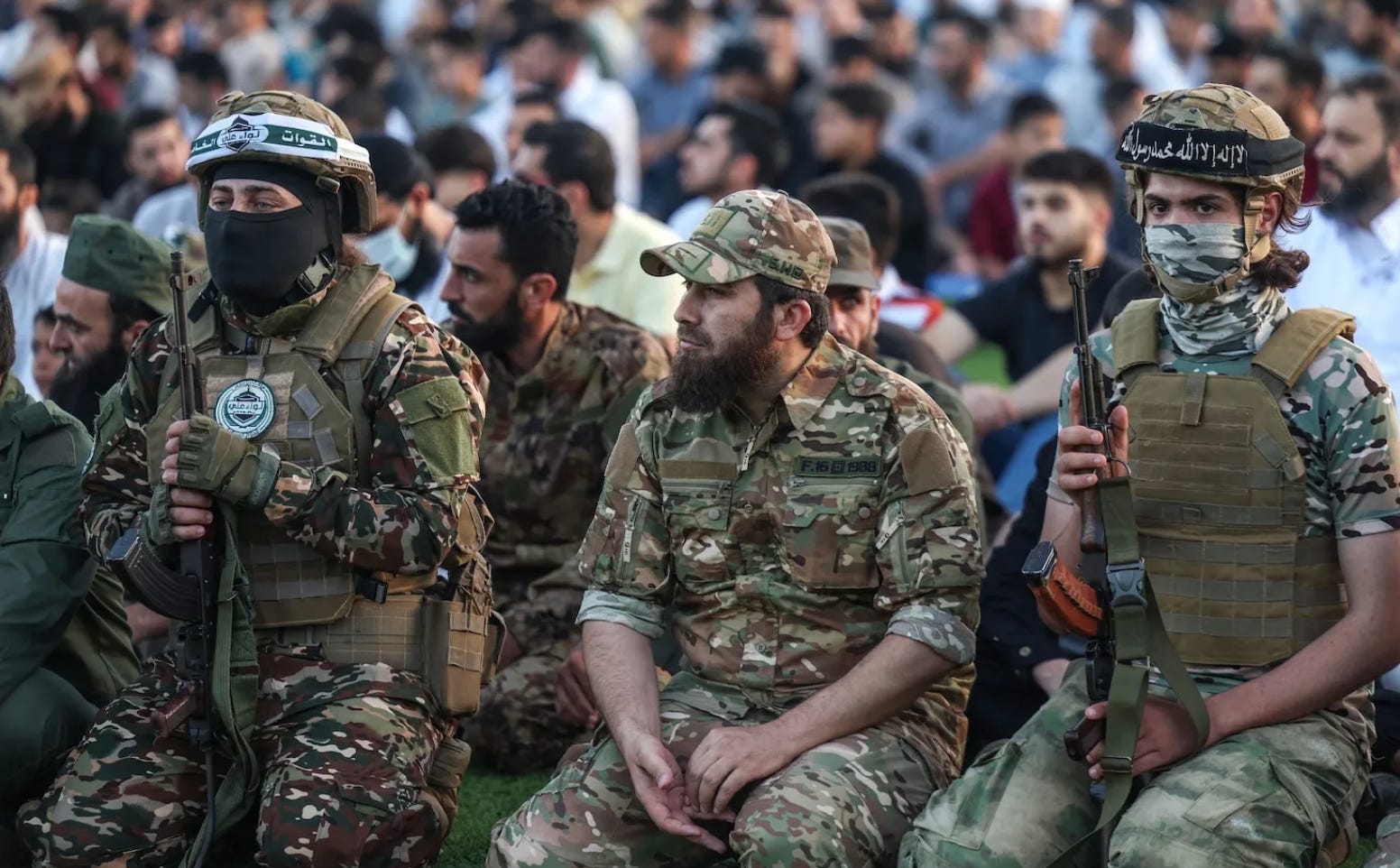
The foreign fighters were a matter of concern. How would they be managed? How would they be repatriated? Well, most of them are now Syrian soldiers. The largest contingent, about 3,200 mostly Uyghur fighters of the Turkistan Islamic Party, a group Beijing considers terrorist, was kept intact as the 84th Division under its own commander. The smaller contingents, a few hundred men each, were broken up and scattered at brigade level.
The US first demanded that the foreigners be expelled and then accepted the government’s plan. Drevon gives two reasons why it worked. Between 2020 and 2024 HTS ran its own counter-terrorism campaign in Idlib against Islamic State and al-Qaeda loyalists, so the foreigners still there by 2024 were the ones who had already accepted HTS’s authority. The second reason the foreign fighters integrated is that their home countries will not take them back, so their safety depends on keeping quiet and obeying. Some radicals remain. Uzbek fighters have clashed with security forces and been arrested, an Iraqi Kurdish jihadi group that refused to join was struck by the US-led coalition, and the leader of a French unit near Idlib has openly attacked al-Sharaa and called on other foreigners to back him.
Among the foreigners HTS promoted is Ömer Çiftçi, an HTS commander of Turkish nationality known as Mukhtar Turki. He was first given the division formed from Jaysh al-Islam, a Salafi faction from the outskirts of Damascus and the only former faction denied command of its own unit. Later he was put in charge of the division of Abu Amsha, the warlord whose Turkish-backed faction ran Afrin for years amid accusations of extortion and abuse, as the government broke up the SNA. In other words, a Turkish jihadi veteran was sent to dismantle the Turkish government’s own proxy. The decision that made this possible was taken by the Turkish government itself. By June 2025 it was paying its Syrian clients through the Defence Ministry in Damascus, and the SNA’s commanders lost the one thing that had held their men together. The Turkish government chose a centralized Syrian state over the militias it had financed for years, and the militias had no political project of their own to fall back on.
Who has the power
The army now holds all these men, but Drevon places it at the margins of the state’s coercive apparatus, with the core kept elsewhere. Drevon describes a two-tier system. The army defends the borders and absorbs the former factions. Internal security, intelligence and policing belong to the Interior Ministry, which was built around the General Security service HTS created in Idlib, and outsiders can join it only as individuals. The decisions that matter are taken in a National Security Council chaired by al-Sharaa, whose ministers of defence, interior and foreign affairs and head of intelligence all come from HTS. The factions were given generous room in the army because they were kept out of the institutions that control everything else. So it looks as if the Syrian state has, for now, secured a monopoly on organized force. This surely does not mean that the fighters integrated into the army have actually changed.
Drevon finds that the groups that resisted the integration were the ones with a political claim of their own and a foreign protector. Yani the Druzes and the Kurds.
The Druze of Sweida wanted guarantees about the character of the state, and they had Israel, which bombed the Defence Ministry in Damascus in July 2025, so the province still runs itself. The SDF had a project of Kurdish self-rule and American backing. Washington cut its funding in December 2025, and Turkey continued to push with full force. In January 2026 Syrian government forces took the Kurdish neighbourhoods of Aleppo, then Raqqa and Deir ez-Zor. The SDF then signed on terms worse than those it had refused a year earlier. It formally dissolved in August 2026, though the integration itself is still under way. Drevon’s sources described the old arrangements in the north-east as largely intact on the ground, and both sides complained about how slowly things were moving. Eleven weeks after the SDF announced its own dissolution, it is still handing over its weapons one batch at a time. The jihadis, the Idlib Islamists and the Turkish-backed warlords had either no political project distinct from HTS’s or no patron willing to defend one. For these groups, size and firepower made no difference to the final outcome. A large, well-armed faction was absorbed just as surely as a small one, only more slowly and in stages.
Limits of bureacratic ingenuity
The answer to my opening question, then, is that the radical Islamists and foreign fighters of the Syrian war are now soldiers of the Syrian Arab Army, paid by the Defence Ministry. For al-Sharaa, this is a remarkable consolidation of power. He has achieved something that eluded other victors of fragmented civil wars, bringing rival armed organisations under a single military hierarchy without conceding them a political share in the new state. Even more remarkably, he has managed to do this without fully dismantling their military structures at the outset. The question is whether the method that has worked so well in neutralising armed rivals can also work politically and socially.
Looks like Al-Sharaa has treated the demands of rival organisations as administrative questions to be settled through appointments, military ranks and institutional absorption. Yet the grievances of the communities from which these organisations emerged cannot be disposed of in the same way. The Kurds’ demands for political recognition and decentralisation, the Druze insistence on guarantees against sectarian domination, and the anxieties of Alewites concern the character of the Syrian state itself. These are not questions that I believe bureaucratic ingenuity can settle.
This Weberian method has an obvious attraction for a leader determined to avoid the fate of Libya or Lebanon. But we should not forget that Syria has its own history of a state whose security apparatus grew stronger as political representation became increasingly meaningless during Assad dynasty. Al-Sharaa may be constructing a more coherent state, but coherence alone cannot guarantee legitimacy, particularly when the institutions responsible for internal security remain concentrated in the hands of his former comrades.
This is perhaps the central paradox of Syria’s transition. Al-Sharaa has been remarkably successful at dismantling the organisations that might challenge his authority, while doing much less to create institutions through which the constituencies behind those organisations can participate in shaping the country’s future. He has found a way to incorporate fighters without negotiating with them as political actors. Whether he can govern a society through the same logic is another matter.
Jérôme Drevon, “Integration Without Representation: Bureaucracy, Depoliticization, and Military Formation in Post-Civil War Syria,” working paper, September 3, 2026, https://doi.org/10.2139/ssrn.7552745