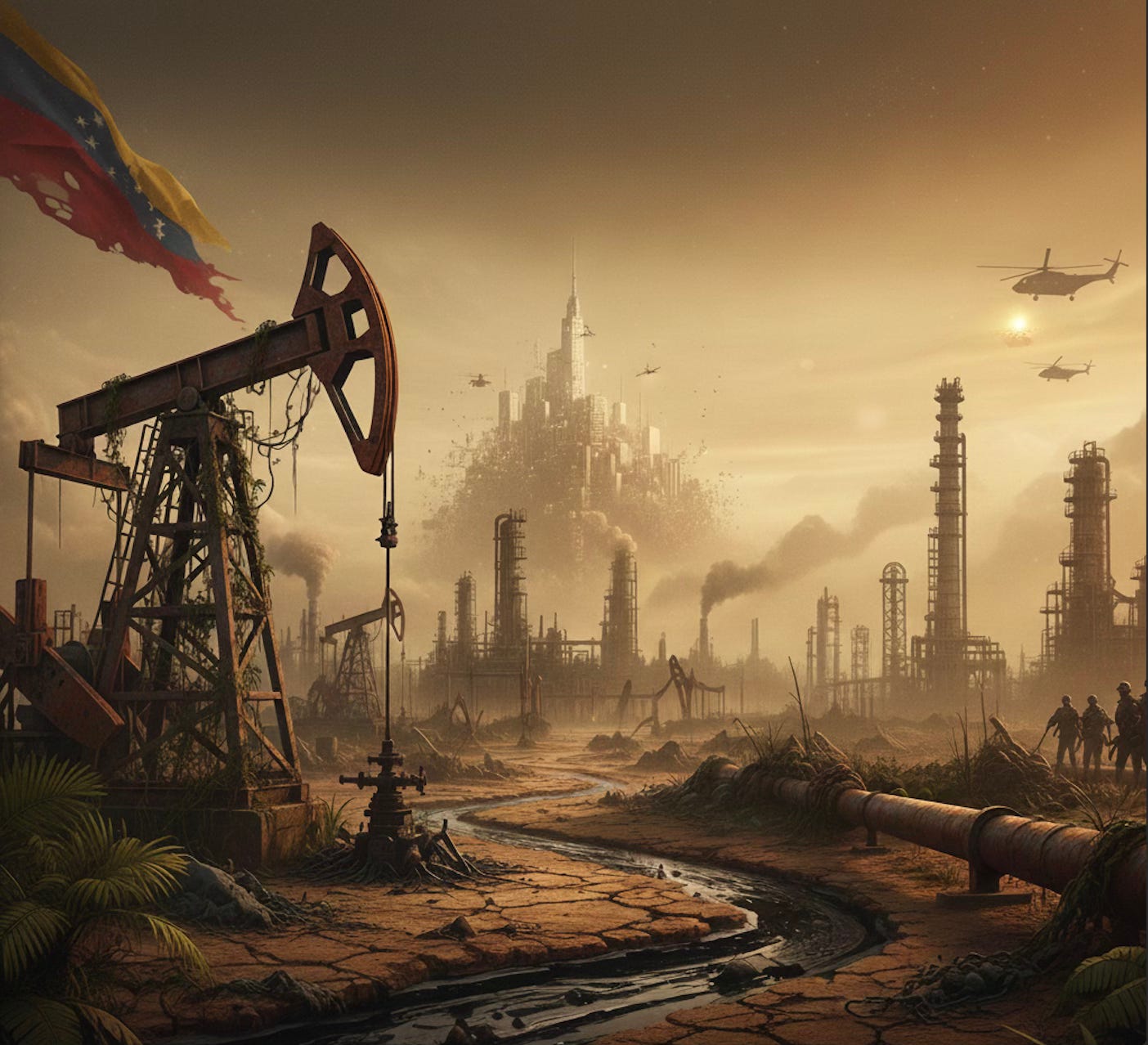
Venezuela’s ‘Oil Curse’: Parallels from the Middle East
As the US takes on a mandate over Venezuela, the Middle East’s long shadow falls once more over fantasies of easy oil wealth. What the oil curse is and why it endures.
The digital zeitgeist of Turkey is perpetually haunted by the aphorism coğrafya kaderdir (geography is destiny). It is invoked with such frequency that it now colors a wide range of observations, from the ironies of a decimated rule of law and non-existent free speech to the idiosyncratic dietary preferences of Istanbul’s street cats, who seemingly prefer a tasty plate of kuru fasulye-pilav ( over any proper kibble.
This expression is typically deployed to emphasize that had a person, institution, or concept been nourished elsewhere, their trajectory would have been characterized by superior health, wealth, and opportunity. While the phrase has been somewhat diluted by the wry, cynical humor of Turkish social media, it remains firmly anchored in a national psyche where the inherited trauma of the WWI and the War of Independence translates into a phobia of being dismembered or colonized by predatory great powers. In this climate of existential anxiety, there is a subsequent and recurring expression of paradoxical relief to ‘geography is destiny’: . ‘Çok şükür’, the saying goes, ‘at least we do not have oil.’
The Iranians cannot say that, can they. The Libyans, the Iraqis, and the Kuwaitis are similarly barred from such comfort(!). Ironic, yes but true when we remember that their geological luck has functioned as a magnet for a level of bellicosity that continues to shudder through the rest of the world.
Oily Face of Mandate Era
What have we gone through the last several days? Can be said ‘transformative’ for the international order. We have witnessed the immense, clinical military capabilities of U.S. Delta Forces as they extracted Nicolás Maduro and his wife, Cilia Flores, from the fortified heart of Caracas. This was an act that effectively signaled the obsolescence of the intellectual, ethical and legal frameworks carefully curated in the post-war era. Also the rhetorical mask of "self-defense" has finally slipped to reveal the old, oily face of 19th century mercantilism.
While the official justification for this operation in Venezuela remains anchored in a ‘crusade against narco-terrorism’ and the dismantling of a corrupt patronage system, Trump has been remarkably candid about the primary prize of this intervention. I, for one, appreciate this transparency.
After decades of being marketed regime change under the guise of democracy promotion or the war on terror, it is a refreshing breath of air to hear the American executive openly declare that the United States will "run the country" as a de facto mandate system focused on the division of spoils.
Trump’s vision of American oil companies marching into Venezuela’s Orinoco Belt to extract billions in wealth as reimbursement for domestic damages is a seductive narrative for a specific base of voters. It is also a fantasy.
Most experts concur that the Venezuelan petroleum infrastructure is currently a rusted monument to mismanagement, a decimated landscape of capital flight and technical brain drain that would require hundreds of billions of dollars and decades of stability to resuscitate. There will be no immediate windfall. This reality is particularly ill-suited for a leader whose primary psychological drives are short-term ratings and the instant gratification of a reality show victory. He cares little for the slow, arduous work of building strong institutions or reconstructing.
The Political Trap: The Rentier State
All this inevitably drags the ghost of the Middle East back into the limelight, the echoes of Iraq and Libya are now too loud to ignore, reminding us of the persistent, often tragic concept known in political science as the “resource curse” or its specific phenomenon; “oil curse.”
In the world of global economics, this phenomenon describes how countries with vast natural endowments frequently experience significantly poorer economic development and more brittle governance than their resource-poor neighbors.
The economic symptoms of this curse often begin with a condition called “Dutch Disease,” named after the Netherlands’ experience in the 1970s. When a country experiences a sudden surge in oil exports, its real exchange rate appreciates, making it nearly impossible for domestic manufacturers and farmers to compete globally. This “resource pull effect” shifts labor and capital into the oil sector and construction, effectively hollowing out traditional industries like agriculture. When the oil eventually runs out or prices crash, these displaced sectors often find it impossible to recover.
The Honeypot: Corruption and Conflict
However, as a scholar of the Middle East, I find the political dimension of this curse—the creation of the rentier state—far more insidious. In these systems, the government lives off nontax revenues, effectively severing the fundamental social contract. Yani, the classic demand of “no representation without taxation” is perversely inverted. When citizens are untaxed, they lack the financial leverage to demand accountability, while the regime remains insulated from the needs of a productive populace. As political scientist Michael Ross argued in his influential 2001 study “Does Oil Hinder Democracy?”—perhaps the most significant quantitative effort to link resource wealth with autocratic persistence—petroleum revenue makes authoritarian regimes remarkably durable. Why? Because, for one, it allows leaders to “buy off” potential opposition through expansive patronage or to fund a gargantuan, high-tech coercive apparatus to quash dissent.
Some theorists suggest a potential cure: distributing oil wealth directly to citizens and then taxing it back to induce a demand for accountability. It is a noble idea that rarely survives the greed of the “honeypot.”
This ‘honeypot effect’ is a primary driver of violence, as the massive gap between the low cost of extraction and high market values provides an overwhelming incentive for individuals to capture the state for personal gain. In countries like Nigeria, billions of dollars have been lost to such state-level theft. Furthermore, these resource concentrations increase the value of capturing the state, incentivizing non-state actors to attempt to topple the government through violence. This risk is particularly acute when oil is located onshore in territories belonging to marginalized ethnic groups.
Regional Context: The Middle East
The Middle East remains the “exemplary” case for this curse, even if some scholars argue this is partly due to “survivorship bias.” For instance, the small, highly stable monarchies of the Arabian Peninsula might not have survived as independent, sovereign states without historical British intervention motivated by oil security. The region also highlights the link between oil and interstate bellicosity, most notably in the case of Iraq under Saddam Hussein. In these instances, oil-funded rulers used their capital to dismantle domestic checks and balances, allowing them to engage in risky foreign invasions like the occupation of Kuwait.
Despite these grim patterns, the oil curse is not an inevitable fate. Norway acted like a sensible lottery winner after discovering its oil reserves, creating a transparent wealth fund and abiding by a social contract with its citizens. Oman, too, has managed to avoid the worst of the syndrome by maintaining countercyclical policies that smoothed out price collapses. However, these are the exceptions. In a different world, the small principalities of the Arabian Peninsula provide the strongest statistical evidence for the link between oil and the lack of democracy.
The curse also carries a unique social dimension in the Middle East regarding the gender gap. Unlike manufacturing-based growth, oil-led growth does not typically draw women into the private-sector workforce. Because the oil sector is capital-intensive and male-dominated, and “Dutch Disease” erodes sectors like agriculture that often employ women, oil-rich states frequently exhibit lower female labor force participation.
Conflict and Foreign Meddling
Unsurprisingly, the “curse” often involves external actors who interfere in domestic politics to secure resource flows. The 1953 CIA-backed coup in Iran stands as the most cited example of foreign meddling undermining a country’s sovereignty. We also know the unfounded claims of weapons of mass destruction that led to the invasion of Iraq in 2003, an intervention that literally broke the country beyond repair. Paul Wolfowitz infamously suggested that Iraqi oil would pay for its own reconstruction, a figure that now stands as a testament to the dangers of underestimating structural decay. The reality was far more corrosive.
The case of Libya under Muammar Gaddafi and its subsequent collapse after 2011 offers an even more stark illustration. For decades, Gaddafi’s Libya was a textbook rentier state, where oil wealth allowed the regime to bypass the need for a productive citizenry. When the regime collapsed, the vacuum was not filled by democratic institutions but by what Michael Ross terms “booty futures.” This is the phenomenon where armed groups finance their insurgencies by selling off the future exploitation rights to resources they have yet to capture. The oil that once sustained a single autocrat now fuels a fractured landscape of competing militias. Who can guarantee Venezuela’s fate would be different?
Other Perilous Developments in the Region
Iran

In Iran, the nationwide protests sparked in early January 2026 have entered a critical, survivalist phase. Triggered by a catastrophic collapse of the Rial and soaring inflation, these demonstrations have rapidly evolved from a cry for economic relief into a full-scale political revolt that spans from the traditional bazaar merchants in Tehran to the historically marginalized western provinces. Unlike the internet blackouts of previous years, the state has adopted a more sophisticated, layered strategy of "engineered degradation" to disrupt communication while attempting to keep a fragile economy from total paralysis. The security response on the ground, however, remains archaic in its brutality. Live ammunition has already claimed dozens of lives, suggesting that the regime’s tolerance for dissent has reached a terminal nadir.
Articles to read on this matter:
Everything you need to know about the Iran protests—and more.
Iran protests: Trump Threatens Military Action But It Won’t Him the Results He Wants.
Syria

The fragile truce in northern Syria is unravelling with alarming speed. Recent negotiations in Damascus between the Syrian Democratic Forces (SDF) and the interim government of al-Sharaa failed to produce any tangible results regarding the integration of Kurdish military and civil structures into the national state. This diplomatic stagnation has translated into violence in Aleppo, where deadly skirmishes in the Kurdish-majority neighborhoods of Sheikh Maqsoud and Ashrafiyah have once again brought the regime and the SDF head-to-head. Syrian authorities have ordered civilians evacuate as the military prepares for a direct operation against the SDF. The SDF has categorically rejected the regime's accusations of a military threat, asserting that they have no formal military presence within Aleppo city following a documented withdrawal and transfer of security responsibilities to local internal security forces. Damascus appears ready to ignore these distinctions.
Damascus is also full of unverified reports. Allegations of an assassination attempt against al-Sharaa have swirled through social media, prompting the Interior Ministry to release footage of the leader walking through the streets of Damascus, allegedly shopping in Mezzo district to project an image of stability. Some sources argued that the video belonged to a previous shopping event and cannot be taken as evidence.
While the government categorically denies any attack took place, the mere persistence of such rumors—combined with Israeli intelligence reports flagging credible threats from Iran—underscores the precarious nature of the new Syrian leadership. Whether these are genuine attempts on his life or the psychological warfare of a deeply fractured political landscape, they highlight the immense difficulty of stabilizing Syria - which should be very alarming for all of us.


