Playing with Iranian blood, using Kurds as boots – for what?
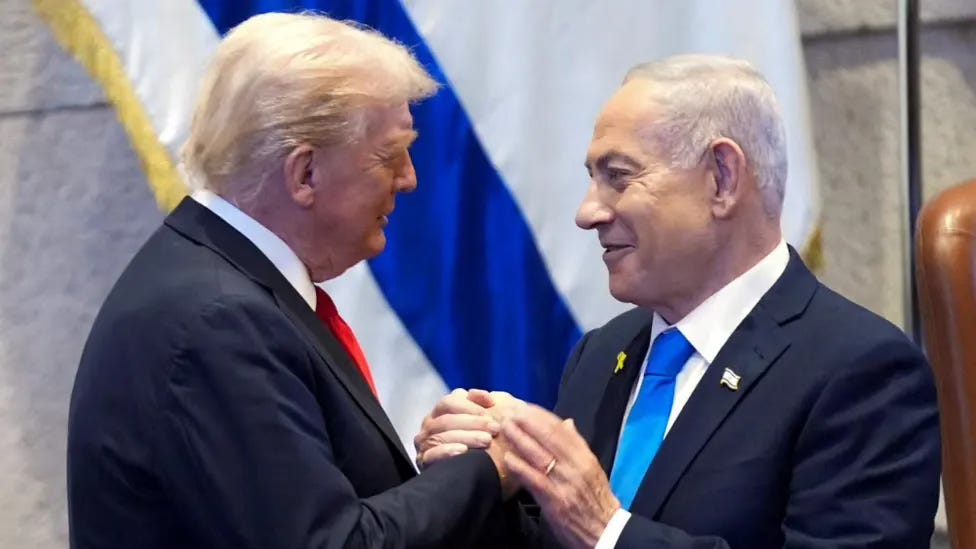
Trump and Netanyahu do not care about regime change. They want chaos. But for what? Let’s think about it. Could it be…?
We go on asking why these two men, Trump and Netanyahu, waged a war against Iran. Surely we have moved beyond the claim that Iran posed an imminent threat (it did not), or that it was building a nuclear bomb with its “completely obliterated” nuclear facilities during the so called 12-day war (they were not). The head of the International Atomic Energy Agency, Rafael Grossi, recently stated that inspectors have found no evidence of a coordinated Iranian programme to build nuclear weapons.
So we are left with a narrower set of possibilities. Either regime change in Iran. Or outright chaos, sustained long enough for Israel to manipulate the balance of power, perhaps even to engage in territorial opportunism if circumstances permit. But how would that be achieved? There are numerous examples showing how difficult it is to produce regime change through aerial bombing alone. Air power weakens and destroys infrastructure. It rarely dislodges a consolidated regime.
Which brings us to the repeated public appeals by both men to the people of Iran, urging them to take to the streets and take over their own government. At that point the logic becomes clearer. The burden of transformation would shift from those who launched the war to those who must survive its consequences.
Remember Hungary 1956?

By the autumn of 1956 Hungary had been a Soviet satellite for more than a decade. Political competition had been eliminated, the security services entrenched, and the economy forced through collectivisation and heavy industrial priorities that generated compliance without consent. The limited thaw that followed Stalin’s death, and the brief premiership of Imre Nagy, suggested that a different accommodation with Moscow might be possible. When that experiment was curtailed, expectations did not quietly recede. They lingered in universities, in factories, and within parts of the party itself, where it was increasingly clear that the postwar order rested on force rather than assent.
The demonstration of 23 October began as a student march in Budapest, formally aligned with reformist developments in Poland. The demands it articulated were at once procedural and national: freedom of expression, multi party elections, the withdrawal of Soviet troops, Nagy’s return. When security forces opened fire, the character of the event changed. Weapons circulated, army units defected, and for several days it was uncertain whether the state could reassert control.
The revolt did not take place in isolation. For years the United States had presented itself as the advocate of Eastern Europe’s “captive nations”. Radio Free Europe broadcast continuously into Hungary in Hungarian, reporting on the uprising and framing it within a broader narrative of liberation. Washington did not announce that it would intervene militarily if events escalated. It had little intention of doing so. Yet the cumulative effect of American rhetoric, repeated assertions that Soviet rule was provisional and historically unsustainable, helped create a setting in which resistance could be understood as aligned with Western strategy rather than exposed to it.
When Soviet forces re-entered Budapest in early November, the calculation shifted. The second intervention was decisive. Around 2,500 Hungarians were killed, thousands more were injured and roughly 200,000 left the country. The episode demonstrated not only the strength of Soviet power but also the distance between the American language of liberation and the willingness to enforce it.
Keeping this episode in mind, and remembering how the Iranian regime behaves under existential pressure - how restraint quickly becomes secondary to control, how little value it places on the lives of its citizens, how it killed more than 30,000 people just a month ago under a communications blackout - calling for mass mobilisation now is effectively an invitation to another bloodbath in the streets.
Undermining the Legitimacy of Iranian Protest
There is also the question of legitimacy. By calling on Iranians to rise up, Trump and Netanyahu, with their record of belligerence, risk weakening the very movements they claim to support. Protest movements derive their strength from domestic grievances and from their ability to articulate a national rather than externally scripted agenda.
Iranians have been teaching the world how to resist one of the most rigid and brutal regimes of the modern era for more than a decade. They do not need Trump or Netanyahu. On the contrary. When leaders who are simultaneously engaged in overt confrontation with Iran publicly urge Iranians to overthrow their government, they collapse the distinction between internal opposition and external hostility. The regime is then handed a ready-made narrative in which any protester can be portrayed as an instrument of enemies already at war with the state. Even movements whose motivations are plainly domestic can be reframed within a security paradigm that the authorities control.
The consequences could be severe. A failed or brutally suppressed uprising under conditions of war would consolidate hardline factions, expand emergency powers and weaken civil society networks that have taken years to build. It would not only produce death. It would also erode the legitimacy and organisational capacity on which meaningful internal change depends. Which social movement would want to be associated with a call issued by Trump and Netanyahu and later avoid being branded vatanfurush by fellow Iranians?
Kurds as Boots on the Ground
But the instrumentalisation does not end with Iranian civilians. Tabii ki. Trump appears to be attempting something similar with Iranian Kurdish groups, hoping to turn them into boots on the ground against Tehran.
First came calls to Iraqi Kurdish leaders Masoud Barzani and Bafel Talabani. Then the CIA reportedly entered the picture and continued discussions.
The organisations involved operate from bases along the Iran–Iraq border in the autonomous Kurdish region of northern Iraq. The idea is to exploit the current military pressure on Iran by opening an additional front in the west. The calculation in Washington appears to be that attacks there might weaken Iran’s security apparatus and create space for internal unrest.
The Kurdish groups have not accepted the proposal. They have instead requested American military backing and a no-fly zone. There is also discussion of covert assistance, including the possible provision of weapons.
An investigative journalist recently noted another small but revealing detail. Only five days before the bombing began, two major American defence and intelligence contractors posted job advertisements seeking a Kurdish linguist in the Sorani dialect with top security clearance. The timing suggests that the idea of drawing Kurdish actors directly into this conflict may have been assembled at the last minute, in the days immediately preceding the strikes. That alone is unsettling.
It also reminds us that wars often produce beneficiaries that do not appear immediately on the surface. Defence contractors, intelligence intermediaries and private firms operate quietly around the edges of conflict, finding opportunities in situations that are presented publicly as matters of security and strategy.
There is also another development deep in correlation here that I need to mention: Only a few days ago, five major Iranian Kurdish opposition parties announced the formation of the Coalition of Political Forces of Iranian Kurdistan, bringing together the Democratic Party of Iranian Kurdistan (PDKI), PJAK, PAK, Komala and the Khabat Organisation. In their joint declaration the parties committed themselves to closer coordination in pursuit of the overthrow of the Islamic Republic, Kurdish self-determination and the establishment of democratic political institutions in Iranian Kurdistan.
I am not suggesting that this convergence is simply the product of American or Israeli design. The effort to overcome the long-standing fragmentation of Iranian Kurdish politics has been under discussion for some time, particularly in the wake of the Jin, Jiyan, Azadi movement that erupted after the killing of Mahsa Amini, the young Kurdish Iranian woman detained by the morality police for refusing to cover her hair.
Yet political developments rarely occur in a strategic vacuum and this one hardly looks coincidental. The fact that this declaration of unity arrived just as the prospect of a U.S.–Israeli confrontation with Iran was becoming increasingly tangible raises a question about timing.
It is entirely possible that Kurdish actors were already moving toward coordination. It is equally plausible that signals of external encouragement, and the anticipation of a broader conflict with Tehran, accelerated the decision to formalise that unity when they did.
Turning Iran into Another Syria
I think it should be clear that what Netanyahu may ultimately want from this crisis is not regime change but prolonged instability. A situation of internal conflict, perhaps even a civil war resembling Syria’s long catastrophe. Because it is difficult to see how this path that they are taking could produce a stable or democratic Iran.
What it would certainly produce is something else: Iranian lives spent as blood to sweep away the regime, Kurdish fighters treated as expendable instruments, a region increasingly pulled into the vortex of confrontation, with Gulf states drawn closer to the conflict with each passing day. There is also one country for whom Kurdish mobilisation along Iran’s western frontier would be intolerable. Not only because of the security implications along its border, but also because such instability would likely produce a new wave of displacement, leaving Ankara with the prospect of hosting millions of vulnerable people fleeing the resulting chaos. Turkey.
We will return to the question Turkey’s likely reaction when more concrete information emerges about developments in Iran and Iraq.
But before that, another possibility must be considered.
Why this war. Why now. Could it be?
We may simply be reluctant to accept the most disturbing explanation. That much of what we are witnessing — all of it, perhaps — reflects the personal calculations and corruption of the two men who launched it.
The historian Timothy Snyder recently made precisely this argument. The war on Iran, he suggests, is also a war on truth, designed to strengthen authoritarian tendencies at home, in the US. “Is the war about nuclear weapons, or regime change, or electoral interference? It is about none of these things,” Snyder writes. “It is about feeling good and staying in power.”
We need to gather ourselves and think seriously about solidarity in a time of extreme volatility, corruption, bullying and a striking lack of leadership. Otherwise we will all lose. Badly.


