

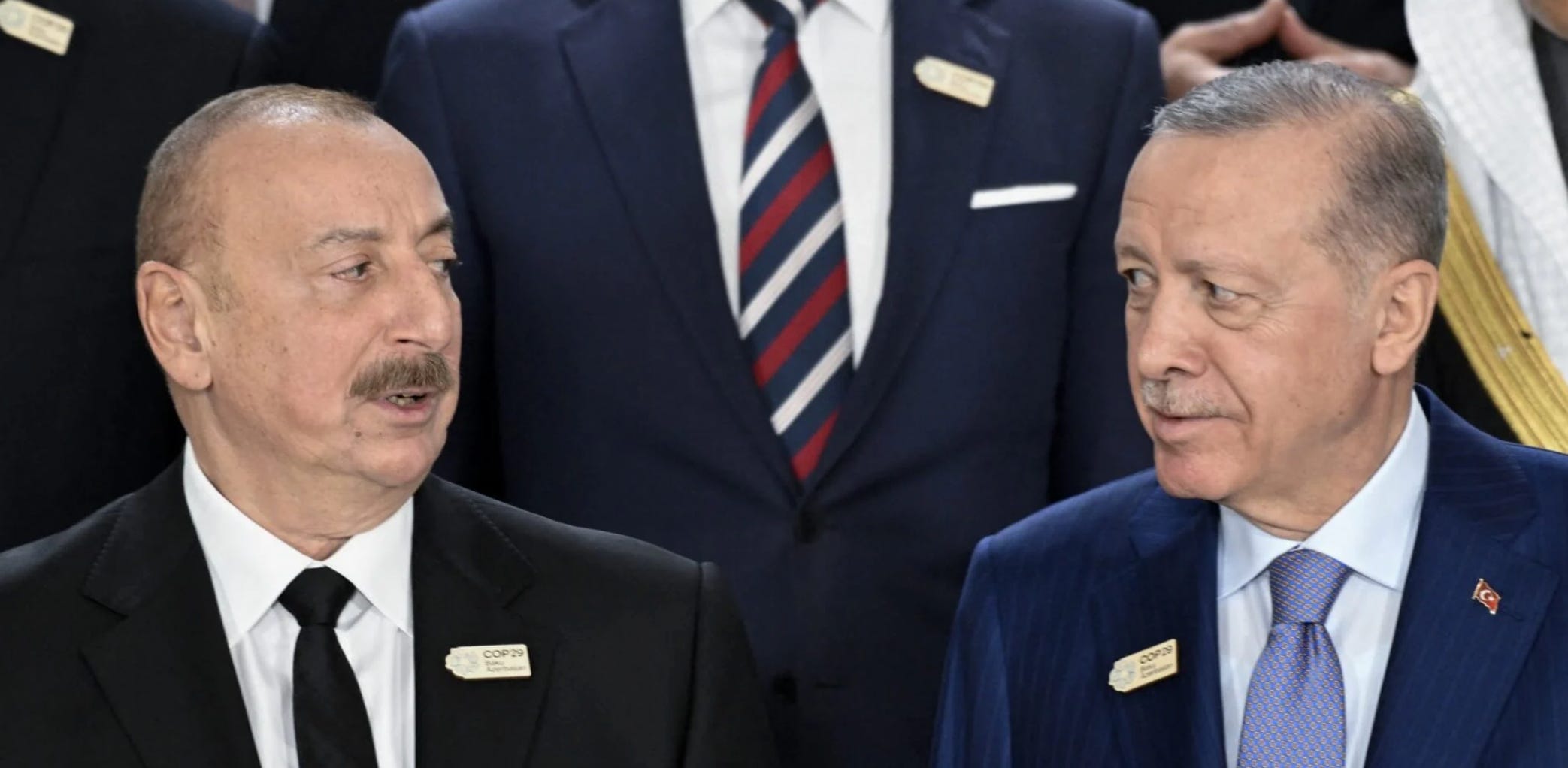
For 30 years Azerbaijan has turned up in Turkish newspapers on a few fixed occasions. It appeared when there was fighting in Karabakh, when a pipeline was inaugurated, and when the two presidents stood side by side and repeated the formula Heydar Aliyev made famous in the 1990s, “iki devlet, tek millet” - two states and one nation.
Between those occasions, it hardly appeared at all. For the past six weeks, an unexpected tension between the two countries has been carried into public debate. In a confusing and a tad unflattering way. We discovered, rather discomfitingly, how little we know about Azerbaijani politics, about who holds power in Baku and how they keep it. Also about the religious and social cleavages inside the country, and about what its rulers think of us, the Turks. All of this, I believe, was obscured under that incantation: “two states, one nation”!
The ban that made the AKP
The quarrel began, or seemed to begin, with school uniforms. On 21 September the Azerbaijani cabinet amended the ruleson what pupils in state schools may wear and barred clothing that violates the secular principle of education.
As a result, girls in headscarves were kept out of classrooms, and in early October the same principle was applied to teachers, some of whom were stopped at the school door. When pupils and parents protested, the Interior Ministry announced that 37 people had been detained. The legal ground had been laid in July, when parliament added “patriotism and secularism” to the principles of the general education law.
Azerbaijan has been here before. In December 2010 the education minister kept the headscarf out of schools with a verbal instruction that had no law behind it, and the government rode out the protests that followed. This time the ban was written into law and defended in public.
The headscarf issue is a familiar one for Turkey and strikes a deep chord with the AKP’s electorate and its founders. On 28 February 1997 the generals, acting through the National Security Council, presented the coalition government of Necmettin Erbakan, the founding figure of mainstream Turkish political Islam, with a list of demands that drove him from office within four months. The episode came to be called the postmodern coup, because it was carried out with memoranda instead of tanks.
Erbakan’s Welfare Party was closed by the Constitutional Court, and the ban on headscarves in universities was enforced with new zeal. Large numbers of women gave up their degrees or lost jobs in the civil service. In 2001 younger figures from Erbakan’s movement, Recep Tayyip Erdoğan and Abdullah Gül among them, founded the AKP, and in November 2002 they won their first general election. Lifting the headscarf ban, which the party did step by step over the following decade, became one of its proudest claims to legitimacy.
AKP officially silent
So one might have expected the sharpest protest against Baku to come from the AKP government. Interestingly, the Erdoğan government kept officially silent instead. The party’s spokesman, Ömer Çelik, declared on 7 October that the AKP would not allow political tension between the two countries. Binali Yıldırım, a former prime minister who now chairs the council of elders of the Organization of Turkic States, told an Azerbaijani news site, “Who would dare to meddle in Azerbaijan’s internal affairs?” On 14 October Devlet Bahçeli, leader of the Nationalist Movement Party, Erdoğan’s governing partner, whose votes keep Erdoğan in power, called for respect for the legal systems of both countries.
The silence is easy to understand, actually… Once you set aside the fast-eroding fiction of Erdoğan and his entourage as “principled Islamists”, it is plain to see.
Azerbaijan is a supplier of Turkey’s gas, the owner of one of its largest industrial investments and a partner in pipelines and defence.
SOCAR, the Azerbaijani state oil company, has invested about $18 billion in Turkey over 15 years. It owns the Petkim petrochemical complex and the STAR refinery at Aliağa near İzmir, which Aliyev and Erdoğan opened together in 2018, and it holds the majority stake in TANAP, the pipeline that carries Azerbaijani gas across Anatolia to Europe. Last December SOCAR bought a gas-fired power plant in central Turkey. For years SOCAR was described as the largest foreign investor in Turkey. Azerbaijani state capital has also reached into Turkish courtrooms, as the long fight over Bodrum’s Yalıkavak Marina showed when it ended with SOCAR-linked owners in control.
In Erdoğan’s foreign policy, money and business have nearly always come first when they pulled against principle. If there was anyone left who would have thought that a schoolgirl’s headscarf in Baku would weigh more than a refinery in İzmir, someone should slap that person awake to the realpolitik of Erdoğanland.
Well, oops, there was one person… Oktay Saral, who had served as a chief adviser to the president since 2016. On 12 October he wrote on X that the headscarf “is not an obstacle, it is a requirement of faith” and urged Azerbaijan to turn back from its mistake. He did not know that the only mistake was him posting that tweet! A few AKP deputies backed Saral and said similar things. But the next day the New Azerbaijan Party, which Aliyev chairs, accused the AKP of interfering in Azerbaijan’s internal affairs and of joining a smear campaign.
According to Middle East Eye, the Azerbaijani government then asked the Turkish government to remove Saral and handed over a list of social media accounts it wanted closed and their owners prosecuted. Some of the accounts were reportedly blocked. On 26 October Saral announced his resignation. “Our President appointed me to this position, and I resigned at his instruction,” he said.
That same night police in Istanbul detained Muhammed Emin Yıldırım, the Istanbul representative of Köklü Değişim, a media outlet linked to the pan-Islamist Hizb ut-Tahrir, on a charge of insulting the leaders of a foreign state. A colleague of his was detained in Hatay, and an activist was questioned at police headquarters in Ankara. By then the Azerbaijani prosecutor had issued warrants for seven people living in Turkey, among them Rıdvan Kaya, who chairs the Islamist rights association Özgür-Der, and Baku had barred 31 Turkish citizens from entering the country.
The AKP was founded by people who lived through the headscarf ban, and in its 24th year in power its police were detaining Turkish citizens for criticizing one. Nice!
Aliyev no-show
Even that did not satisfy Baku. Erdoğan telephoned Aliyev on 21 October and invited him to the summit of the Organization of Turkic States in Ankara, a meeting at which Azerbaijan was to hand the organization’s chairmanship to Turkey. Aliyev did not come.
APA, the Azerbaijani Press Agency, a privately owned but reliably pro-government outlet, reported that he would attend the closing ceremony of the FIFA under-15 World Cup in Baku instead, and Azerbaijan was represented in Ankara by its foreign minister, Jeyhun Bayramov. According to some sources, the absence was read in Baku as a reply in kind, and APA itself reminded its readers that in diplomacy everything is reciprocal.
Erdoğan had stayed away from an Asian security summit hosted by Aliyev on 15 October, and his foreign minister, Hakan Fidan, had walked out of the hall when the Israeli president, Isaac Herzog, began to speak.
On 27 October Azerbaijan welcomed the United Arab Emirates’ candidate for UN secretary-general, Lana Nusseibeh, while the Erdoğan government was preparing to put forward Feridun Sinirlioğlu. Three days later APA published an attack on Sinirlioğlu, accusing him of having lobbied for a unilateral rapprochement with Armenia.
The Israel grievance
By then, I think, it was clear that the anger in Baku concerned more than headscarves. APA publishes nothing the Aliyev government would not wish to see in print, and it had been saying for weeks what the grievance was. On 6 October it ran a report headlined “456 ship voyages from Turkey to Israel: The unseen side of ‘zero trade’”. It counted voyages from Turkish ports to Israeli ones in the first nine months of 2025, more than a year after the Erdoğan government announced that it had stopped all trade with Israel, and it presented the figures as a reply to “black propaganda” coming from Turkey about Azerbaijan’s own ties with Israel.
A second APA report, on Turkish-linked ships that docked at Israeli ports in September, was taken down within hours of publication. Aliyev’s ruling party, the New Azerbaijan Party (YAP), said it “categorically” rejected attempts to portray Azerbaijan’s ties with Israel “as allegedly exceptional”. An editorial in the pro-government site Minval complained that for three years Azerbaijan had faced a “torrent of accusations and humiliation” over Israel in Turkish media. The latest round had begun on 24 September, when Azerbaijan’s delegation stayed in its seats at the UN General Assembly while Benjamin Netanyahu spoke and the Turkish delegation walked out. Baku’s answer was that it had stayed to listen even to Armenia.
The relationship between Azeris and Israelis is old, and it rests on oil and arms. Azerbaijan began selling oil to Israel in 1999. According to the shipping analysts Kpler, Azerbaijani crude made up 46.4 per cent of Israel’s oil imports last year, the largest share this decade. The oil travels by the Baku-Tbilisi-Ceyhan pipeline to the Turkish port of Ceyhan, where it is loaded onto tankers bound for Israel, and Turkey earns about eighty cents for every barrel loaded.
It is not a secret that throughout the Gaza genocide, the oil that ran Israel’s economy crossed Turkish territory to reach it. In the other direction, Israel supplied 60 per cent of Azerbaijan’s arms imports between 2015 and 2019, according to the Stockholm International Peace Research Institute, and Israeli drones did much of the work in the wars over Karabakh. Karabakh, a mountainous region inside Azerbaijan’s internationally recognized borders, had been held by Armenian forces since 1994. Azerbaijan took back much of it in a 44-day war in 2020 and the rest in a one-day offensive in September 2023, after which nearly all of the region’s Armenians, more than 100,000 people, fled. In Turkey the 2020 victory is usually told as a Turkish one, won by Bayraktar drones, Turkish military training and Erdoğan’s open political backing, and Erdoğan himself has claimed a share of it.
The two countries’ intelligence services have long been reported to share information on Iran.
Between Turkey, Iran and Israel
None of this fits easily with what most Turks believed about Azerbaijan. First of all, many assumed that a country with a Shia majority on Iran’s northern border would live in Tehran’s shadow. Many of the same people assumed, with equal confidence, that it lived in ours, I mean Turkey’s.
Seen from Baku, the region looks different, as we now seem to be finding out. Iran is the nearest neighbour, and more ethnic Azerbaijanis live in Iran than in Azerbaijan itself. Russia ruled the country for nearly two centuries and still hosts a large Azerbaijani diaspora. The Ottoman legacy and the bond with Turkey are real, but they are one axis among several. Aliyev has spent this year moving between three Middle Eastern powers, Turkey, Iran and Israel, at a time when two of them were at war with each other. When the US and Israel struck Iran this spring and the IRGC, Iran’s Revolutionary Guards, threatened Azerbaijan over its partnership with Israel, a telephone call between Aliyev and the Iranian president, Masoud Pezeshkian, appeared to settle nerves in Baku. Business with Iran has continued throughout.
Since 2005 Iranian gas has supplied Nakhchivan, the Azerbaijani exclave cut off from the mainland by Armenia, under a swap in which Azerbaijan sends gas to northern Iran in return. The two countries are partners in the North-South transport corridor linking Russia to the Gulf, and in the first eight months of this year Azerbaijan imported more gas from Iran than it sold to it.
No patron needed
On 2 October, at the congress where his party abolished the term limit on its chairman, Aliyev said Azerbaijan needed no one’s “help or patronage” and had paid for its weapons at world market prices, “down to the last bullet”. To Turkish ears this sounded like ingratitude, because Turks have been led to believe that it was Turkish military expertise and assistance that helped Azerbaijan reclaim Karabakh. “What is Aliyev implying now?! What ingratitude!” was the sentiment on Turkish social media.
When I started writing this piece, I gave it the headline “Azerbaijan squeezed in the heated axis of Turkey, Israel and Iran”. Well, now that I think about this recent quarrel, it is fair to ask who is really squeezed.
Aliyev sells oil to Israel, swaps gas with Iran, owns refineries in Turkey, and has made each of the three understand that Azerbaijan’s affairs are his to decide. The Erdoğan government condemns Israel while Azerbaijani oil bound for Israel is loaded at Ceyhan. It built its legitimacy on religious freedoms, among them the freedom to wear the headscarf in public buildings and schools. Now it looks as if it has zero memory of its own past, and it even fires its own men who defend the headscarf in Baku. Meanwhile, its Armenia policy has been decided in Baku since 2009. That October Turkey and Armenia signed two protocols in Zurich to establish diplomatic relations and reopen their border, which Turkey had closed in 1993 in solidarity with Azerbaijan. The protocols were never ratified, because Aliyev objected.
None of these contradictions began in September. The “two states, one nation” slogan kept them out of Turkish newspapers, and the less Turks knew about Azerbaijan, the easier the contradictions were to miss. This autumn Aliyev decided to show them to the Turkish public.
What’s behind the hijab ban?
The religious map of Azerbaijan is complicated. Between 60 and 65 per cent of Azerbaijan’s Muslims are Shia. There are substantial Sunni communities in the north and west of the country. The Azerbaijani state manages religion through an institution older than the republic. In 1872 Tsar Alexander II created separate boards for the Shia and Sunni clergy of the Caucasus.
Moscow rebuilt them in 1944 as a single Spiritual Administration of the Muslims of Transcaucasia, today’s Caucasus Muslims Board, whose charter requires a Shia head and a Sunni deputy. Its head, Sheikh ul-Islam Allahşükür Paşazade, has held the post since 1980 and has spent 46 years as the state’s religious voice. Even he told local media in October that the hijab is “an important religious obligation”. The state broadcaster, AzTV, answered the criticism of the ban by airing footage of Aliyev kissing the Quran.
Azerbaijani secularism, then, is the Tsarist and Soviet practice of governing religion through one licensed clerical body, and it differs from Turkish laïcité in its origins and in its methods. After independence in 1991, the door was open to anyone who wanted a hand in shaping the country’s faith. Iranian clerics arrived, Azerbaijani students went to study in Qom, and Gulf money built Salafi congregations such as the one at the Abu Bakr mosque in Baku. Sufi and Nurcu networks (the Nurcu are followers of Said Nursi, a Kurdish Islamic scholar who died in 1960 and whose Quranic commentary, the Risale-i Nur, gave rise to one of Turkey’s largest religious communities) came from Turkey, along with officers, teachers and doctors. Among them was the Gülen movement, an offshoot of the Nurcu tradition, which the Turkish state has designated a terrorist organization (FETÖ) since the failed coup of July 2016. When Erdoğan fell out with the Gülen movement, Aliyev obliged him. In 2014 SOCAR took over the movement’s high schools and university preparation centres in Azerbaijan, and after the failed coup of 2016 Qafqaz University, one of the country’s most respected private universities and a Gülenist foundation, was handed to SOCAR’s Baku Higher Oil School.
In general, it is fair to say that the Soviet-educated elite that runs the country has never trusted religious politics from either Turkey or Iran. When officials defended the 2010 ban, they blamed the protests on Iran. In 2009, according to a US diplomatic cable reported in the Turkish press after WikiLeaks published it, Aliyev told an American official that he worried about Turkish television series showing women in headscarves, because Azerbaijanis took Turkish women more seriously than Iranian ones.
This October an Azeri ruling party official put the regime’s view in one sentence when he said that “certain circles in Iran and Turkey” find it hard to accept Azerbaijan’s secular path. Aliyev’s own statements, from the cables to his party congress, suggest he fears the AKP’s kind of Islam as much as Iran’s.