
Extremely dangerous love of Mr Trump
Trump came to the NATO summit bearing gifts for Erdogan and contempt for everyone else. Their bond is personal, volatile, and dangerous at a moment when the Middle East can least afford it.

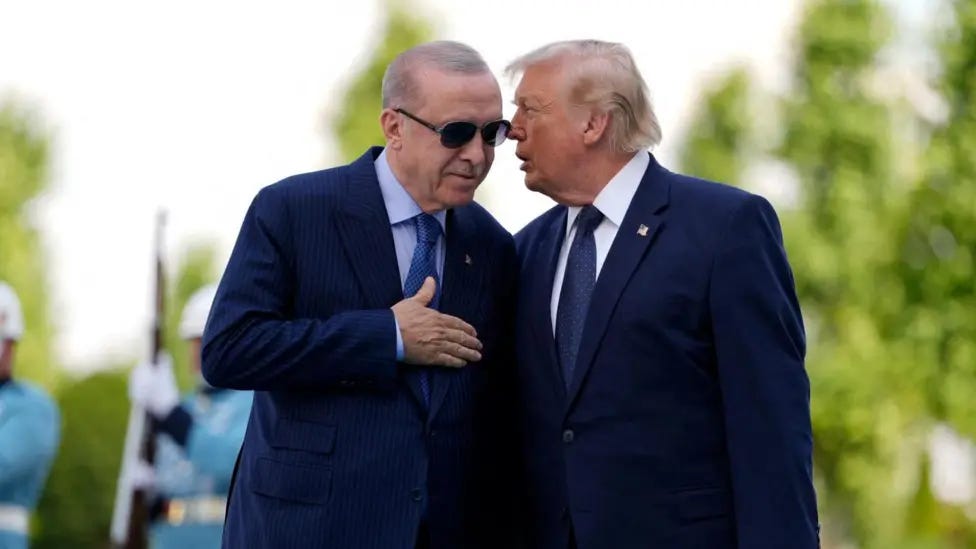
Yes, we had heard this before. His love for ‘the tough guy’ that Erdogan is. In his grammatically haphazard, structurally nonsensical and semantically void sentences, US president Donald Trump stated that Erdogan is a great leader who had stood by him during his hard times (he refers to the impeachment period) and that he managed to do something no one could, that is, ‘taking Syria’. Most recently he said that he would only come to the July 2026 NATO summit because his friend Erdogan is hosting.
And he did.
Gifts and contempt
Erdogan went to Esenboğa airport to welcome Trump to the capital, Ankara. The two walked arm in arm and talked about what I do not know, as Erdogan’s English is limited to non-existent. Surely they have a special bond.
Trump came to Ankara ‘bearing gifts that would make Erdogan very happy’ and repeated, whenever he found the opportunity, that the only reason he was attending the NATO summit was that Turkey was hosting it. He did his classic show of contempt for NATO, more so for the Europeans.
‘I was very disappointed with NATO. [Referring to the Iran war] We didn’t need any help at all, and in a way, I was testing people, I was testing to see whether or not they’d be there because I’ve long said that we help them but I’m not sure that they’d be there for us. We have invested trillions of dollars in NATO.’
In the meantime, the contested issue of Turkey buying F-35s is brought to the fore. The gift he meant was this, to lift the sanctions against Turkey that were imposed and made into law in 2017 because Turkey bought S-400s from Russia.
Trump says he has not yet decided whether to sell F-35 jets to Turkey but is considering how good an ally President Erdogan has been.
‘I haven’t totally made up my mind, but my inclination is to say, look, he’s done everything; he’s helped us in so many different ways. I like Erdogan, he is terrific.’
Turkey and the Iran War
And then he said this: ‘You know, he [Erdogan] could have gone into the [Iran] war. Bibi [Netanyahu] said real things yesterday about Turkey and Erdogan. And I said, you know, I spoke to Netanyahu. I said Erdogan could have gone into the war because he doesn’t like Israel much, and he doesn’t like Bibi much, and he didn’t go because of me.’
And then: ‘Turkey is a military power, with millions of soldiers. Turkey is very strong. They have a lot of our best equipment. They’re trying to get the F-35. He [Erdogan] would have gone in [the Iran war], and he would have been on the other side [Iran’s side]. I don’t think he likes the other side either, because he happens to be very sane, and they [Iranians] happen to be very crazy.’
In the same meeting, he also called Iranian leaders ‘scum’ and ‘cuckoo’ and said that, as far as he was concerned, the ceasefire deal was off.
I know. I had to listen to him say these words, because I could not believe my eyes reading them on the screen. He said them about the leaders of one of the biggest countries in the Middle East, whose people seem to have rallied around Khamenei’s funeral a few days ago, more than 15 million of them, chanting revenge. Iranians are known for a fierce national pride, sharpened by a long memory of Western interference, and insults from the West cut deep.
Why Trump admires him
The NATO summit seems like a big win for Erdogan. He is in his element, constantly being praised while the European countries are chastised, Iran is thrown into hellfire and Spain is told off as a ‘wasted cause, we do not want to do any trade business with Spain any more.’ Pro-Erdogan media and obsequious pundits are in fireworks. Even nationalists who are not so pro-AKP say that everyone should give the man his due. He did fantastically, they say. And that is what it looks like, really. He calls his protégé Syrian president Ahmad al-Sharaa and Ukrainian president Volodymyr Zelensky to meet with Trump. He says he is going to take part in increasing NATO’s role in the Ukrainian war. He positions himself so that every road runs through him.
This is the narrative he likes to sell and many leaders looks like they enjoy buying it.
Meanwhile, at home as I tried to explain last week, Erdogan had crossed the Rubicon in his authoritarian practices by jailing his main contender and waging lawfare against the opposition party, on top of keeping full control within media, bureaucracy, academia, judiciary and business elites.
Ironically, this is why he is being looked up to by Donald Trump. How he cleared his way of unwanted obstacles, frivolous laws and regulations, how he built a sycophantic media, how he hollowed out and refurbished universities to his liking, how he built his clientelist business empire, how he does business via foreign policy, how he rules with his family. All of them and more made Trump respect Erdogan. Love and envy for Erdogan.
Turkey – Israel - Iran
This is a dangerous love.
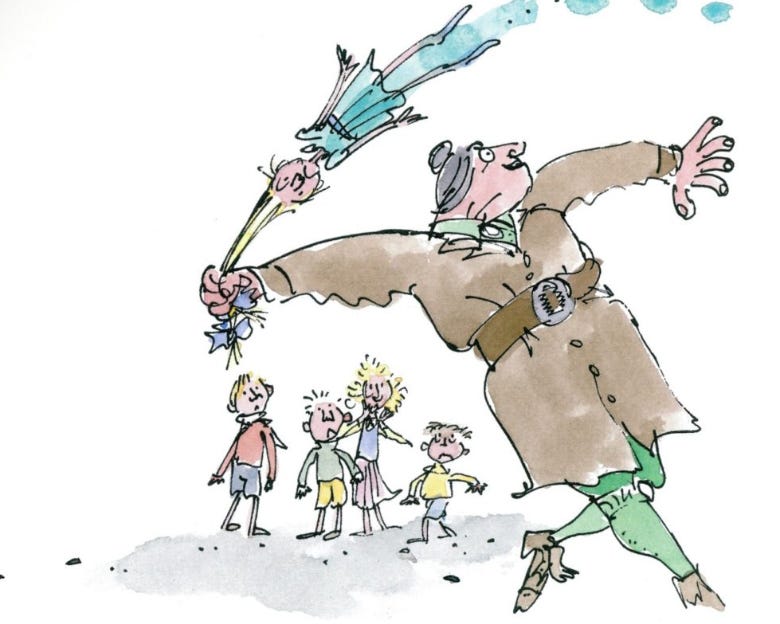
Not only because Trump is learning the toolkit for consolidating an authoritarian and crony system from Erdogan, but because he gets emboldened by his example. And in Erdogan’s presence, Trump copies Erdogan’s tone more. Erdogan can be more elaborate and sophisticated than Trump, but his disdain for some of the European countries can be as raw and personal. Another thing happens when this duo is in each other’s company. In his cunning ways, Trump uses Erdogan to make his point with parties he does not like at that moment. Like an evil schoolmaster in a Roald Dahl book, he becomes this neglectful and mean authority to pit one against the other.
As he just did with Netanyahu. He blurts out a claim Erdogan has never made and no one in his government has ever uttered, that Turkey might have entered the Iran war on Tehran’s side. The two are already at each other’s throats over Gaza and Syria, where Israel is working to limit Turkey’s reach. For now, Trump picks one naughty child over another and teases the one in Tel Aviv. A month later he could do the same to Erdogan. I am sure Ankara knows how erratic and volatile the Trump-Erdogan relationship is, even if the pro-government pundits, whose ‘analysis’ carries negligible intellectual weight, do not. Above all, it is personal. It runs between two men rather than between two states, which makes it contingent on almost anything, Trump’s mood, or Erdogan’s, for that matter.
What should worry us most is that, at a moment of remarkable refashioning of the world order, and of the Middle East above all, it is dangerous to fuel the already fraught back-and-forth between Turkey and Israel. Big events, wars and revolutions, often begin with a tiny flicker that sets alight years of accumulated grievance and conflict. And once the war machine starts moving, it is hard to remember the contingent event that triggered it. In his head, Trump is staging a muppet show with Israel, Iran and Turkey. It is a combustible game, and his love for Erdogan will save neither Turkey nor anyone else if a single mistake sets the machine going.
That is why Trump’s adulation gives me little to celebrate and much to fear.
Will Turkey get F-35s?
The trouble began in 2017, when Erdogan agreed to buy the S-400, a Russian air-defence system, and it hardened in 2019 when Turkey took delivery over Washington’s objections. The American fear was technical and simple. Running a Russian radar alongside the F-35, America’s fifth-generation stealth fighter, might teach Moscow how to see the jet built not to be seen. So Washington threw Turkey out of the programme it had helped build and paid into, and the quarrel drove a wedge between the two allies that has held across three American administrations.
Two penalties followed, and US Congress is behind both. In December 2020 came sanctions, imposed under a 2017 American law meant to punish states that buy weapons from Russia’s defence sector. Then a clause in the 2020 defence budget barred Turkey from the F-35 until it no longer possesses the S-400 and has stripped out every trace of it, hardware and personnel alike. This is the machinery Trump now says he wants to dismantle but he cannot do it alone, because lifting either penalty needs the consent of a Congress.
Congress is still not persuaded. Even the senators most willing to let Turkey back in say Ankara has not done enough, and that the core worry, Russian access to the secrets of the F-35, would survive the S-400 merely being parked somewhere else. The Republican who chairs the Senate’s foreign relations committee, once a firm opponent, now says he is hopeful.
Then there is Israeli lobby working against the sale arguing that arming Ankara would upset the balance of power in a region where, by Netanyahu’s account, Turkey harbours aggressive designs, above all in Syria. Greece warns that the security concerns of every NATO member must be weighed, and reminds anyone listening that Turkey’s own parliament still holds, by a resolution passed in 1995, that any Greek move to extend its territorial waters would be grounds for war.
So, will Turkey get the F-35s? Perhaps. Trump wants it, and he has cleared some of the ground. But it runs through a divided Congress, Greece and Israel set on blocking it, and a fear that parking the S-400 in another country changes nothing about the danger it poses.
Do you think it would also be true to say that American president's conduct has been facilitated by the long strategic opportunism in NATO, having quickly absorbed Türkiye along with Greece regardless of their non-Atlantic geography, because because it was useful to all parties in the early 1950s?
In other words, the regional autonomy Türkiye has recently pursued, asserted and claimed may be inseparable from its long history of unfixed orientation within NATO.
But Türkiye's seventy years of geostrategic and threat-absorbing usefulness to America and Western Europe has also made it possible (even foreseeable) that a nationalist Turkish president would sooner or later make use of that usefulness, when an American president eventually comes along who is short on ideas and running short of clout?
Do you think it would be reasonable to say this history is helping the present opportunism to flourish?
With thanks for your ongoing analysis and exploration of these long-brewing troubles - and best wishes from Canberra,
Benedict Moleta