

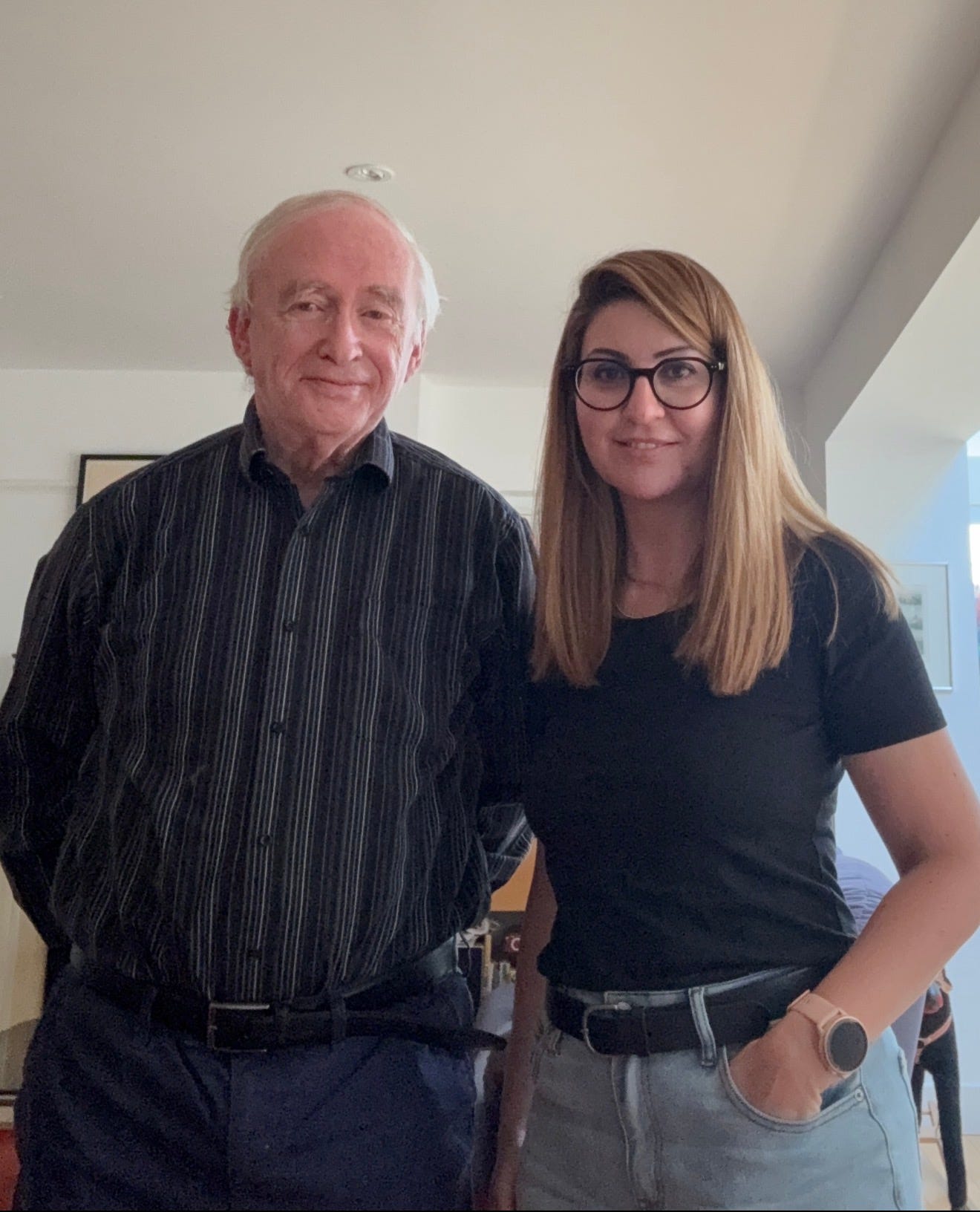
This week I come to you in podcast form, as I occasionally do, with a conversation with Prof. Michael Freeden. We covered a lot of ground: what an ideology actually is and how it organises the way we think, why the distinction between ideology and pragmatism doesn’t hold up, how nationalism, Islamism, and populism differ in structure from the older ideological families, and why democratic politics is giving way to something he calls demotic.
Freeden has spent nearly five decades on that question. He taught at Oxford from 1978 to 2011, first at Mansfield College, where he is now a professorial fellow, and he remains Emeritus Professor of Politics there. He founded the Journal of Political Ideologies and wrote the books that most political scientists reach for when they need to think carefully about the subject, among them Ideologies and Political Theory: A Conceptual Approach and Ideology: A Very Short Introduction. What follows is an outline of the ground we covered, for anyone who wants a map before pressing play, or a way back into the argument afterward.
Redefining Ideology
Freeden’s starting point is that ideology is not what people usually mean when they use the word as an insult. In everyday speech, calling something “ideological” suggests it is rigid, dogmatic, closed to evidence. Freeden’s own definition runs the other way. For him, an ideology is a framework that organises political thinking, and it does this by settling, at least for a while, the meaning of contested words like justice, freedom, or democracy. He calls this act of settling “decontestation.” Every one of those words can mean several different things at once. An ideology is what fixes one meaning as the operative one, so that people can act on it rather than argue about it indefinitely. Two people can use the word democracy and mean genuinely different things by it, and what decides which meaning governs a given political moment is not logic but the ideological framework each side is operating inside. This, Freeden argues, is not confined to party manifestos or parliamentary debate. It runs through daily life. Queuing for a bus involves an implicit theory of fairness and of who has authority over whom. Politics, in his account, is not a separate room we enter and leave. It is a layer running underneath ordinary social behaviour.
Against the Pragmatism Myth
Much of our conversation turned on a distinction Freeden considers false: the one between being ideological and being pragmatic. Politicians and commentators like to present pragmatism as the absence of ideology, a kind of neutral problem solving unburdened by belief. Freeden rejects this. Every ideology that survives, he told me, has to be able to adapt to new circumstances, the way an aircraft wing has to flex under pressure rather than staying rigid. An ideology that cannot bend will break. So a politician like Keir Starmer, frequently described as a pragmatist rather than an ideologue, is in Freeden’s reading pursuing a version of social democracy that has simply adapted itself to the political weather. The adaptation does not mean the ideology has disappeared. It sometimes changes so much, though, that it turns into something else entirely, which is why a party can keep a name like “Liberal” for generations after its politics have become thoroughly conservative, as happened in Japan.
Thick and Thin Ideologies
To explain how ideologies hold together while changing, Freeden uses what he calls a morphological approach, borrowing the biologist’s term for the study of structure and form. He compares an ideology to a piece of modular furniture. It has a core of components that cannot be removed without the whole thing collapsing, liberty for liberalism, for instance, and then a set of variable parts that can be swapped in and out, which is why there can be several legitimate versions of liberalism, or conservatism, or socialism, existing at once without any of them being a fake.
Within this structure, he separates ideologies that offer a full account of political life, which he calls thick-centred, such as liberalism and socialism, from those that address one domain and borrow the rest from elsewhere, which he calls thin-centred. Nationalism is his clearest example: on its own it offers little beyond solidarity and an emotional attachment to country, and it tends to import its economic or institutional programme from whichever thicker ideology it is paired with. Feminism, in his account, works similarly, contributing an original analysis of gendered power while taking its distributive politics from liberalism or socialism depending on the strand.
Islamism and Populism as Case Studies
Islamism gets the same treatment. Freeden describes it not as one doctrine but as a shifting combination of religious, nationalist and conservative material, which is why so many of its variants have proven able to accommodate elections and market economies, with Iran’s version standing out as the exception rather than the rule. Populism he treats as thinner still, built mainly on a binary between “the people” and “the elite” and a sense that one’s own group arrived first, with little else holding it up.
We ended on the far right, and on what Freeden calls the shift from democratic to demotic politics, the difference being that the first runs through institutions built to slow decisions down while the second runs directly through mass and social media, rewarding whoever is loudest. He connects some of this to the fading memory of the Nazi period among younger Europeans, and to a wider impatience with the slow work of governing.
What Comes Next
I asked Freeden, at the end, whether he was optimistic. He answered with an image before an answer. Governing, he said, is like a man surrounded by a pack of wolves with a limited number of bones to throw. You throw one to whichever wolf is closest and most threatening, it retreats, and then the next wolf takes its place, and you throw another. That, for him, is what governing actually is: not a plan carried out but a sequence of concessions made to whichever danger is nearest, over and over, with no point at which the wolves are gone for good.
He does not expect the kind of sweeping social transformation that reshaped societies in the 18-19-20th centuries, though he does not rule it out either. Change of that scale, he pointed out, can arrive with no warning: nobody predicted the end of apartheid, and nobody predicted the end of the Cold War and the reunification of Germany, both of which came in 1989. He raised North and South Korea as a case where such a reversal might still happen, and Vietnam as a case where formal unification has not erased the real differences that fifty or sixty years of separation left behind.
This is why Freeden thinks ideologies will keep developing piecemeal, reacting to events as they occur, rather than following a single coordinated programme of change of the kind intellectuals or ruling groups could once assemble. That older model depended on a small class of people with the standing to define ideas for everyone else, at a time when large parts of the population had no vote and therefore no recognised voice in political life, whatever ideas they may privately have held. The expansion of who now has access to political language and platforms is, in his view, a genuine achievement. It has also removed the filtering that used to come with that older, narrower arrangement, so the same opening that gave more people a voice has also opened the door to a great deal of irresponsibility.
Pressed again on optimism, he said he is optimistic, though not within his own lifetime, and perhaps only over the next fifty years. He was direct in setting his view against Francis Fukuyama’s argument that liberal democracy represented the endpoint of political development, a single line moving toward improvement. Freeden does not see one line. He sees many things moving at once, some getting better while others get worse in the same moment, technology being his example: a source of real medical progress and, elsewhere, a source of new harm.


