

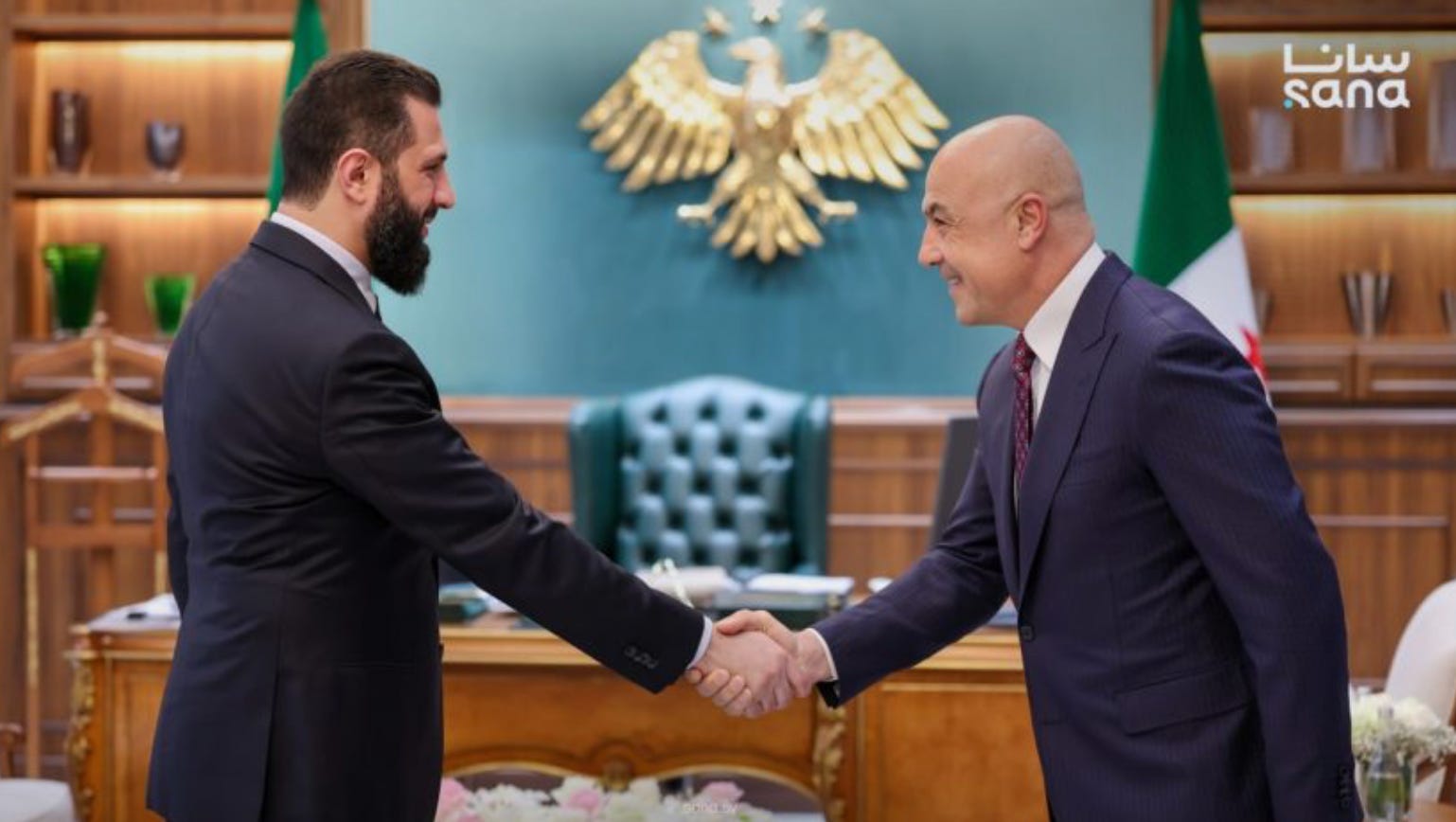
Ever since I saw that Turkish hotel magnate shake hands with Syrian president Ahmad al-Sharaa in May 2026, I have wanted to talk about this overarching and initially invisible structure. A structure you can find anywhere in the contemporary capitalist world, where greed and impunity rule, and where politics and the business world are highly intertwined, the latter being the beneficiary of this politics.
Then came Tom Barrack, Donald Trump’s ambassador to Turkey and special envoy for Syria, who appears to have found himself a second office in Istanbul. No, no, not in the embassy building or anywhere near it.
It is a garden terrace on the northern shore of the Golden Horn, with Galata Tower behind it and the Fatih and Yavuz Selim mosques across the water. A fancy hotel called Aliée. Guess who runs the place? Yes, the same hotelier who shook hands with al-Sharaa.
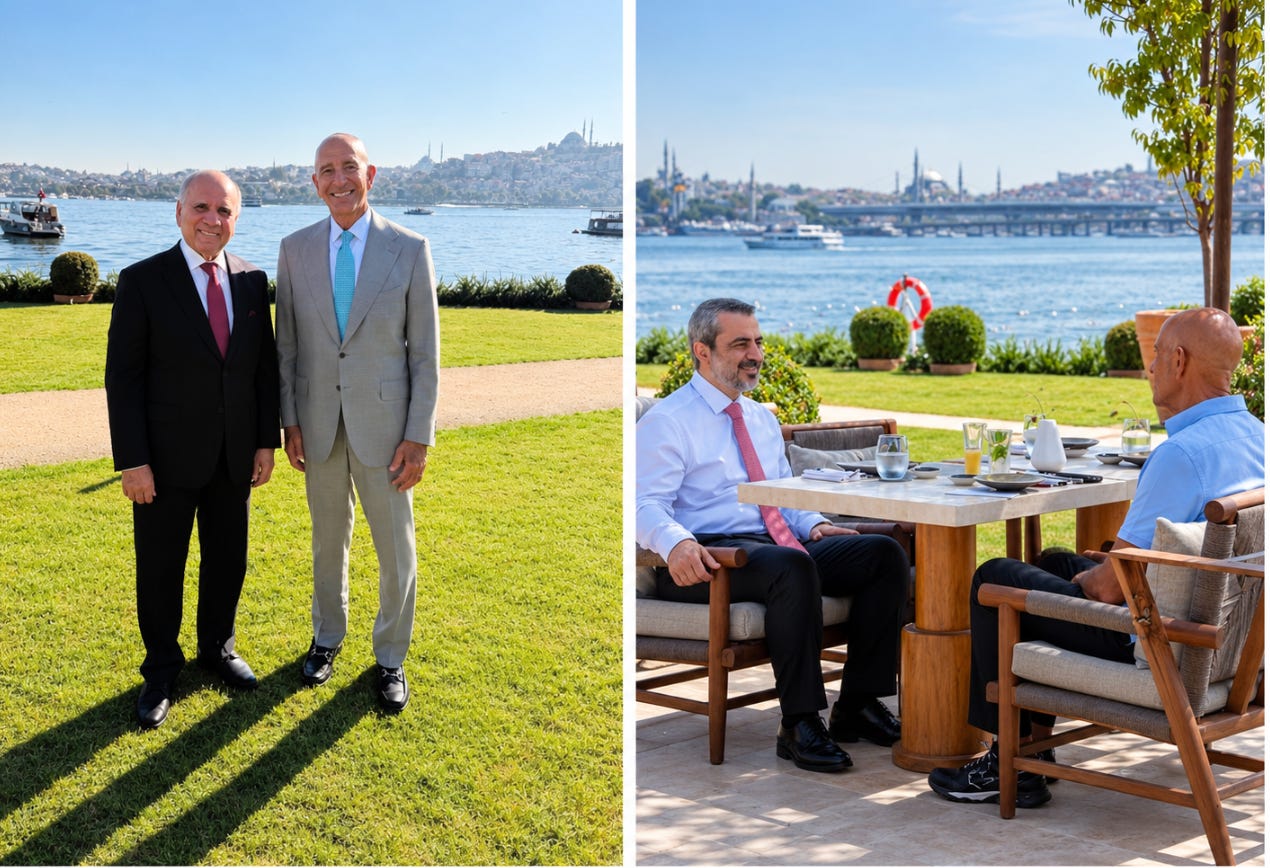
Barrack received Syria’s foreign minister, Asaad al-Shaibani, there on 17 August and again on 8 October. Two days later, on 10 October, Barrack received Iraq’s foreign minister, Fuad Hussein, at the same Tersane on the Golden Horn. They discussed relations after the departure of American troops, regional security and the exchange rate of the Iraqi dinar. On X, the ambassador declared himself honoured to host the minister by the Golden Horn and offered a short history lesson on the place as a meeting point for diplomats. The garden had by then become a regular venue.
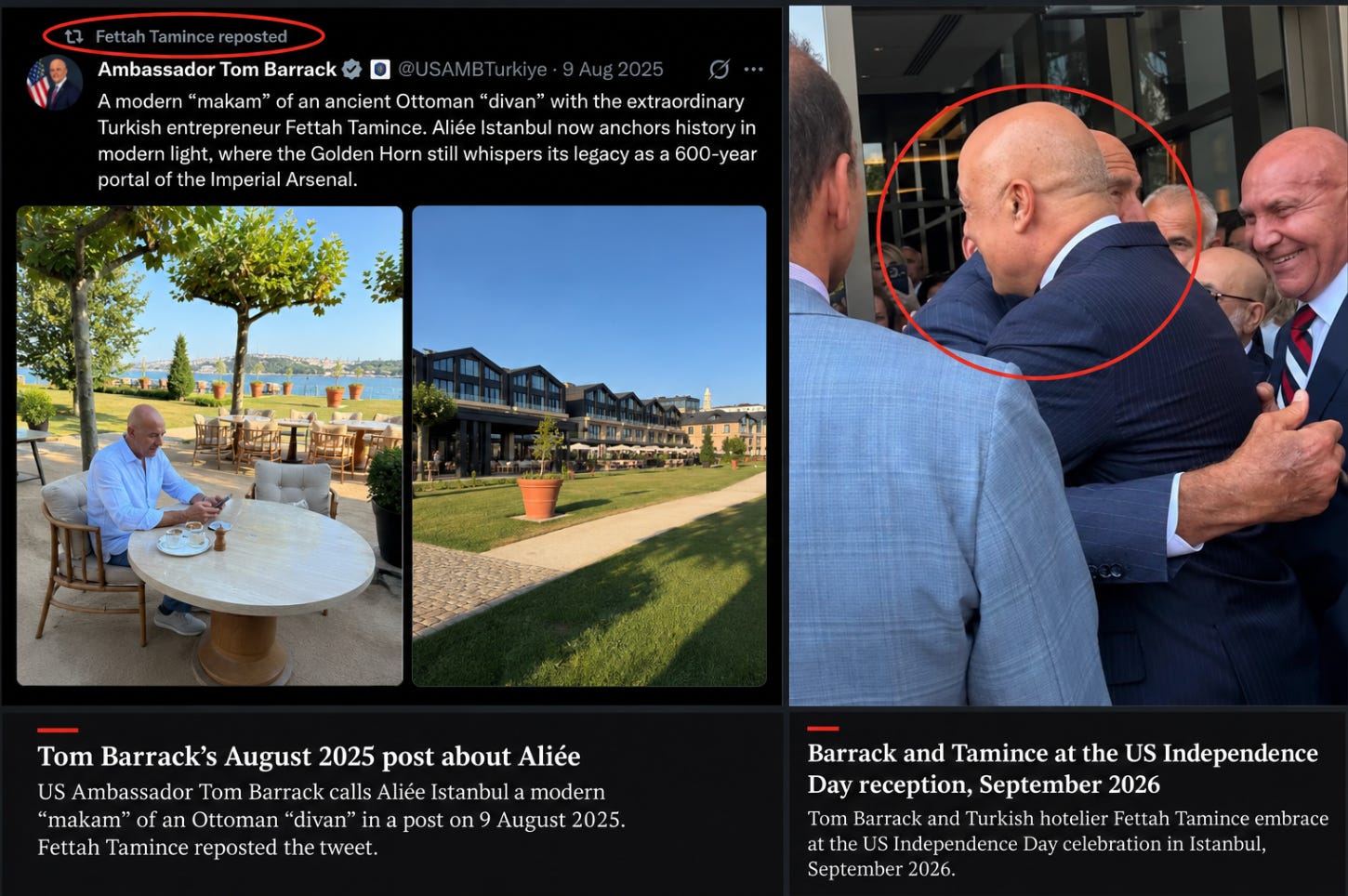
The ambassador (should I say Trump’s mate and property developer rather than ambassador?!) really fancies this place. In August last year he wrote on X that it offered a modern reading of the Ottoman divan, the council chamber where the sultan’s ministers settled the business of the empire.
As I have written in numerous posts, Barrack loves to show off his limited grasp of Ottoman history and the parallels he likes to draw with the contemporary world, many of which have infuriated Turks, Kurds and Arabs of the region. Nevertheless, within a year of this tweet, the terrace was hosting the business of two governments. Turkey and Syria. Under the auspices of a US ambassador.
What is more striking than this lack of diplomatic decorum and utter disregard for the rules of statesmanship is that people like Barrack don’t need to hide it. Also nobody involved appears to think that this requires explanation. On the contrary… They think it is good, even good business. What’s the harm in holding meetings over a nice view of Istanbul, they would ask? What is wrong with removing ‘cumbersome’ institutions that lie between good business and good businessmen? It is a lost battle to try to answer this in a vacuum that no history or decent upbringing has managed to penetrate.
And this is the least problematic detail of this story, let me tell you, dear reader.
The sultan’s shipyard
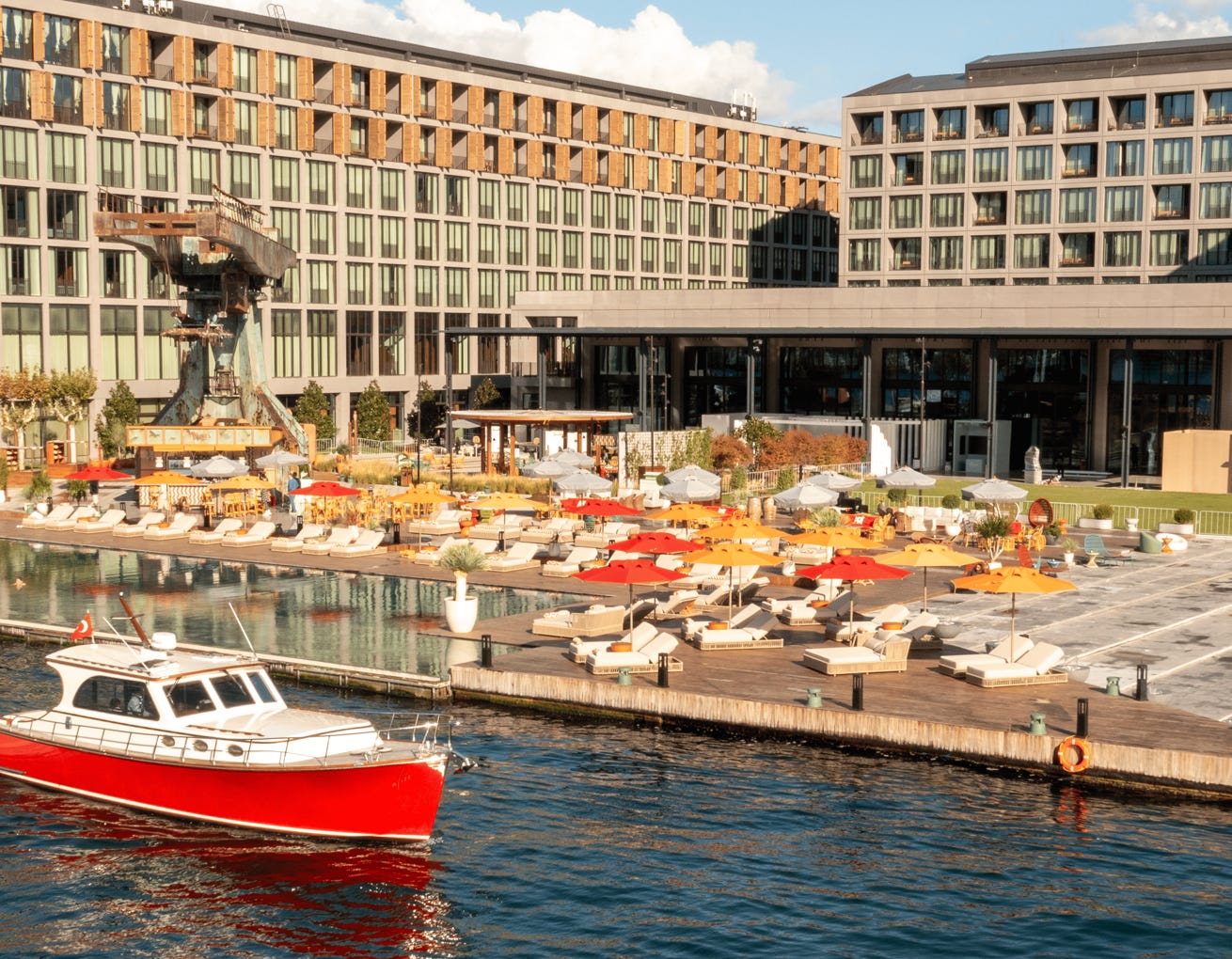
The terrace stands on the grounds of the Tersane-i Amire, the imperial shipyard founded on the Golden Horn in 1455, two years after Mehmed II took Constantinople. Heritage campaigners describe its three adjoining yards as the oldest working shipyard in the world. When the state tendered two of them in 2013, the third was still building and repairing Istanbul’s city ferries. On the tendered land now stands Tersane Istanbul, a district of hotels, serviced apartments, offices, shops, a mosque, a culture centre and two yacht marinas. Aliée occupies restored historic buildings, and an old hammam on the site has become a private suite.
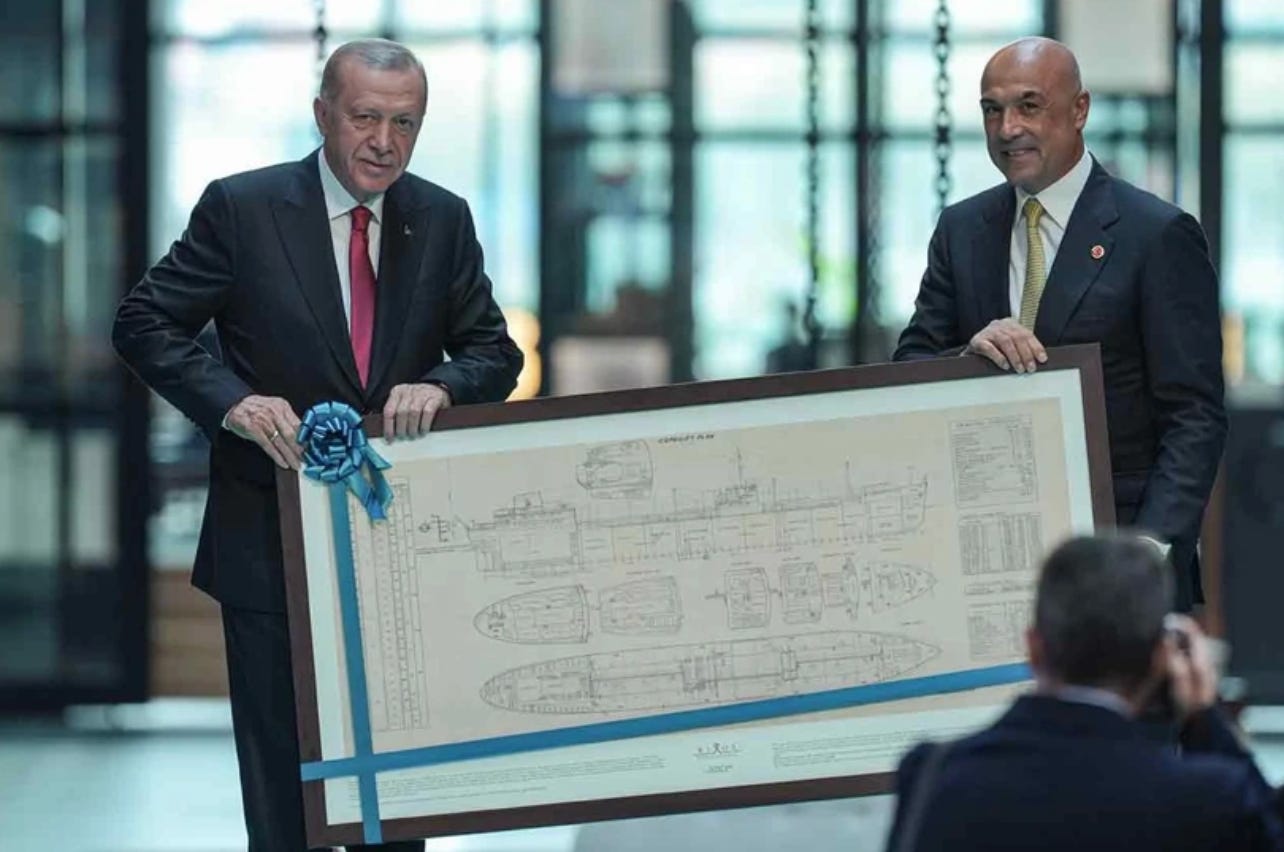
The chambers of architects and engineers sued, arguing that this construction violated the public interest. While their case was pending, the government declared the site a “special project area”, and in October 2014 the shipyards were emptied and construction of this complex continued. In 2021 a former MP from Erdoğan’s AKP, joined the operating company’s board and in September 2024 Erdoğan happily cut the ribbon.
A classic case of clientelism. The scholars Ayşe Buğra and Osman Savaşkan, in New Capitalism in Turkey, explain how this works. Under AKP rule, they argue, the government acquired wide discretion over what businesses most need and cannot obtain elsewhere, such as public land, zoning, licences and state contracts. It used that discretion to raise a new business class whose fortunes depended on its favour. Business associations close to the party served as the channels through which favour was requested, and loyalty returned. The resulting market rewarded proximity to power, and firms outside the circle competed on worse terms or not at all. Remember this modus operandi because we will come back to it.
Diplomacy in the Ottoman garden
According to Syria’s state news agency, the 17 August meeting between al-Shaibani and Barrack concerned bilateral relations and “priorities related to Syria’s economic recovery”, including the completion of sanctions relief and reconstruction.
The 8 October meeting between the same two men covered bilateral relations, regional developments and further cooperation. It came a day after Reuters reported, citing a US official and a Syrian military official, that Syria was considering military assistance to Saudi Arabia in its renewed war against the Houthis. The US official said Riyadh had asked Damascus to deploy forces.
Meanwhile, nobody has explained why the same garden keeps being chosen, and I will not guess. It is enough to note that the American and Syrian governments are discussing the rebuilding of Syria on premises controlled by a Turkish businessman, Fettah Tamince, who wants a share of that rebuilding.
Indeed, on 4 May 2026 Tamince sat with President Ahmad al-Sharaa in Damascus. The Syrian presidency’s own account said the meeting covered investment opportunities in tourism and hospitality, energy, real estate development and the rehabilitation of infrastructure.
In other words, almost exactly the sectors through which Syria is now being rebuilt.
Before moving on to what Tamince and the Turkish government stand to gain economically from Syria, I want to open a parenthesis to disclose a tiny bit of information.
Both Barrack’s name and Tamince’s business network appear in the Epstein files released by the US Justice Department in January 2026. Life is full of little surprises, serendipities and coincidences, yeah?
US journalists analysing the documents found extensive correspondence between Barrack and Jeffrey Epstein continuing for years after Epstein’s 2008 conviction for soliciting prostitution from a minor. Their contact continued after Barrack became a major fundraiser for Trump’s 2016 presidential campaign. There is no evidence in the released material that Barrack participated in Epstein’s crimes or knew of continuing criminal activity.
The Tamince material is different. In a 2017 email, the Dubai businessman Sultan Ahmad bin Sulayem sent Tamince a passport copy and asked him to arrange a traineeship at his Antalya spa for a woman he described as the personal masseuse at “our friend” Epstein’s private spa. A Rixos manager replied in Tamince’s absence and outlined a ten-day programme at the spa of The Land of Legends, his Antalya resort, while Epstein’s assistant handled the arrangements on the other side. Tamince says he never met or corresponded with Epstein and that he was doing a favour for bin Sulayem, whom he describes as a friend. By his own account, two women received two weeks of training at Rixos Premium Belek.
Surely, appearing in the Epstein files is not evidence of participation in Epstein’s crimes. Nor should Barrack’s relationship with Epstein be casually equated with Tamince’s appearance in this chain of correspondence.
The point is something narrower, and to me still unsettling. The social circuitry revealed by these documents, the ease with which billionaires, political fixers, hotel owners and intermediaries move through one another’s properties, contacts and favours. The company they keep… This supranational network itself… Even if there is no crime per se, there is a political pathology here.
Enough to cause me reflux. Close parenthesis.
Tayyip Bey’s man
Ok let’s focus back.
Who is Fettah Tamince and how did he come to control a six-hundred-year-old imperial shipyard, the Tersane, and lead luxurious touristic enterprises in the Middle East and Turkey?
Fettah Tamince was born in 1972 in Çaldıran, in the eastern province of Van, the eldest of nine children. He began in the carpet and jewellery trade in Antalya and Germany and founded Rixos Hotels with a Ukrainian partner, Igor Kurmenyuk, in 2001. So he started growing right before the AKP came to power. His construction company earned most of its turnover from public contracts in Kazakhstan, where it built many of the signature buildings of Nursultan Nazarbayev’s new capital, Astana. In 2004 he said of himself, “Yes, I am Tayyip Bey’s man and I fell in love with him after I met him, I see him every week in my dreams”. (Tayyip Bey being the respectful way of addressing Erdoğan by his first name.) Erdoğan, then prime minister, spent his summer holidays at Tamince’s hotels, Rixos.
Over the years, Tamince placed equal admiration elsewhere too. Because a strategic businessman would hedge his bets.
In a 2005 Milliyet interview, whose link has interestingly been lost (this kind of disappearance happens around powerful and wealthy men), he said that he had admired Fethullah Gülen, the Islamic preacher and movement leader who had deeply infiltrated Turkey’s state apparatus, since childhood, and that he believed in his leadership. Erdoğan and the Gülen movement were allies then, and a businessman could pledge himself to both. After the corruption investigations that targeted Erdoğan and his family in December 2013, which Erdoğan blamed on the Gülenists, Tamince bought 10 per cent of Zaman, the movement’s flagship newspaper. After the failed coup of 2016, also blamed on the Gülenists, he was investigated for membership of what the state now calls a terrorist organisation, and for embezzlement at Antalya International University, whose board of trustees he chaired.
In 2018 the prosecutor declined to bring charges. A judge overturned that decision and was removed from his post within weeks, and his replacement restored it. In 2020 the Court of Cassation sent the file back to Antalya.
Four years later, Erdoğan was cutting Tamince’s ribbon on the Golden Horn. There you go.
Files that open and stall
Two other files follow a similar procedural pattern. In 2011 a sixteen-year-old intern at Tamince’s Rixos in Antalya was found dead. The autopsy recorded a fall from a height. The National Criminal Bureau, appointed by the prosecutor, argued from contradictions in the testimony that he had been beaten and thrown from a roof. The investigation has been open for fifteen years and, according to the boy’s family, has passed through seven prosecutors. Tamince gave a statement only in 2024. The hotel says the intern died at a guesthouse used as staff lodging and that it has no connection to the case. His father says the file has stalled because of Tamince’s closeness to the government, and last month a special team was reportedly assigned to it.
In 2011 Tamince was also questioned as a suspect in an investigation into prostitution and human trafficking centred on Atatürk’s yacht, the Savarona. Investigators found, according to DW’s reporting of the file, that foreign girls, some of them minors, had been brought unregistered to his hotel in Belek. He denied any knowledge, and after the prosecutor was replaced, the new one decided not to charge him. Tamince has not been charged in either case.
But around him, as you might have noticed, investigations open, change hands and stall, and none has ended in a conviction.
Following the flag to Damascus
Tamince has followed the Turkish state’s Middle East policy with remarkable fidelity.
For example, in August 2008, when Erdoğan and Bashar al-Assad were friends, the two leaders held talks over lunch at his Rixos in Bodrum. Tamince’s hotel.
According to Zaman al-Wasl, a Syrian opposition outlet, Tamince was among the Turkish investors closest to Assad. In 2009 he visited Damascus twice within twenty days, and on 26 November he dined with Bashar and Asma al-Assad and their children. Even after relations between the two governments soured, he led a delegation of Turkish businessmen to Damascus at the end of July 2011, as the regime was crushing peaceful protests.
By January 2019, Assad was Erdoğan’s enemy. Tamince, however, was already looking ahead. At Davos on 30 January 2019, he told AA -Turkey’s state news agency- that he made his investments “in parallel with Turkey’s vision”. He was already operating in Iraq and was waiting for conditions to settle before returning to Syria. “The reconstruction of Iraq and Syria is on the table,” he said. “Inshallah, once things settle, we will go to Syria too.”
7 years later, he was sitting across from the man who had replaced Assad.
Tamince is the most vivid case of a wider pattern, the clientelist structure that has flourished under Erdoğan and the circle of businessmen who have prospered within it. Kalyon and Cengiz, two of Turkey’s largest construction conglomerates, belong to the five firms Turkey’s opposition calls the beşli çete, the “gang of five” because they won so many of the largest public tenders of the Erdoğan years, from motorways and bridges to Istanbul’s new airport. In May 2025 both joined a Qatari-led consortium that signed a $7 billion agreement to build power stations in Syria, and both are also in the consortium for the $4 billion expansion of Damascus airport.
You see, firms raised on Erdoğan regime’s state contracts at home now follow the Turkish state into countries where it has political stakes.
The other track runs through the Trade Ministry and the exporters. According to UN trade data, Turkish exports to Syria rose from about $2.2 billion in 2024 to $3.5 billion in 2025, while imports from Syria came to just $235 million. Turkey was already Syria’s largest import partner before Assad fell, in an economy the World Bank valued at about $21 billion in 2024.
Erdogan and al-Sharaa have set a bilateral trade target of $10 billion. Ziraat, the Turkish state bank, is seeking to establish operations in Syria, and Turkish firms are pursuing industrial zones along the border and in the north-west.
The emerging logic is to sell goods first, then finance them, then produce inside Syria with Turkish inputs and credit. Unlike a hotel, this track has the potential to build productive capacity, though on terms heavily influenced by the larger partner. Damascus has already cut tariffs on 269 Turkish products, exposing Syrian manufacturers and farmers, many still recovering from the war to cheaper imports.
A Syria ready to receive it
The Turkish model of state-sponsored capitalism, in which political connections determine access to public land, contracts and economic opportunity, finds remarkably fertile ground in post-Assad Syria. Joseph Daher, as Swiss-Syrian political economist describes the political economy taking shape under al-Sharaa as one that favours big capital, concentrates economic power in the ruling circle and imposes austerity on everyone else. So much for Sharaa’s jihadism!
The mechanisms of clientelism that Buğra and Savaşkan identified in Turkey are also taking shape in Syria.
The levers, the mechanisms of clientelism that Buğra and Savaşkan identified in their book for Turkey are all present in Syria.
The state still holds the land through Decree 66, an Assad-era law that allowed it to clear whole neighbourhoods for redevelopment. Many of the projects offered to foreign investors are, unsurprisingly, in real estate and tourism. Contracts are being gathered into the presidency as well. A procurement authority created in March 2026 now oversees state purchasing. It sits under the presidency’s secretary-general, a post held until May by the president’s brother, Maher al-Sharaa. The criteria for choosing the companies that signed investment agreements have never been disclosed. The new rulers also hold the legal fate of the business class in their hands. Reuters found that a committee overseen by another of the president’s brothers, Hazem al-Sharaa, gained control of more than $1.6 billion in assets. It did so through takeovers and settlements with Assad-era tycoons, many of them negotiated privately. A businessman’s past has thus become something to bargain over with the ruling family.
The channels of favour are being rebuilt as well. Daher reports that the chambers of commerce have been restructured with appointees close to Hay’at Tahrir al-Sham (HTS), the Islamist group al-Sharaa led before Assad fell, and that union leaders have been appointed without elections. A former HTS commander, Muhammad Omar Qadid, now heads the state’s financial audit body. He owns Sham Cash, the platform that pays public salaries and pensions, while a company associated with him operates state fuel stations without publicly disclosed tenders. Bassam Haddad showed in Business Networks in Syria how Assad’s economy ran on networks binding regime officials to a small circle of businessmen.
The danger now is that the network survives with new members, and that the Turkish government and its clients join it as outside partners.
Who wins, who pays
The model offers al-Sharaa what it once offered Erdoğan. It delivers prestige projects quickly. It supplies business partners whose loyalty is secured by their dependence.
The profits that come from privileged access to the state, rather than from productive activity, called in literature political rents. Rents accumulate in a few hands, while the public pays through higher prices, diverted public resources and lost homes. In Turkey, growth relied heavily on construction, cheap credit and politically allocated contracts. That model helped create the weaknesses exposed by the currency crises of 2018 and 2021, and Turks are still paying for them.
For Syria, emerging from 14 years of war, the stakes are higher. Reconstruction may enrich a handful of businessmen and furnish al-Sharaa with impressive new buildings, but it will do little to restore public confidence or secure lasting stability if most Syrians remain impoverished and excluded from its benefits. The same danger extends to industrial zones and factories, however productive their stated purpose, because they too depend on decisions about land, financing and contracts. The real question is where those decisions are made. They can be made through open tenders that Syrians can scrutinise, or in fancy hotel gardens with nice Istanbul views, in the company of American property developers turned ambassadors.