

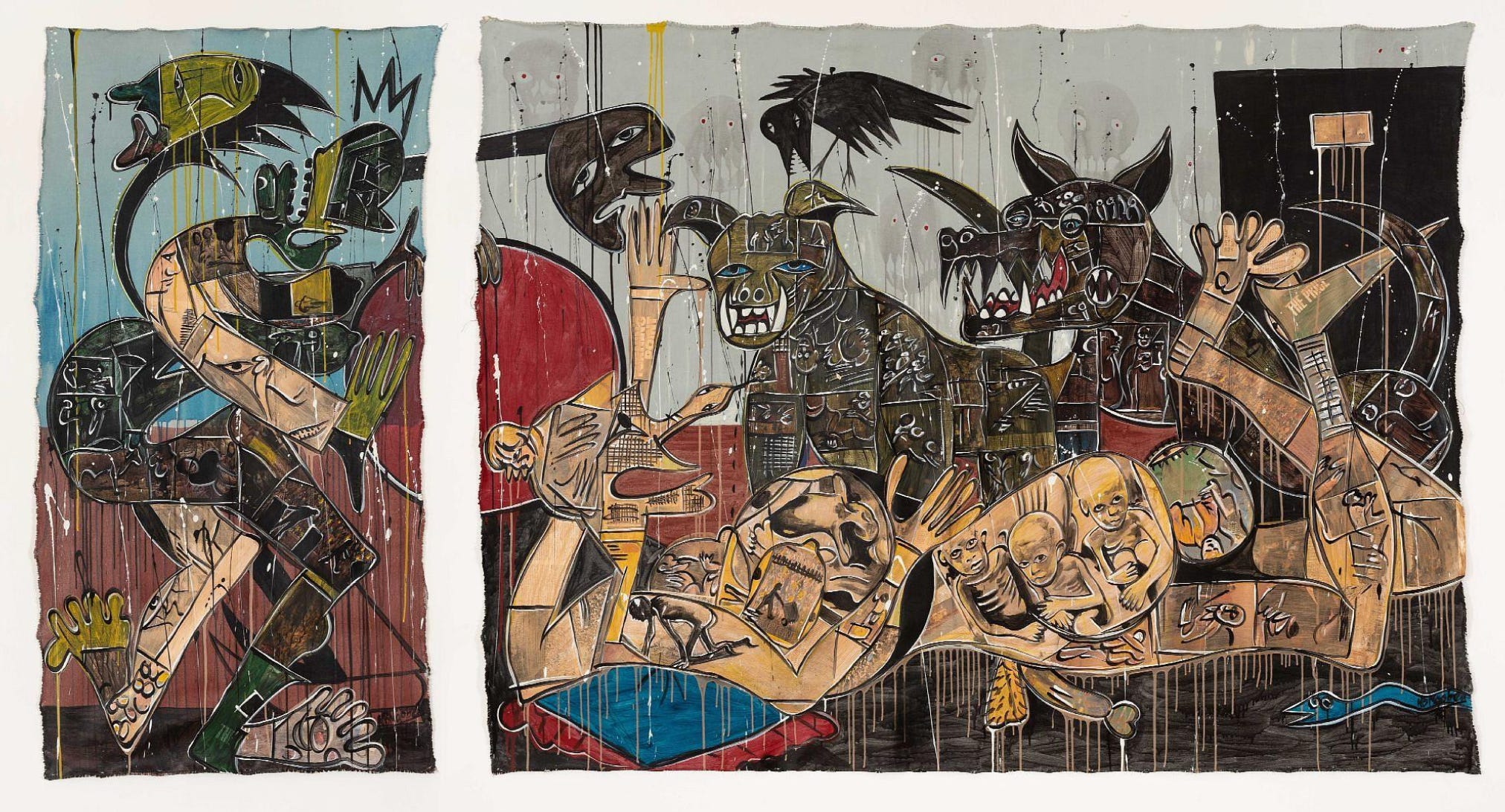
Vomit, yes. Looks like it. Smells like it. Feels like it.
And we witnessed the whole incident, from regurgitation to the mess spreading across the floors of our lives. Yes, vomit is what Turkish domestic politics feels like nowadays. Considerably lower than the corruption of politicians, to which we have now grown accustomed, and somehow more demoralising than the usual coercive practices of the one-man regime.
After Erdoğan dared to jail his most prominent challenger, the Istanbul mayor Ekrem İmamoğlu, who was detained on 19 March 2025 and sent to prison four days later, on the very day the CHP held its primary to name him its presidential candidate, the level of authoritarianism and the quality of politics moved in opposite directions. The former has risen; the latter has fallen.
Since then, the regime has seized one opposition mayoralty after another by imprisoning mayors elected as CHP candidates in the local elections of 31 March 2024. Those elections were the CHP’s best result in nearly half a century. The party came first nationwide for the first time since 1977, with 37.8 per cent of the vote against the AKP’s 35.5 per cent. It won 35 of Turkey’s 81 provinces, including 14 of the 30 metropolitan municipalities, Istanbul, Ankara and İzmir among them. But it did not last long. The Erdoğan regime could not afford to lose that much to the opposition.
What followed has been extraordinary even by Turkey’s recent standards. Dozens of mayors who had been elected as CHP candidates are now in prison, while many others have been removed from office, investigated or prosecuted. The investigations are officially corruption cases. The opposition argues that they amount to a systematic attempt to reverse at the courthouse what Erdoğan failed to prevent at the ballot box. The government rejects that accusation. Surely.
On top of this, after a short deliberation with his small circle of sycophants, Erdoğan decided he could go a step further and shape the opposition itself. On 21 May 2026, an appeals court annulled the CHP congress that had elected Özgür Özel chairman, removed him and the party leadership from office and reinstated Kemal Kılıçdaroğlu, the former chair who in thirteen years at the helm never beat Erdoğan in a general or presidential election, or for that matter in an argument. Of course, the decision was formally the judiciary’s, but by then the distinction between judicial intervention and political engineering had become difficult for opposition voters to take seriously.
The result was a rupture. Özel and 90 other MPs eventually left the CHP and founded Yeni Parti, or New Party, in July. What had been the country’s main opposition party, fresh from its greatest electoral success in decades, had been split apart within two years.
And then there are the mayors themselves, who, as we say in Turkish, ‘tüy diktiler’, literally “stuck a feather on top [of dried dung]”, which means making a bad situation even worse, yani adding insult to injury, but with a more graphic imagination. Some appear to have been coerced by kompromat, the threat of prison, pressure on their families or the simple knowledge of what happens to opposition politicians who refuse to bend. Others simply chose perfidy. Decided that survival, power or personal advancement mattered more than the voters who elected them.
Özgür Özel and other opposition figures have repeatedly alleged that mayors were offered a choice between prosecution and joining the governing party. Erdoğan and the AKP deny using judicial pressure to secure defections. Surely!
Whatever the precise motivation in each case, the outcome is difficult to ignore: municipalities won by opposition voters have ended up in AKP hands without another election being held. One by one, in front of our eyes.
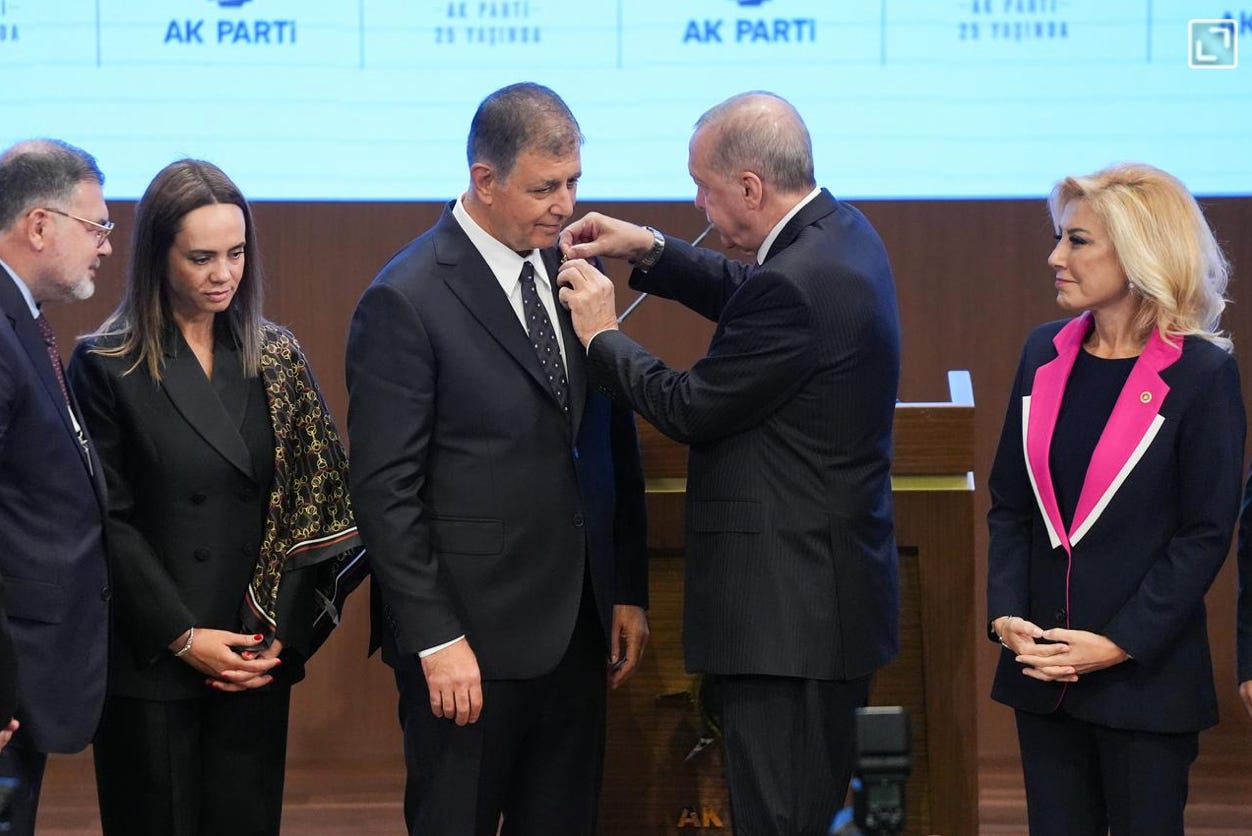
The most sordid example came from İzmir.
Cemil Tugay won the İzmir metropolitan mayoralty as a CHP candidate in 2024 with almost half the vote. In January this year, when rumours first circulated that he might join the AKP, he dismissed them emphatically. If he did such a thing, he said, those closest to him would no longer be able to look him in the face. His mother had told him she would disown him and his wife that she would divorce him. He went further, asking how one could work in a party where decisions depended on a single person and saying that its political worldview was incompatible with his own.
Eight months later he met Erdoğan. On 7 October Erdoğan pinned an AKP badge on him. His wife attended the ceremony.
For the AKP, İzmir is not simply another municipality. It is perhaps the most symbolically important city it has never managed to win. The centre left has governed the metropolitan municipality continuously since 1999, and the AKP has never captured it at the ballot box. İzmir’s secular and fiercely Kemalist political identity has made it the CHP’s great urban fortress and has also given renewed political meaning to the old expression Gâvur İzmir, used pejoratively against a city regarded by conservatives as insufficiently pious and insufficiently obedient. Erdoğan had tried repeatedly to win İzmir. He never did. Now he has grabbed it, through Tugay’s apostasy.
And the AKP celebrated accordingly. According to its elegance(!), I should say. On the eve of Tugay’s transfer, the party’s official social media account released a video beginning with a mountain of rubbish. Then the rubbish disappears, flowers begin to cover the mountain and the melody of the İzmir Marşı comes in, whose lyrics go, “İzmir’in dağlarında çiçekler açar...” The video ends with the date, 7 October 2026. A song that has become inseparable in contemporary political culture from İzmir, Atatürk and the secular opposition has been appropriated to celebrate the spoils of a defection, of a city the AKP had never managed to win through votes. Yani nauseating. Or namely rezillik.
What all this has inflicted on opposition voters is nihilism, and perhaps on anyone still trying to take politics seriously. Trust in politics as an institution has rarely been this low. The problem is no longer simply that authoritarianism has been ratcheted up to another degree, nor even the possibility that Turkey may never again hold a genuinely free election in which opposition candidates are allowed to compete without being jailed, disqualified or otherwise shaped according to Erdoğan’s preferences. Something more corrosive has happened.
There is increasingly little motivation left to support anyone in the opposition when so many of the people elected to resist the governing party can simply migrate to it. How do this many mayors change their party at precisely such a moment? Who selected these men and women in the first place? Who vouched for them? What did opposition parties know about the people to whom they entrusted municipalities and millions of votes? Erdoğan has certainly manipulated, pressured and reshaped the opposition, but some of its own politicians have made the job embarrassingly easy. The party institutions are thoroughly debased.
But the rot within the AKP also had to surface just in time to remind us, in case we had forgotten while dealing with the defections, disloyalty and kompromat within the opposition.
Yes, I’m talking about the investment fund scandal, which began to unfold in mid-September, adding the smell of money to an already foul political landscape.
The scandal grew out of a spectacular boom in investment funds that promised returns capable of outrunning Turkey’s inflation. Some funds became heavily concentrated in thinly traded shares whose prices could be pushed rapidly upwards, inflating the value of the funds themselves and attracting still more investors. Eventually the mechanism began to collapse. Regulators ordered more than a hundred funds liquidated, hundreds of thousands of investors were affected and prosecutors launched a large market manipulation investigation.
And this is where the financial scandal enters the same fetid political territory. Fatma Betül Sayan Kaya, Erdoğan’s former family minister and until recently an AKP deputy chair, resigned from her party posts after allegations that she and her husband had made extraordinary gains from investments connected to the funds now under investigation. On 7 October the Justice Ministry said that she and her husband had been named as suspects in the money laundering inquiry. The allegations remain unproven. But the political effect was already clear, as a scandal involving market manipulation, enormous sums of money and hundreds of thousands of investors had reached directly into the senior ranks of the governing party. The whole scene had begun to stink even more.
Will this corruption cost Erdoğan much?
Even a scandal of this size has raised no visible hope in opposition circles, or among the pundits, that it will cost Erdoğan or his party much. The common assumption is that he will find a way to manipulate it, change the subject and manoeuvre past it, as he has done before. Two decades of experience justify that assumption. Erdoğan has survived corruption investigations, leaked recordings and economic collapse, and each time his voters stayed with him. The resignation also has a newer source, that is the nihilism described above. When opposition mayors elected to stand against the AKP turn up at its group meeting wearing its badge, it becomes hard to believe that anyone in politics will be held to account for anything, or that there is anyone left on this scene with a shred of decency and principle. Other than the ones in jail. Think of a polity where being in jail has become a badge of honour.
A recent study by the Hungarian political scientist Áron Hajnal, published in Political Studies this year, helps explain why a party can survive a scandal like this. Hajnal compared 153 countries over two decades to see whether societies split into hostile political camps end up with more corruption at the top. He found that it depends on what kind of split it is. When people simply disagree about policy, a moderate amount of disagreement reduces corruption, because each side watches the other closely and is quick to expose wrongdoing. When the disagreement becomes extreme, the effect reverses. When people come to hate and fear the other side, corruption rises. Voters who believe the opposition would destroy the country stop punishing their own politicians for stealing, so the politicians have less reason to stop. This describes Turkey closely. Erdoğan spent two decades teaching his voters to fear the opposition, and that fear is what lets him call the AKP a clean party in the middle of what Özgür Özel calls ‘the robbery of the century.’
Sounds like much of the fanfare that has been growing internationally and simultaneously gaining traction.