
Why is Erdoğan upgrading authoritarianism
First they jailed his rival. Now a court has removed the opposition leader who took up the fight. Erdogan's Turkey has crossed the line from flawed democracy into something harder. Why, and how?

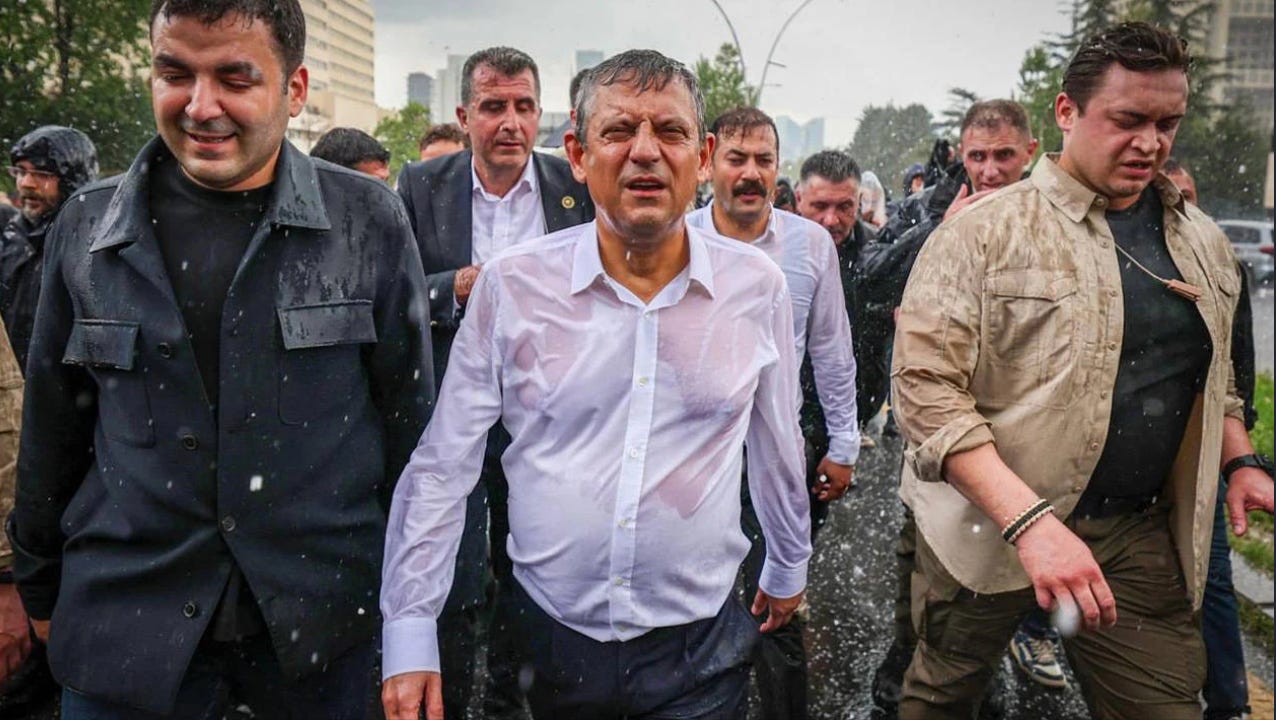
The crux: Turkey’s president Recep Tayyip Erdogan has spent the past year dismantling the only party capable of beating him at the ballot box. Last week he reached its leader.
A court in Ankara stripped Özgür Özel of the chairmanship of the CHP (Republican People’s Party); the party that founded the modern Turkish republic a century ago and is now its main opposition. The court’s reasoning was technical, a dispute over how Özel was elected at a party congress two years ago. The effect was not technical at all. For the first time, a Turkish court has told an opposition party who it may not have as its leader.
Since 2024, hundreds of CHP members and elected officials have been detained on corruption charges the party rejects. Ekrem İmamoğlu, the Istanbul mayor and the candidate most able to defeat Erdoğan in a national contest, has been imprisoned. District mayors have been replaced by trustees.
And now… Riot police have entered the headquarters of an opposition party, firing tear gas inside the building.
A court has decided that the party which has been polling ahead of the governing AKP since the local elections of March 2024 may not retain the leader its own congress selected. The party’s chairman Özgür Özel was not only continuing to support İmamoğlu as the main opposition presidential candidate for 2028 and arguing for his innocence, but he had also managed to become a leader people trust and one able to mobilise large numbers of his electorate. All of which was unacceptable for the government.
The İmamoğlu arrest targeted a person, a rival with a face and a following. The Özel ouster targets the party as an institution, its internal sovereignty, its right to determine its own leadership without a judge intervening. Turkey’s multiparty system, established in 1946 and consolidated in 1950 with the Democrat Party’s electoral victory over the single-party CHP, has survived three military coups, the closure of dozens of parties by the Constitutional Court, and the long shadow of the 1980 generals. It has not previously experienced what is happening now, which is the executive deciding through proxies who may lead the opposition that competes against it.
Why is he doing it?
Goodbye competition
The obvious answer is sufficient as far as it goes, but let’s have a look.
The CHP has been winning. In the local elections of March 2024, the AKP lost every major city. Polling since has been consistent. An open contest in which İmamoğlu, or Özel, or any leader of comparable standing was permitted to run would carry real risk of an Erdoğan defeat, and Erdoğan cannot risk losing. So, he has begun to design the opposition itself, to determine who may run within it, to ensure that whoever does run carries the marks of judicial damage and/or will not be able to defeat him.
This is one notch up in the authoritarian structure. And it is with this the notch that the conceptual vocabulary that political scientists have used to describe Turkey for the past fifteen years stops fitting.
Bye bye competitive authoritarianism.
Au revoir electoral authoritarianism.
Hasta la vista hybrid regime.
Bon voyage majoritarianism and illiberal populism.
Hello good old straight not stirred authoritarianism.
Gift from God
Competitive authoritarianism, the term used to describe regimes that hold genuinely competitive elections on a fundamentally uneven playing field, had been the choice for explaining Turkey post-2013 and Gezi.1 The parallel concept of electoral authoritarianism placed the same set of cases under a slightly different emphasis, with elections themselves as the institutional core of the regime type.2 Both captured something real about Turkey under the AKP: incumbents enjoyed structural advantages of media access, state resources, and a pliant judiciary, but opposition parties could and did organise, contest, and occasionally win, as the CHP did in Istanbul and Ankara in 2019 and then a landslide in 2024 sweeping all major metropolitans, the heartland of Turkish economy.
This obviously never meant that the elections were free and fair. The playing field was uneven, sometimes grotesquely so, but it was still a field. Whether Turkey was best understood as hybrid, as a defective democracy, or as competitive authoritarianism depending on which dataset one consulted, the underlying claim was that Turkey occupied the gray zone between democracy and dictatorship.3
Since the 2017 constitutional referendum that converted the country into a hyper-presidential system…
Since the extreme securitisation and oppressive policies, the regime undertook in the aftermath of the 2016 coup attempt, which was masterminded by his former ally the late Fethullah Gülen and which Erdoğan, having survived it, called “a gift from God”…
The crackdown on individual liberties had been continuous and widespread since then.
The global pattern
In the last eighteen months, things have escalated even more, as I wrote in this post. İmamoğlu’s arrest and now the ousting of the main opposition party’s leader and his team through an absurd court case show that neither of those frameworks holds in the Erdoğan world.
The threshold for distinguishing competitive authoritarianism from full authoritarianism was always whether opposition victories remained possible despite the tilt and unfairness. Turkey is now removing that possibility through judicial means, which means the contest is being decided at the level of who may compete rather than who wins. One useful framework for what has emerged may be autocratic legalism4, in which the formal apparatus of law and constitutional procedure is deployed to dismantle the conditions of competition without ever formally suspending them.
But let’s go back to the initial question — why is Erdoğan doing it — and tweak it: how is Erdoğan able to upgrade authoritarianism?
To answer this, we may need to broaden our look backwards and forwards. Authoritarian regimes do not simply repress and stagnate. They learn. They observe each other, their methods diffuse, they update their toolkits, and they develop more sophisticated mechanisms for managing dissent, controlling civil society, and producing the appearance of pluralism without its substance.
The global pattern shows that for the first time since the 1970s, more countries are moving away from democracy than toward it, and the mechanism is overwhelmingly incremental, executive-led, and legally validated - carried out through courts and constitutional amendments rather than military coups, each step technically lawful.
But there is more to this global pattern that we need to see, and Erdoğan’s Turkey sitting at the crossroads of power relations, energy competition, and transnational capital flows, is one of its main components.
Follow the money
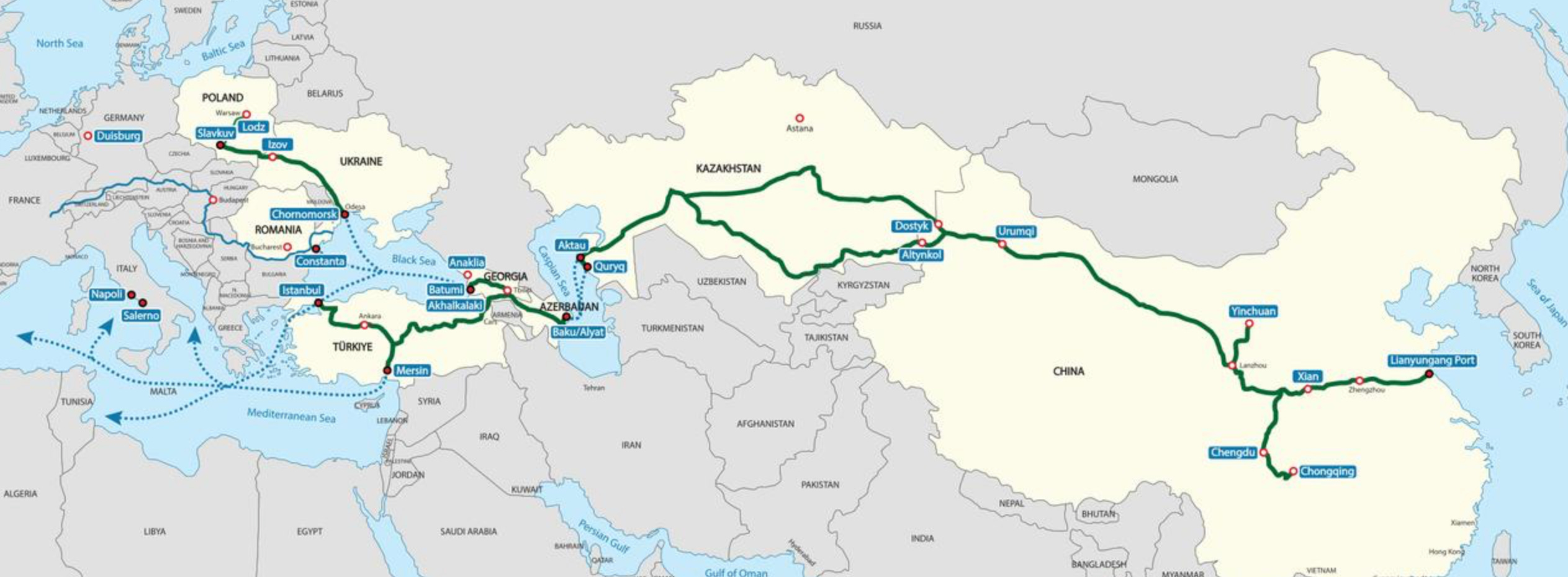
A recent op-ed published in Turkey’s longest-serving pro-labour newspaper, Evrensel, lists the economic trajectory that has been in the making for some time.
First, logistics. Turkey is positioning itself at the centre of the competing transcontinental trade routes that will carry goods between Asia and Europe — the Middle Corridor running across the Caspian, the Zangezur Corridor through the South Caucasus, the Gulf railway connections, the Development Road project — and is betting on becoming the indispensable hub through which they pass.
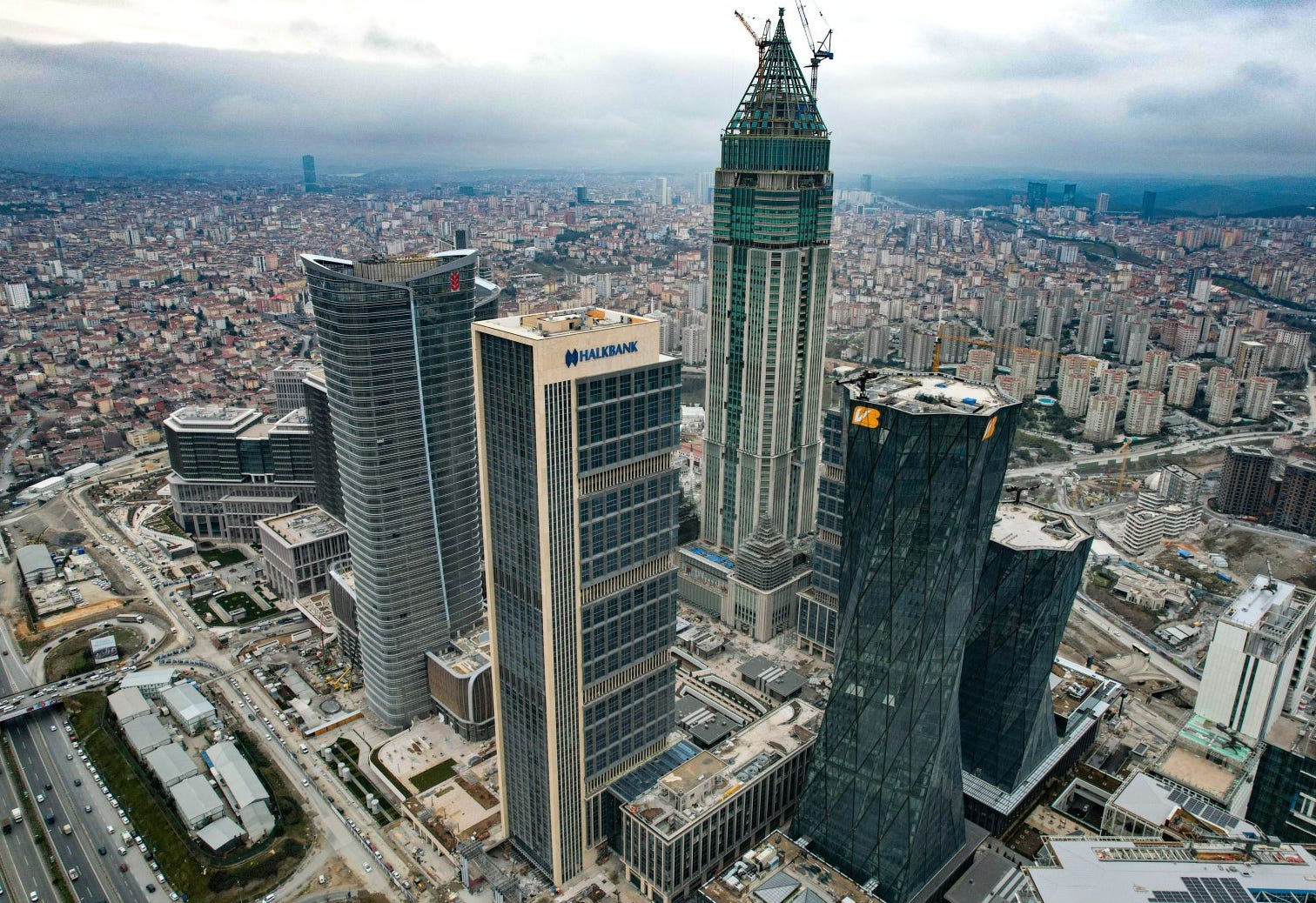
Second, finance. The Istanbul Finance Centre is being built on the Dubai International Financial Centre model, a privileged regulatory and tax zone designed to attract hot money.
Third, extraction. Between 2024 and 2025, mining licences covering nearly 470,000 hectares were tendered, with Canadian, Australian, British, and American firms dominating a sector whose outputs feed Toronto and London stock exchanges rather than the domestic economy — a pattern that maps cleanly onto David Harvey’s theory of accumulation by dispossession5, the argument that contemporary capitalism does not merely grow through investment but continuously opens new frontiers by privatising commons, dispossessing communities, and turning land and resources into tradable assets.¹⁰
Fourth, defence. With a budget exceeding 48 billion dollars and over 3,500 firms, the industry has become a strategic node of capital accumulation that shapes the governing bloc’s foreign policy orientation.
Fifth, labour. Systematic strike bans, flexible contracts, and a vocational training scheme that produces cheap labour from adolescence complete the architecture.
This means the attack on the CHP is not only about Erdoğan’s own survival but about the survival of this accumulation regime, on which other accumulation regimes depend.
The exhausted bargain
The sociologist Cihan Tuğal has described the early AKP as a passive revolution -Gramsci’s term for the way a ruling order absorbs a movement that might have threatened it, granting just enough of its demands to defuse it while steering it away from real change. This is what the AKP did with Islamism, he argued. A religious movement that had carried genuine grievance among the urban poor was brought inside the system and reconciled to it: devout Muslims were folded into the market and pacified by consumption. Consent was manufactured, and for two decades it held. (Also see my post on Islamism in Turkey and Malaysia)
But no longer.
In a later book, The Fall of the Turkish Model, Tuğal6 traced its undoing: the synthesis of Islamism, democracy and the market that the AKP had been celebrated for, and that some hoped the Arab uprisings might emulate, came apart.
Erdoğan’s project can no longer deliver enough to keep that consent, and so it falls back on coercion. The machinery of the economy -the corridors, the licences, the financial zones, the disciplined labour force - runs as before; what has drained away is the willing agreement that once made it legitimate. That gap, between a system that still functions and a public that no longer assents to it, is now being closed by judiciary.
The German scholar Wolfgang Streeck distinguishes between the Staatsvolk, yani the citizens who vote and expect security and public goods, and the Marktvolk, the investors and creditors whose confidence governments depend on.7 The shift in advanced capitalist democracies since the 1980s, he argues, has been the progressive subordination of the former to the latter.
Turkey is a semi-peripheral state, neither at the core of the global economy nor at its margins, but positioned to extract leverage from both, and the terms of that subordination Streeck describes -the citizen placed beneath the investor (Marktvolk) - is built into the ground. The Istanbul Finance Centre is a literal enclave for the Marktvolk, a bounded zone with its own tax and regulatory law. Step outside it and the citizens (Staatsvolk) face strike bans and dispossession.
From why to how
From this perspective, the Erdoğan regime’s external partners, the Canadian mining firm completing acquisitions, the German conglomerate signing defence contracts, the Gulf sovereign wealth fund investing in infrastructure, have no interest in a political transition whose outcome cannot be priced.
Erdoğan is replaceable in principle, but only by someone who will maintain the licences, the zones, the corridors, and the labour regime. A successor who attempted to redirect Turkey’s resource base toward domestic needs would not be tolerable to the interests that benefit from the current configuration, regardless of the size of the electoral mandate.
So it is not only Erdoğan who wants to stay. There is a whole system that favours actors like him who work with this system.
I have called Erdoğan, in my earlier work, the CEO of Islamism, and the description holds in a particular sense even as its contents have shifted. The Islamism itself has receded, contrary to the increasingly hysterical framing produced by the Israeli government and amplified by its supporters, in which Erdoğan is cast as the standard-bearer of a regional Islamist insurgency. He is not.
The Islamic movement was absorbed and transformed, as Tuğal showed; what remains is the cultural and rhetorical residue, mobilised tactically when useful and set aside when not. What persists, and what makes the CEO description still apt, is the managerial form.
Erdoğan governs as the chief executive of a dense interlocking system of contracts, licences, foreign partnerships, and security arrangements, and his political longevity rests on his demonstrated capacity to deliver predictability to the interests that depend on that system.
This is a style of leadership that other neoliberal-state authoritarians, India’s Modi for example, the various rightward formations in Europe, and the second Trump administration study and learn from. Erdoğan is one of the system’s most successful practitioners.
The age of impunity
And then there is this.
The age of impunity and constant conflict and wars make the upgrade cheaper than it would have been a decade ago. A head of state overseeing a genocide in Gaza that has killed tens of thousands of civilians has faced no meaningful international accountability. The second Trump administration has spent its term attacking the very institutions designed to constrain executive power, and the assault has been absorbed by Western governments largely without consequence.
The Gulf states, surely, are not watching this from the outside. Their money is already inside it: in the finance centre, the infrastructure, the trade corridors. And a predictable Erdoğan protects what they have put in.
European countries need Turkey as a military force, an immigration buffer, and a NATO supply-chain partner, and have learned over two decades how to deal with Erdoğan rather than against him. Neither the EU nor the United Kingdom has raised much voice against Erdoğan’s upgrades, if you have noticed, because the structural reasons not to speak outweigh the rhetorical reasons to. This is the international environment within which the main opposition leader’s ouster takes place, and it is why it takes place now.
The threshold of what is tolerable has shifted, and the leaders who watch these things carefully have drawn their conclusions.
The rest of us should draw ours.
Steven Levitsky and Lucan A. Way, Competitive Authoritarianism: Hybrid Regimes after the Cold War (Cambridge, 2010); the term was introduced in their “The Rise of Competitive Authoritarianism,” Journal of Democracy 13:2 (2002).
Andreas Schedler, The Politics of Uncertainty: Sustaining and Subverting Electoral Authoritarianism (Oxford, 2013); see also Schedler (ed.), Electoral Authoritarianism: The Dynamics of Unfree Competition (Lynne Rienner, 2006).
On the measurement of regime type across these categories, see the V-Dem (Varieties of Democracy) project, whose disaggregated indices have become standard; Freedom House and Polity offer alternative operationalisations.
Kim Lane Scheppele, “Autocratic Legalism,” University of Chicago Law Review 85 (2018).
David Harvey, The New Imperialism (Oxford, 2003), ch. 4.
Cihan Tuğal, Passive Revolution: Absorbing the Islamic Challenge to Capitalism (Stanford, 2009); and The Fall of the Turkish Model: How the Arab Uprisings Brought Down Islamic Liberalism (Verso, 2016).
Wolfgang Streeck, Buying Time: The Delayed Crisis of Democratic Capitalism (Verso, 2014).