What Orban’s defeat tells us about Erdoğan and neoliberal rule
Orban's defeat to Magyar is read as continuity in a different form. A closer reading suggests the weakening of the neoliberal-populist system both Erdogan and Orban built over the years.
While many celebrated Hungary’s strongman Viktor Orbán’s fall via elections at the beginning of April, some found it important to remind us of the political colour and allegiance of those who took him down. Those who are called to be killjoys underlined the fact that “what happened in Hungary is […] that after the leader had been in power for 16 years, voters wanted a fresh face, but not a fundamentally different policy.” And that “Peter Magyar is not anti-Orbán. […] What he promises to change is governance, not ideology.”
By now I can say that the way one responds to Orbán’s defeat and Magyar’s victory reveals the political posture of the observer, whether in Europe or in Turkey.
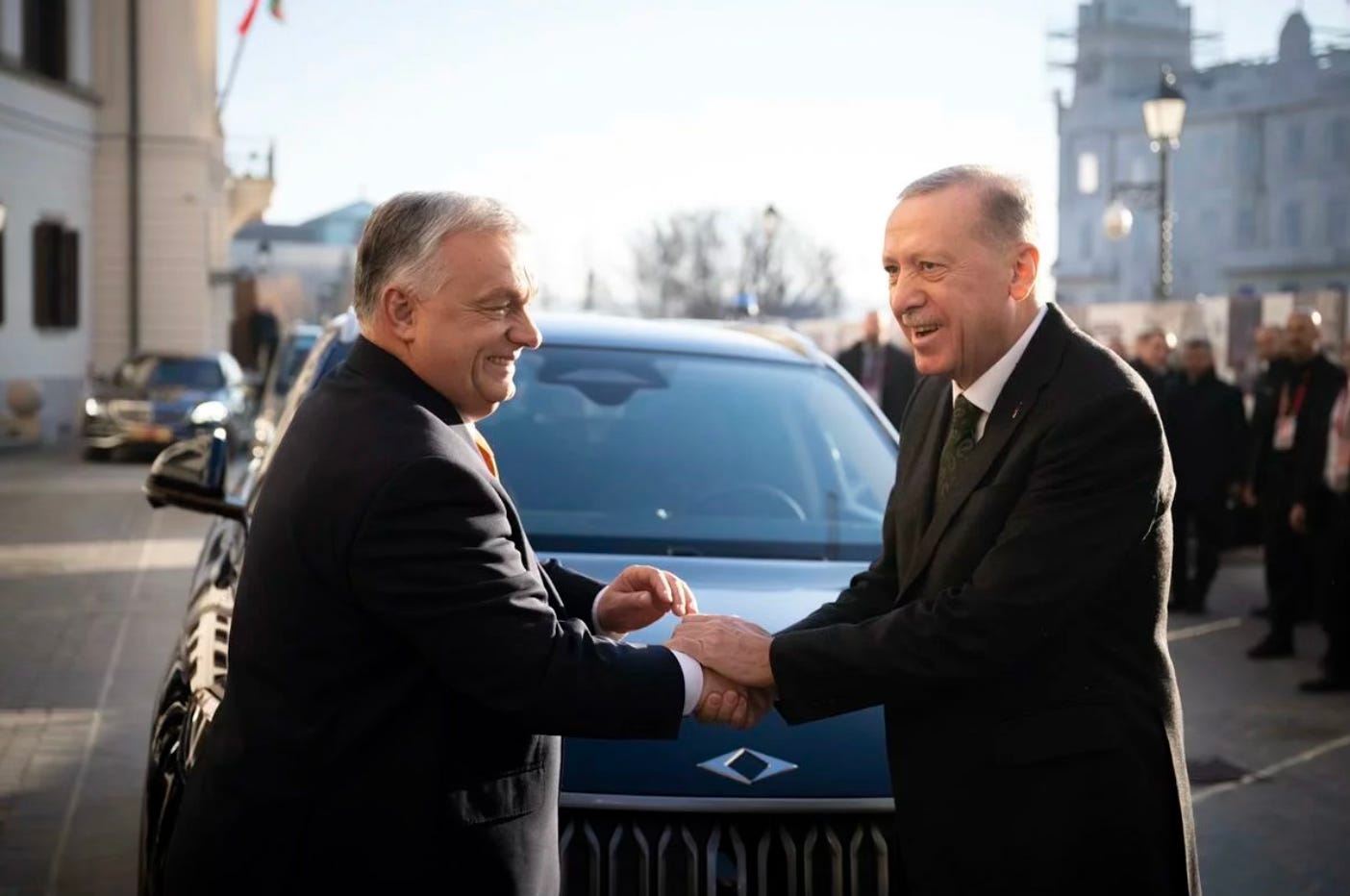
As you know, the authoritarian styles of Orbán and Erdoğan have been comparatively examined and likened for quite some time. Even though Orbán is an Islamophobe and Erdoğan a proud Muslim, they seem to get along well for the exact reason that they epitomise what is called authoritarian populism, and Hungary and Turkey are often described as cases of competitive authoritarianism.
That is why his fall has been part of the debate in Turkey’s media.
Magyar’s victory in the Turkish media
The pro-government media, filled with sycophants who claim to be good Muslims, have been largely silent on Orbán’s fall, a close ally of Netanyahu. They are silent because they fear that Orbán’s fall means that Erdoğa could also go, and that their crony system would follow. Something they are not entirely wrong about.
Segments of Turkey’s right-wing conservative commentariat, once aligned with the AKP and Erdoğan but estranged over the past decade alongside figures who had formed the party’s intellectual and organisational backbone, have read Magyar’s victory in a similar vein to some of the European pundits mentioned above, though with some nuances.
One of them noted that regime change in a Central European country has dominated Turkish newspapers, television, and social media for days. The intensity of attention, he suggests, reflects the striking degree of resemblance between the political structures of Hungary and Turkey. He goes on to underline that Orbán was not unseated by the left. A right-wing challenger removed him at the ballot box. He argues that incumbent voters are less receptive to voices speaking from across the divide than to those emerging from within.
Another commentator raises a more pointed question. Magyar had belonged to Orbán’s inner circle until their break. How, he asks, did he manage to shed the burden of that association and present himself anew to the electorate? The answer is edged with speculation. Leaders who sense the inevitability of their own decline, he implies, may quietly facilitate transition. Atatürk is invoked as precedent, alongside İnönü, both cast as figures who recognised shifting conditions and prepared the ground for political change rather than resisting it outright.
A third adopts a more demonstrative tone, drawing lessons for Turkey more directly. The Hungarian case, he argues, suggests that figures such as Ali Babacan or Ahmet Davutoğlu, both former pillars of the AKP, could emerge as credible challengers.
What unites these readings is a quiet conviction that the Hungarian result was a transfer of personnel rather than a rupture in a system. The regime’s architecture is left intact in their telling. Only the face on top has changed, and the lesson for Turkey is reduced to a casting question: which member of the old inner circle might credibly play the Magyar role? We can all see the comfort of this reading, no?
It flatters Erdoğan, because it leaves his political economy and ideological project untouched. It flatters the AKP’s exiled founders, who are invited to picture themselves as presumptive heirs. It flatters the pundits themselves, who can now locate the coming transition within a familiar conservative vision without having to concede that the vision itself has failed.
But are they right, the European and Turkish pundits, about what the Hungarian election result means?
Orbán and Erdoğan’s ideology
First, some basics.
Do Orbán and Erdoğan actually share an ideology, and if so, is it one we can usefully call right-wing? The question matters, because the pundits’ reading depends on a yes that is never examined.
A right-wing ideology today, across much of the democratic world, tends to rest on three commitments: a defence of national sovereignty against supranational and cosmopolitan claims, a traditionalist account of family and cultural order against liberal pluralism, and a market economy treated as the natural expression of freedom.
Where the two regimes in question depart from the standard Anglo-American or continental European right is that they have added a fourth commitment on top: the conviction that the national majority is not a procedural fact to be counted at elections but a standing ethno-religious body whose will is already known, and whose authentic voice is the leader. This fourth commitment changes the meaning of the other three, and it is what we may be missing when we equate Orbánism with a probable post-Orbán conservatism.
It helps to think of these regimes as buildings with three layers. The façade is what one sees from the street, the civilisational story each regime tells about itself, Christian Europe in Budapest, Sunni Ottoman revival in Ankara.
The load-bearing walls are the everyday machinery that holds the structure up, yani the captured media, the patronage economy, the family-values traditionalism, the courts rebuilt as instruments of the executive.
The foundation is a single concept that carries the weight of everything above it, what might be called majoritarianism. The idea that the people are not a procedural electorate counted every four years but a standing ethno-religious body whose authentic will is spoken for by the leader, and that constitutions, courts, and central banks exist to serve that will rather than constrain it.
Orbán and Erdoğan have built on the same foundation, with a similar plan, but different façades. When Turkish pundits point to Magyar’s conservative register and conclude that the ideology survived, they are pointing at the façade.
What Magyar’s Tisza platform proposes to remove is the foundation - so rule of law will be restored, EU-aligned constitutionalism reinstated, media pluralism reintroduced, and the majority demoted from a substantive body to a procedural count. That is his pledge. But then, the building does not stand when the foundation is replaced, whatever the façade looks like. So a great deal changes, not just governance, and what is taken to be ideology is often something else entirely.
Neoliberal populism + statism
At this point Cihan Tuğal’s work on what he calls neoliberal statism becomes indispensable. Tuğal argues that the Erdoğan and Orbán regimes outlasted the classical neoliberal populists of the 1990s because they fused three things the earlier cases lacked: dense mass organisation, statist economic tools grafted onto a neoliberal frame, and mobilisation of the faithful against internal enemies.
Let me name the statist tools they used, because these are what differentiate Orbán and Erdoğan from other populists.
Both regimes brought their central banks under political control, enabling interest rates to be cut when elections approached, regardless of inflationary cost. Both built state investment funds, large pools of public capital outside normal budgetary scrutiny, deployed to rescue friendly firms and finance megaprojects when foreign credit tightened. Both designated national champions in strategic sectors, construction, energy, banking, defence, telecoms, and channelled state contracts, subsidised loans, and regulatory advantage towards them, producing the patronage economy on which the regime rests. Above all, both steered a construction boom from the presidency, using public housing authorities, infrastructure megaprojects, and urban transformation to generate employment at scale, visible monuments the leader could inaugurate, and rents distributed to loyal contractors.
All of this was designed to keep the electoral coalition solvent when global conditions turned. Which worked, until it did not.
The picture in Hungary: inflation peaked above twenty-five per cent, the highest cumulative figure in the European Union since 2020. Household consumption per capita is the lowest in the Union. The economy has entered technical recession twice in two years. The fertility allowances that were meant to anchor the Christian nationalist project have failed on their own terms, with births falling back to where they stood before the policy began.
Does this sound like merely a governance problem, or the failure of a model? A model that depended on foreign investment for accumulation while promising national sovereignty in rhetoric, and that financed itself through construction rents and a central bank subordinated to the presidency. What has failed in Hungary, and is failing in Turkey, is not simply corruption or leadership fatigue. It is the system itself.
In a similar vein, Magyar’s past is precisely where Turkish pundits are wrong to take comfort. His provenance is a biographical fact, not an ideological one. He belonged to Orbán’s inner circle until 2024, and he broke with it on substance: over a child abuse pardon scandal, over the family-and-friends economy, and over the direction of Hungary’s relationship with Europe.
The pundits are reading pedigree as if origin determines ideology. It does not.
Hungary’s centre-left coalition that lost in 2022 did not lose because it was led from outside the regime. It lost because the economic base had not yet cracked, and because the electoral machinery was still absorbing discontent. By 2026 the base had cracked. Inflation had done its work on household spending over four years, and the same machinery could no longer hold. Magyar won because conditions changed, not because his past was acceptable to Fidesz voters.
This is the distinction that turns a structural rupture into a personnel change in some readings.
Ekrem İmamoğlu as sign
Erdoğan’s regime rests on the same three legs: a patronage construction economy, a subordinated central bank, and a politically mobilised Islamist base. The trajectory of the lira since 2018, the inflation that has eroded wages, the dependence on Gulf money and now Chinese short-term capital, are not Erdoğan’s personal errors. They are what happens when the neoliberal-statist hybrid Tuğal describes exhausts the conditions that made it possible.
The Ekrem İmamoğlu phenomenon has already shown, at municipal level, that cracks open along economic contradictions before they open along ideological ones, and that the figure who moves through that crack is often, as in Budapest, someone the system once recognised as its own.
As I have been writing for some time, there is a succession issue within the AKP, and many around Erdoğan see it as a dynastic question. Literally. Would it be one of the sons-in-law, or Bilal Erdoğan? Even İbrahim Kalın and Hakan Fidan have slipped down the list. Those who frame Erdoğan’s departure as dynastic are not entirely wrong.
As CHP leader Özgür Özel once said, Erdoğan does not allow a winning candidate to survive, as İmamoğlu’s imprisonment illustrates. The electoral structure, the uneven playing field, and gerrymandering tactics may be similar in Orbán’s Hungary and Erdoğan’s Turkey, but Erdoğan has gone further once the main challenger is jailed.
Still, even if a former AKP insider were to emerge as a future opposition figure, that would not vindicate the project they once helped build. It would confirm its exhaustion. It would show that the system consumed every alternative pathway on its way down, and that by the time voters are ready to move, the only available vehicle is one the regime itself produced.
Atatürk and İnönü are weak analogies here. Those were managed transitions from above. What happened in Budapest was a shift under pressure from below, by voters who could no longer sustain the arrangement. As for Erdoğa possessing anything like Atatürk’s sense of patriotic restraint or long-term vision… Best not to pursue that comparison.
A gift for readers: a lecture from Neoskola
Before letting you go this week, a small gift. From Neoskola, a leading Istanbul-based online education platform, which I occasionally contribute to at the level of content decisions. One of Turkey’s foremost political scientists, formerly of Boğaziçi University, Prof. Hakan Yılmaz, has designed a foundational 12-episode lecture series titled Neoliberalism and Populism (Neoliberalizm ve Popülizm: Tarihi, İlişkileri, Sonuçları).
It will be free to access for 7 days for readers of Angle, Anchor and Voice via the link here. For non-Turkish speakers, English subtitles are available.
It is an important way into understanding the system that underpins today’s authoritarian governments and their populist styles of politics, as the debate on Erdoğan and Orbán discussed above makes clear.
Let me know what you think in the comments.


Excellent. Many westerners immediate European and USA initial reaction and interpretation was naive. Agree with your analysis. Hopefully for Hungary. Hopefully for Turkey 🇹🇷. Erdogan will be way harder to replace and with someone better for the country
"A right-wing ideology today, across much of the democratic world, tends to rest on three commitments: a defence of national sovereignty against supranational and cosmopolitan claims, a traditionalist account of family and cultural order against liberal pluralism, and a market economy treated as the natural expression of freedom."
I've often wondered if a market economy really is about freedom to them, or if really it's their base's natural preference for hierarchy and power dynamics. Business leaders are higher in the hierarchy for most people, so I think conservatives have a natural inclination to respect them, with little thought about concepts of freedom itself. Whenever I point out to conservatives I know that Trump (like Erdogan) is not good for business because of his unpredictable policies, or when he tries to politicize the fed, or when applies and removes tariffs based on his personal like of the company's CEO, I get a confused look from them. It's always something like, "he's a businessman" and "he knows what he's doing."