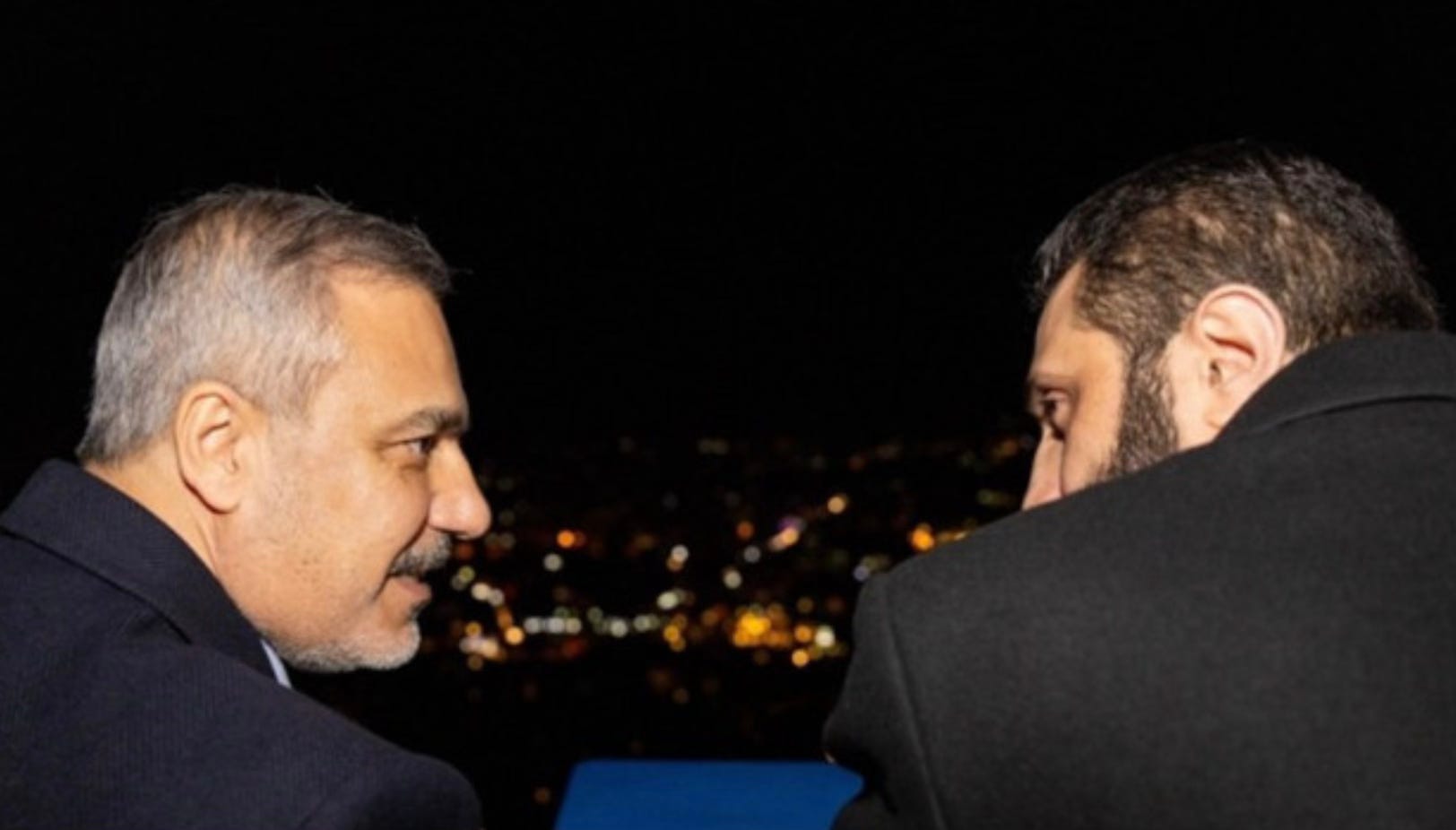
The story that Erdoğan's Turkey wants from Syria
When I heard Hakan Fidan say those two words, I said to myself: a perfect example. He let slip the crux of the interaction. Pure gold.

When I first started researching the relationship between Turkey’s ruling AKP and Egypt’s Muslim Brotherhood (MB/Ikhwan) and Tunisia’s Ennahda in 2018, my main impetus was curiosity. I had just taken what I thought at the time was a break from my journalism career: amid an immense government crackdown, the liberal-left newspaper I was editing had been shut down, and I had embarked on an academic career for what I thought would be a fresh breath of air.
I did not return to journalism and continued on with academia. But back then the initial way in to understanding the deal among these three Islamist entities — the AKP, the Egyptian Ikhwan and Ennahda — came from my training as an investigative journalist. I am telling you this to clarify that I was not a scholar of Islamism, and my initial aim was not to come to broad conclusions about the praxis of Islamists. Nor had I thought that my curiosity regarding this triple interaction would continue for years and become first my doctoral thesis at Oxford and then my second book, The New Spirit of Islamism.
I am also telling you this to give a little hint about my positionality as a researcher at the beginning. As I said, I used to be a journalist whose reporting covered several high-stakes, high-profile cases: those that helped the AKP lift the limits on its power by castrating the military and certain elites around it with bogus charges fabricated by its long-time ally and later arch-nemesis, the Fethullah Gülen movement; the corruption cases surrounding the AKP; its human rights abuses in the handling of the Gezi protests; its failure to deal with ISIS recruits; and, most importantly, its intentional collapse of the previous peace negotiations with the Kurdish movement. So certain government figures did not like me. But more importantly, I did not like them.
And as David Beckham reminds Victoria Beckham — three times — when she is talking about her upbringing: ‘Be honest…!!’
If I am being perfectly honest, I come from a family that holds Mustafa Kemal Atatürk in extremely high regard, along with his foundational insistence on secularity as an indispensable element of progress and modernity. I was never an Islamophobe, but between my family upbringing and the formative education I received in Istanbul, I did not escape the idea that Islamists harbour an insidious double plan even when they seem to be part of the system — like my mother, and like the école de Gilles Kepel within within French scholarship on Islamism.1 If you know the main social cleavages of Turkey, you know what I mean here. (IYKYK. I will get into Turkey more deeply when the topic takes us there. For now, a wry touch is enough, and apt.)
Immersing myself deeply in the scholarship during my studies at Oxford helped, but so did this particular research.
The recurring theme since 2011
I have talked about the findings of this research numerous times before, but not so much about its beginning, which means something at this moment. Here is how I explained the conduct of this research in my book:
‘Although I employed a grounded theory approach, it is important to note that I, too, made assumptions regarding this interplay. Considering the extensive body of literature on transnational Islamism and Turkey’s shift in foreign policy towards the Middle East since 2009, as briefly mentioned earlier, it appeared reasonable to hypothesize that the interplay among these three Islamist entities could be linked to the formation of a transnational Sunni Islamist bloc guided by Islamist ideology. These assumptions have not compromised the grounded theory approach; rather, they have provided an opportunity to contrast an alternative explanation with the research findings.’
[…]
‘To investigate the relationship between the AKP, Ennahda and the MB following the Arab Uprisings, more than seventy elite actors from diverse socio- economic, cultural and national backgrounds were interviewed. Adhering to the process tracing method, the interviews were not randomly selected but carefully chosen based on a thorough examination of individuals involved in the interplay or possessing relevant knowledge. […] In accordance with Isaiah Berlin’s formulation, academics and journalists are driven by the pursuit of truth. That still remains to be our primary objective. However, it is important to acknowledge the limitations inherent in the belief that there exists a singular, universally applicable truth, as this notion can be traced back to a Platonic understanding and poses certain challenges. While I do not intend to delve into an extensive epistemological debate or engage in an exhaustive analysis of the history of political ideas, I find it crucial to clarify my standpoint. Was I deceived by the interviewees or subject to party propaganda? There is no definitive answer to this question. Nonetheless, I took various precautions to mitigate such risks. First, I refrained from posing questions that explicitly sought to confirm whether individuals were seeking success. Instead, during the initial phase of the interviews, my focus was on uncovering the details surrounding the who, what, when and where of their encounters. Where did these meetings take place? Who was present? How frequently did they occur? What were the topics of discussion? Subsequently, the interviews shifted towards exploring the underlying motivations by asking the question, why. I approached this enquiry with an open-mind. It was only towards the end that I gently probed them about the assumptions regarding their close relationship with the AKP following the revolutions. To validate the accuracy of the meetings, individuals involved and intermediaries, I cross-referenced each interview with one another.’
[…]
‘During this research, a recurring theme of success emerged organically in every interview and subsequently took centre stage in this research, without any deliberate manipulation or influence. The Egyptian MB sought to understand the specific components of a “success model.”’
The very rough crux of the story is that Islamists were looking for a success story to adopt, and the AKP at the time of the Arab Uprisings was the ultimate representative of that. This neoliberal impetus, the pursuit of success for the Ikhwan and Ennahda with the AKP as the exemplar, had implications for Islamist politics and their base, all of which I try to explain in my book.
al-Sharaa as the third case
The interesting thing happened with the ascension of Ahmad al-Sharaa to the presidency of Syria, a former jihadist who during his governance in Idlib had maintained close contacts with the Turkish military and intelligence since 2019. Turkey, by way of contingency and the stamina of a strong state, was the winning foreign force of the Syrian civil war. And Syria, with al-Sharaa at the helm, will be the third attempt of Turkey’s AKP, or the AKP’s Turkey, to create a success story.
This is not, as Israel has recently tried to portray it, an alliance of Islamist extremism or an effort to create an Islamic ummah. Muslim politics of transnationalism can surely be read through the categories of international relations, but in this case, there is an important dimension of the pursuit of success which has the potential to alter the core of the ideology itself, and that is my argument.
As I wrote in this post two years ago, and again a year ago here and here in November 2025: ‘Since the first couple of days of al-Sharaa’s ascent in Damascus, a similar process of diffusion is happening between the AKP and al-Sharaa’s team. The relationship of HTS and the Turkish state goes back almost a decade. The meetings with the civil AKP teams, on the other hand, only began with the fall of the Assad regime. But please do not think of this as a robotic downloading of tactics but as a natural diffusion of a mindset. What I am trying to say, I guess, is that the sharp shift that the world sees in Sharaa is not so sharp and abrupt but in line with a broader shift and trajectory in Islamist movements at the beginning of the 21st century. Now al-Sharaa and his closest teammate, foreign minister al-Shaibani, are using a toolbox shaped by the AKP’s self-proclaimed success formula.’
In this diffusion from the AKP to first the Ikhwan in Egypt and Ennahda in Tunisia, and now to al-Sharaa’s government in Syria, vocabulary plays an important role: it opens doors, eases partnership and describes amorphous concepts that each country can then theorise, in the sense the scholars mean2, to fit its own national context. By vocabulary I mean simple key words such as service / hizmet, governance, experience / tecrübe / tajruba, model / an-namudhaj at-turki, legitimacy / meşruiyet / sharriyya, and most importantly ‘success story / başarı hikayesi / qissat najah.’ These are really important signposts for following the trajectory of what today’s Islamists aspire to do.
Hakan Fidan reveals
Now I will give you the most recent example, from the top figure who has been at the centre of this interaction since the Arab Uprisings: with the Ikhwan in Egypt, with Ennahda in Tunisia, and now with al-Sharaa in Syria. First as head of Turkey’s intelligence agency, MIT, and now as foreign minister, Hakan Fidan last week visited Qatar and sat down with Resul Serdar on Al Jazeera for an interview. Look what he said:
‘I think now Syria is successfully enjoying the good relations with the rest of the region and the countries. You know, yesterday there was a good result in EU as well. So, I think Syria is a success story for our region. This is exactly what I was referring when I say regional ownership. The countries of the region came together, and they identified a uniform position vis- a- vis with Syria. And Syria responded to this position very successfully. And I think now everybody is enjoying stability and security in Syria. So, Syria used to be the place of civil war, a cradle for terrorism, and a threat. All the neighbouring countries now, alhamdulillah, it’s all gone. Now Syria is a stable country posing no threat to anybody, and all the refugees are coming back from different countries, including from Turkey.’
Listen to the register of that paragraph and you can hear the entire arc I have been tracing. Fidan is not making a case for Islamist solidarity, nor invoking ummah, nor reaching for the theological registers that earlier generations of Turkish Islamists could not resist. He is speaking the language of regional ownership, stability, refugee return and EU approval, and he is doing so in order to claim Syria as a story that worked. And that is the point, not the contradiction it might look like. The vocabulary is secular, regional, technocratic; the actor being defended by it, are Islamists. A success story pulled off by an Islamist! The second one, in the AKP's reckoning. The AKP counts itself as the first and the landmark. Now that Morsi in Egypt and Ghannouchi in Tunisia have failed, it is left to al-Sharaa to write the success story for an Islamist entity with the AKP's script. You know what I mean?! That is what the whole diffusion has been for.
The AKP and its frames
What crosses borders between movements and parties is not only tactics, policies or organisational forms but vocabularies, narratives and what in the social movement literature3 called ‘master frames’. Yani interpretive scaffolds wide enough in scope that you can hang your own particulars on them. And it is worth pausing on the AKP’s fluency here, because a reader could be forgiven for hearing Fidan’s “success story” as a figure of speech, something offered in passing to an Al Jazeera interviewer. It is not.
The AKP has been in the business of coining and circulating exactly this kind of epithet since its founding in 2002 : the Turkish model, democratic conservatives, the New Turkey, advanced democracy, the pious generation. Some of these are laughable - but that really is not the point - , some were aimed at domestic audiences to redraw the country’s political self-image, others at external audiences to legitimise the party and make it exportable, and several worked both ways at once. Frames travel when they meet three credibility tests: internal consistency, empirical plausibility given the lived experience of their audience, and the standing of the actors who articulate them.
The AKP after 2009 satisfied all three for the Ikhwan and Ennahda, and for al-Sharaa’s circle after December 2024 it largely still does. The cross-national diffusion of movement ideas is in part precisely this: not the transfer of a programme but the transfer of a vocabulary through which programmes get articulated, contested and, eventually, recognised by others as legitimate.4
Whether Syria actually has worked is a separate question, and one most Syrians are still living inside the answer to. What matters here is that the frame has held across three countries, two decades and a remarkable cast of interlocutors, from the Cairo of 2011 to the Damascus of 2025, and that an Islamist project once measured against the will of God is now, increasingly, measured against the metric it once disdained: success. The bigger question, I think, is what goes into this success frame and what gets pushed out of it at this moment in time.
Mekki-Berrada, Abdelwahed, and Leen d’Haenens. Islamophobia as a Form of Radicalisation: Perspectives on Media, Academia and Socio-political Scapes from Europe and Canada. Leuven: Leuven University Press, 2023.
Doug McAdam, Sidney Tarrow, and Charles Tilly, Dynamics of Contention (Cambridge: Cambridge University Press, 2001), 24.
See David A. Snow and Robert D. Benford, “Master Frames and Cycles of Protest,” in Frontiers in Social Movement Theory, ed. Aldon D. Morris and Carol McClurg Mueller (New Haven: Yale University Press, 1992), 133–55; David A. Snow and Robert D. Benford, “Ideology, Frame Resonance, and Participant Mobilization,” International Social Movement Research 1 (1988): 197–217; Robert D. Benford and David A. Snow, “Framing Processes and Social Movements: An Overview and Assessment,” Annual Review of Sociology 26 (2000): 611–39.
See Doug McAdam and Dieter Rucht, “The Cross-National Diffusion of Movement Ideas,” Annals of the American Academy of Political and Social Science 528 (1993): 56–74; Sidney Tarrow, Power in Movement: Social Movements and Contentious Politics, 3rd ed. (Cambridge: Cambridge University Press, 2011); Rebecca Kolins Givan, Kenneth M. Roggeband, and Sarah A. Soule, eds., The Diffusion of Social Movements: Actors, Mechanisms, and Political Effects (Cambridge: Cambridge University Press, 2010).

